All species › Cranes, rails and allies › Rails, gallinules and coots › Gray-headed Swamphen
Gray-headed Swamphen | Porphyrio porphyrio
Purperkoet | Calamón común
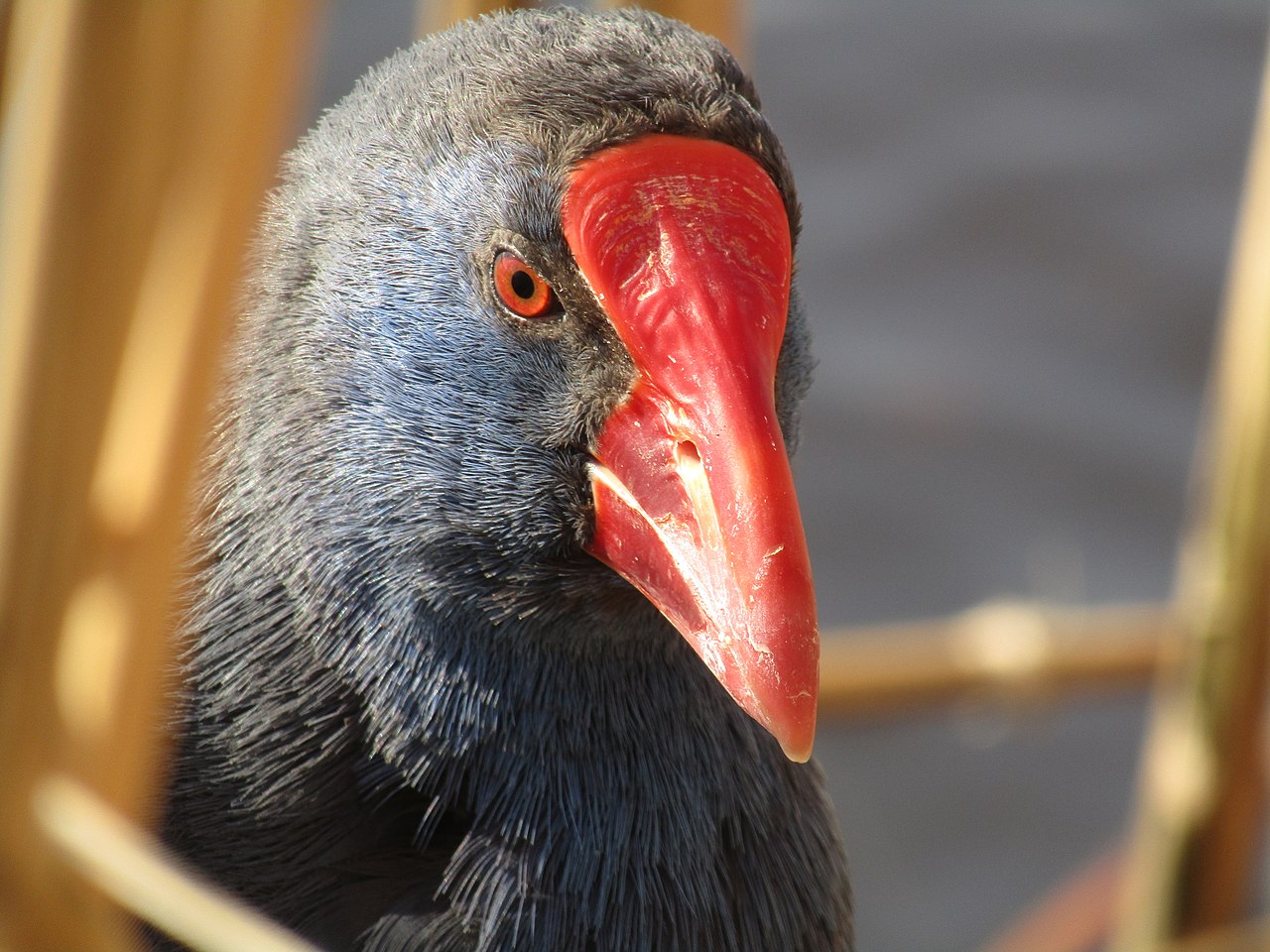
Gray-headed Swamphen is the largest rail in North America, and it does not belong here by origin: it escaped from captivity in the mid-1990s and established itself in southern Florida. It is a heavy, chicken-like bird with an indigo body, a grey-blue head, a coarse red frontal shield above an equally red bill, and red-orange legs. Under the short tail it carries a white patch that flicks up at every step.
Voice
The voice is loud and far-carrying, and the bird commands a large number of different calls: screeching, cackling, giggling, crowing, barking, squeaking and a low croaking. Often one bird begins and the other members of the group join in, so that the sound spreads out across the marsh. Between those outbursts it can stay silent for long stretches and only grunt softly while feeding. Disturbed, it gives a single sharp shriek and the group runs off into the reeds.
Recording: Thierry THOMAS — CC BY-NC-SA 4.0 · Montpellier, Hérault, Occitanie, France · xeno-canto
Identification
A large, heavily built marsh bird of 38 to 50 cm and half a kilo to nearly one, with a thick neck, a short tail and long toes. Head and neck are pale grey-blue, breast and belly indigo to violet-blue, and back and wings dark green to blackish green with a green sheen. The bill is large, deep and red, with a broad red frontal shield above it that carries up over the crown; the legs and toes are red-orange and scaly. The sexes look alike, but the male is distinctly heavier. Young birds are dull grey-brown with a dark bill and a small shield, and only take on the blue during their first year. It walks and swims, climbs into the reeds with its toes, and holds a stem down with one foot to feed from it.
Confusion species
Purple Gallinule (Porphyrio martinica) lives in the same marsh but weighs less than a third as much, has a pale blue shield, a red bill with a yellow tip, a purple-blue head and yellow legs. Common Gallinule is smaller and slate-grey, with a broken white line along the flank and a small red shield. American Coot is dark grey with a white bill and lobed toes. Limpkin is the same size but brown with white spots, and has a long, slightly curved bill.
Habitat
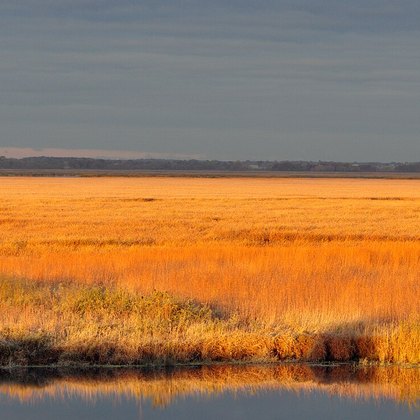
Freshwater marshes with sawgrass, cattail and reed, and beyond that almost any fresh water with tall shoreline plants: canal banks, roadside ditches, stormwater ponds in housing estates, golf course ponds and the edges of sugarcane and rice fields. It feeds mainly on tubers, rhizomes and young shoots of marsh plants, pulling them out of the mud with its bill. Short open grass without cover and salt water are of no use to it. It is not very shy and breeds right up against busy roads.
Where the bird is most often found, arranged by the USNVC — the vegetation classification of the United States and Canada — and CMECS for sea and coast.



Range and movements
In North America it occurs only in Florida. In the mid-1990s birds escaped from private collections in the southeast of the state and began to breed in the wild; exactly which birds these were, and how many, was never established. Between 2006 and 2008, 3,187 were trapped or shot to reverse the establishment, without the numbers falling as a result; after that programme was stopped the species has grown further and moved north into northern Florida. Wanderers have been recorded outside the state as far as Georgia, South Carolina and Bermuda, but it does not breed there; the core lies in the marshes and canals of Miami-Dade, Broward and Palm Beach and in the water management area west of them.
- Resident
- Winter
- Passage
- dark = core range, pale = thinly spread
Where and when to look
In southern Florida, drive a levee road along one of the large water conservation marshes early in the morning: the birds then stand out in the open on the canal bank, feeding. Look for size and posture — a blue rail the size of a chicken, with a red head, can be picked out from hundreds of metres. Where it and Purple Gallinule occur together, leg colour is the quickest separation: red-orange against yellow.
Conservation
The Florida population has grown and spread since the trapping stopped in 2008; there is no current control programme, and the state regulates the bird as nonnative wildlife. The concern is for the native rails, which it displaces at the nest, and for damage to rice and sugarcane. How many birds now live in the state has not been established. The IUCN lists the species as Least Concern (LC); that assessment applies to its original range and says nothing about this population.
Scientific name
Porphyrio porphyrio | (Linnaeus, 1758)
Linnaeus described the species in 1758 as Fulica Porphyrio, in the tenth edition of his Systema Naturae; because it was later moved to another genus, author and year stand in parentheses. Porphyrio goes back to Greek porphyrion, the name classical writers gave a purple waterbird, from porphyra ('purple dye'); here the genus name and the species name are the same word. The type locality was afterwards restricted to the lands around the western Mediterranean. The grey-headed birds of southern Asia — the stock the Florida population comes from — are kept here within Porphyrio porphyrio; elsewhere they are often counted as a separate species, Porphyrio poliocephalus.