All species › Pelicans, herons and ibises › Herons, egrets and bitterns › American Bittern
American Bittern | Botaurus lentiginosus
Noord-Amerikaanse roerdomp | Avetoro Lentiginoso
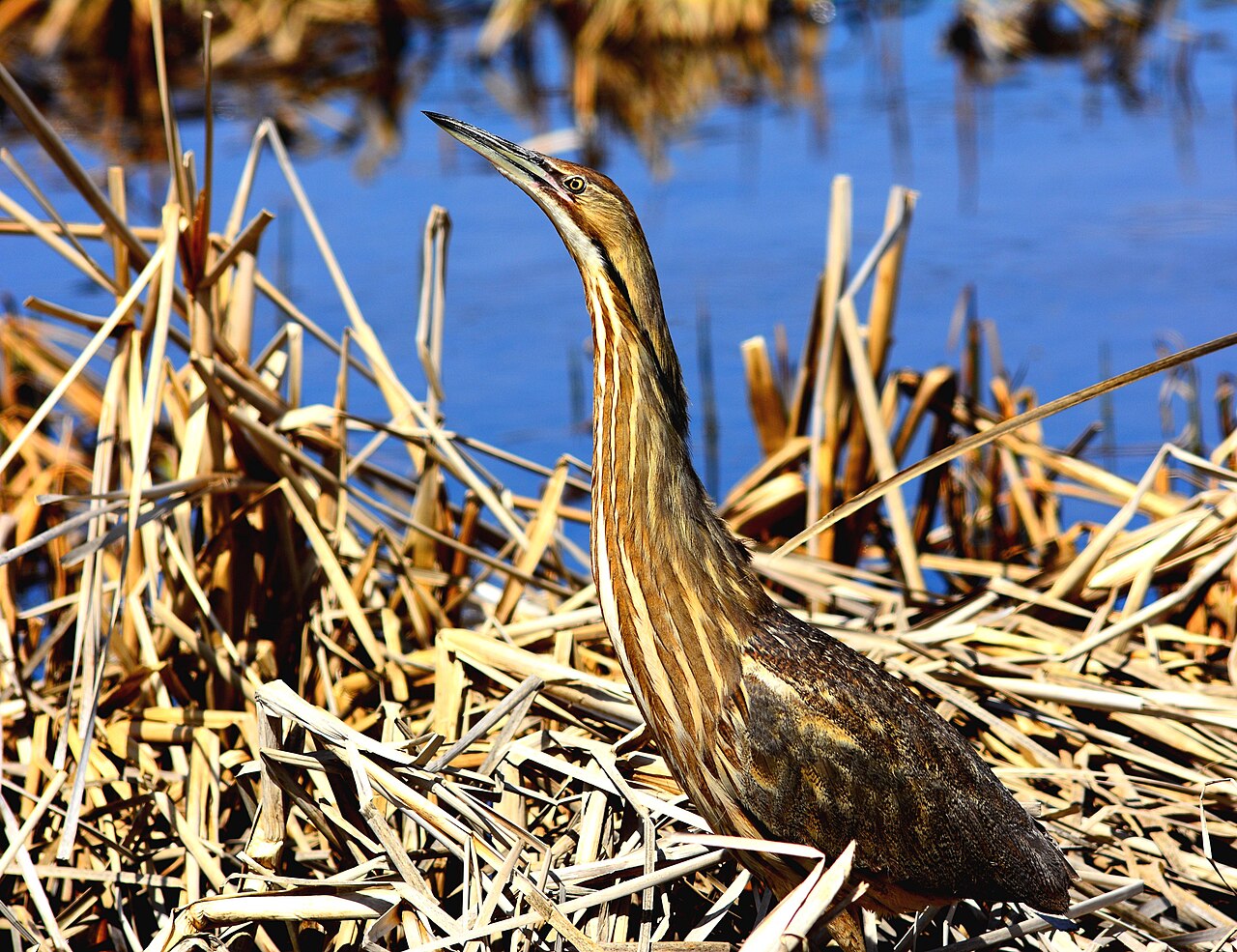
The American Bittern is a stocky, streaky brown heron that would rather not be noticed at all: when alarmed it points bill and neck straight up and blends its patterned plumage into the reeds around it. Its spring call, a deep, pumping boom that sounds like an old water pump, earned it nicknames such as 'stake-driver' and 'thunder-pumper'. Although it is fairly numerous, almost nobody ever sees one.
Voice
The display call is a deep, hollow, three- or four-syllable thump — oonk-ka-chunk — produced by compressing air in a specially inflated section of the oesophagus and forcing it out; the sound carries hundreds of metres through the reeds. Comparisons to 'the gulps of a thirsty giant' and echoic nicknames like 'stake-driver' and 'thunder-pumper' all refer to this same call. Males call mainly at dusk early in the breeding season, usually hidden deep in the vegetation. Outside the display period the species is all but silent.
Recording: Stanislas Wroza — CC BY-NC-SA 4.0 · La Haute-Côte-Nord (near Grandes-Bergeronnes), Côte-Nord, Québec, Canada · xeno-canto
Identification
The plumage is a finely streaked mix of brown, buff and white, slightly darker above than below, coloured the same in both sexes and year-round. In flight the dark, almost black primaries stand out against the otherwise pale brown wing — one of the few truly reliable field marks in the air. On the ground, when disturbed, the bird adopts its characteristic freeze posture: bill straight up, neck stretched, body motionless or swaying gently with the wind, reducing its silhouette to that of a reed stem. The yellow eyes sit low enough that the bird can still look straight down even in that posture.
Confusion species
Immature Black-crowned Night-Herons (Nycticorax nycticorax) are also coarsely streaked brown, but stockier, with a heavier bill and a squatter neck-to-body proportion; in flight the night-heron lacks the sharp contrast between pale wing and dark flight feathers. The much smaller Least Bittern (Botaurus exilis) shares the genus and the freeze posture but is barely half the size and blackish and buff rather than streaked brown. Heard from within the reeds, the American Bittern's call is moreover so low and unbird-like that it is more often mistaken for a large mammal or a distant engine than for a bird.
Habitat
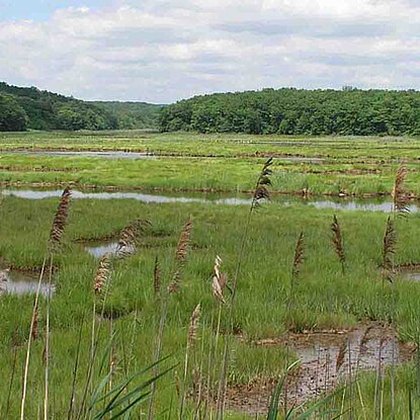
The species breeds in shallow, extensive marshes with plenty of standing vegetation, generally less densely vegetated and shallower than the marsh the smaller Least Bittern prefers, ranging from large reed marshes to bogs and wet hay meadows. Outside the breeding season it seeks out ice-free water, often in coastal marshes and brackish wetlands along the southern edge of its range. It hunts standing motionless or moving in slow steps along the edge of open water, and avoids closed forest and, outside migration, open farmland without marsh vegetation.
Where the bird is most often found, arranged by the USNVC — the vegetation classification of the United States and Canada — and CMECS for sea and coast.




Range and movements
Breeds across nearly all of Canada and the northern United States, from Alaska to Newfoundland and south through the prairies to California, Colorado, the states around the Great Lakes and, locally, northern Mexico; smaller numbers breed further south wherever suitable marsh remains. It winters in the southern United States and Mexico, with part of the population moving on as far as the West Indies and even Panama, which lies outside the guide area. More than half of the original wetlands in the lower forty-eight states have already vanished, which has fragmented the range more than it has shrunk it.
- Resident
- Breeding (summer)
- Winter
- Passage
- dark = core range, pale = thinly spread
Where and when to look
Listen at dusk in May or June from the edge of a large reed marsh for the booming call — it carries far further than the bird will ever be seen. If you spot a vertical, motionless 'reed stem' with a slightly too-thick lower body, check the eyes: a real bittern's stay fixed on you even with the bill pointed straight up.
Conservation
The global breeding population is estimated at around two and a half million birds, and the IUCN rates the species as Least Concern (LC), although regional declines have been documented since the mid-twentieth century in parts of the United States and Canada. Loss of wetland to drainage and conversion to farmland remains the main threat, alongside pesticide pollution.
Scientific name
Botaurus lentiginosus | (Rackett, 1813)
Rackett described the species in 1813 as Ardea lentiginosa, in the old catch-all genus for herons, based on a vagrant shot in England; it has since been moved to another genus, hence the parentheses around author and year. Stephens introduced the genus Botaurus in 1819, a name combining Medieval Latin bos ('ox') with taurus ('bull'), after the hollow, bellowing sound of the call. The epithet lentiginosus is Latin for 'freckled' or 'spotted', after the fine streaking of the plumage. The type locality, Piddletown in Dorset, England, lies thousands of kilometres from the species' actual range — it was a vagrant, not evidence of a resident population.