All species › Pelicans, herons and ibises › Herons, egrets and bitterns › Least Bittern
Least Bittern | Botaurus exilis
Amerikaanse woudaap | Avetorillo Americano
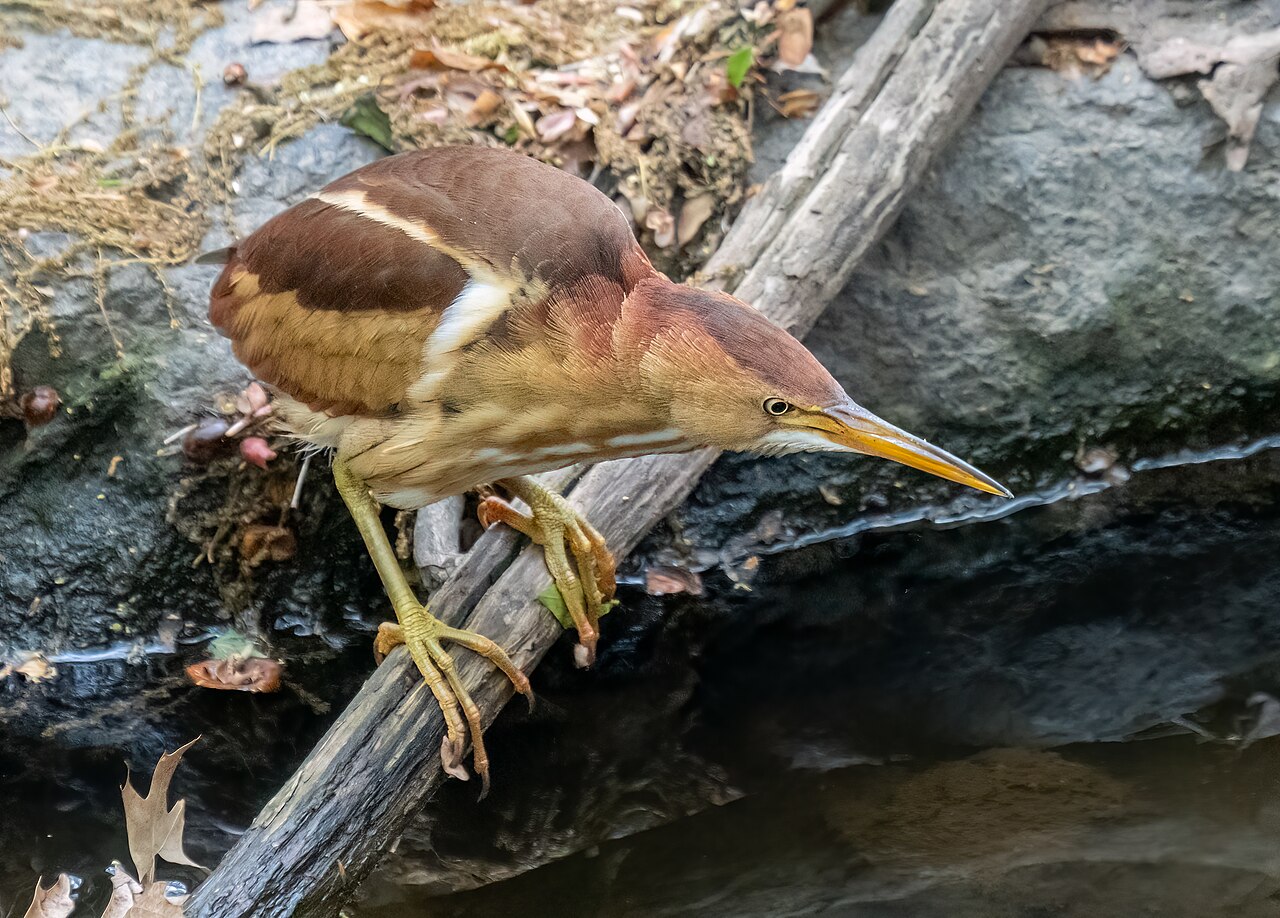
The Least Bittern is the smallest heron in North America, a shy scrap of chestnut, buff and black that rarely shows itself outside the reeds. Its body is flattened from side to side so effectively that it slips between tightly packed stems with ease — a captive bird walked comfortably through a gap barely four centimetres wide. Anyone who knows the species usually recognises it by a soft cooing from the reeds long before ever seeing the bird itself.
Voice
The song is a soft, quick coo-coo-coo-coo, more a gurgling coo than a proper song, and rarely carries far — often the Least Bittern is little more than a voice in the reeds, hard to pin down. Males sing mainly at dawn and dusk, peaking in May and June. Disturbance near the nest brings a short, hoarse croak. The species migrates mostly at night, in silence.
No recording with a suitable Creative Commons licence has been found for this species yet; what to listen for is described below.
Identification
The male has a glossy black crown and back against a buffy neck and chestnut wing shoulders; the female is a duller, browner version, with a dark brown rather than black crown and back. In the breeding season the bare skin in front of the male's eye can flush bright cherry red. An occasional individual is also almost entirely blackish above — a dark colour morph sometimes mistaken for a distinct species. In its characteristic freeze posture the bird points its bill straight up and sways with the reeds, becoming nearly invisible. In flight the pale wing shoulders stand out against otherwise dark wings.
Confusion species
Green Heron (Butorides virescens) is larger, longer-legged and longer-necked, and mostly blue-grey with a chestnut neck, rather than the Least Bittern's small size and buffy, black-marked back. Its closest relative, American Bittern (Botaurus lentiginosus), is over twice its size, evenly streaked brown rather than black and buff, and gives an entirely different, booming call. Hidden in the reeds, the Least Bittern is more often confused with a rail than with another heron: the rustling and scrambling recalls a Virginia Rail, until the bird shows itself and the heron shape — long neck, dagger bill — settles the matter.
Habitat
The Least Bittern breeds in dense, tall marsh vegetation — chiefly cattail and other reeds — with small patches of open water for hunting, in both fresh and brackish marsh on the coast and inland. Nests hang low among the stems, just above the water, held by bending the stems themselves into a platform with a canopy. Outside the breeding season the species also uses artificial wetlands such as settling ponds and golf-course water hazards, and it winters in fresh, brackish and saltwater marsh. It avoids open water without cover and dried-out ground almost entirely.
Where the bird is most often found, arranged by the USNVC — the vegetation classification of the United States and Canada — and CMECS for sea and coast.





Range and movements
Breeds across nearly the whole eastern United States and southern Canada, from Ontario and Quebec south to Florida and Texas, with small, isolated populations in the west reaching California and Arizona. In Florida, southern Texas, Mexico, Central America and the Caribbean the species is present year-round; northern breeders slip away at night in autumn and return in late spring. The historic range has largely held, though the species' secretive habits make it hard to count and leave population trends uncertain.
- Breeding (summer)
- Passage
- dark = core range, pale = thinly spread
Where and when to look
Visit a marsh with dense cattail beds at dawn or dusk in May or June and listen for the soft cooing — seeing the bird without sound as a guide rarely works. A bird that suddenly freezes with its bill pointed straight up has already adopted the alarm posture, and is then picked out mainly by its silhouette among the vertical stems.
Conservation
The global breeding population is estimated at well over three hundred thousand birds, and the IUCN rates the species as Least Concern (LC). Loss of marshland and the replacement of native reed vegetation by invasive plants such as purple loosestrife remain the main threats, all the more so because the species depends so heavily on dense, structurally rich reed beds.
Scientific name
Botaurus exilis | (Gmelin, 1789)
Gmelin described the species in 1789 as Ardea exilis, in the old catch-all genus for herons; it has since been moved to another genus, hence the parentheses around author and year. The epithet exilis is Latin for 'small' or 'slender', a reference to its status as the smallest heron on the continent. Genetic research recently placed the species together with the bitterns in the genus Botaurus, where it had previously stood apart as Ixobrychus exilis. The type locality is Jamaica.