All species › Pelicans, herons and ibises › Pelicans › Brown Pelican
Brown Pelican | Pelecanus occidentalis
Bruine pelikaan | Pelícano pardo
The Brown Pelican is the only pelican that throws itself into the sea from a height: a heavy bird two metres across that turns a quarter-turn just before impact and goes through the surface with a smack. It is at the same time the smallest of its family and the only one tied to salt water all year. In the 1960s pesticides all but wiped it out along the Gulf coast and in California, and it recovered so well that in 2009 it was taken off the United States list of endangered species.
Voice
An adult Brown Pelican is virtually silent: away from the colony you do not hear it, however close it sails past. At the breeding place there is a low, hoarse grunting and a clattering of the bill, mostly in greetings between partners. The young are anything but silent and beg with a harsh, high screaming that carries across the whole colony. From a diving bird you hear nothing but the smack on the water.
Recording: Isain Contreras Rodríguez — CC BY-NC-SA 4.0 · Topolobampo, Ahome, Sinaloa, Mexico · xeno-canto
Identification
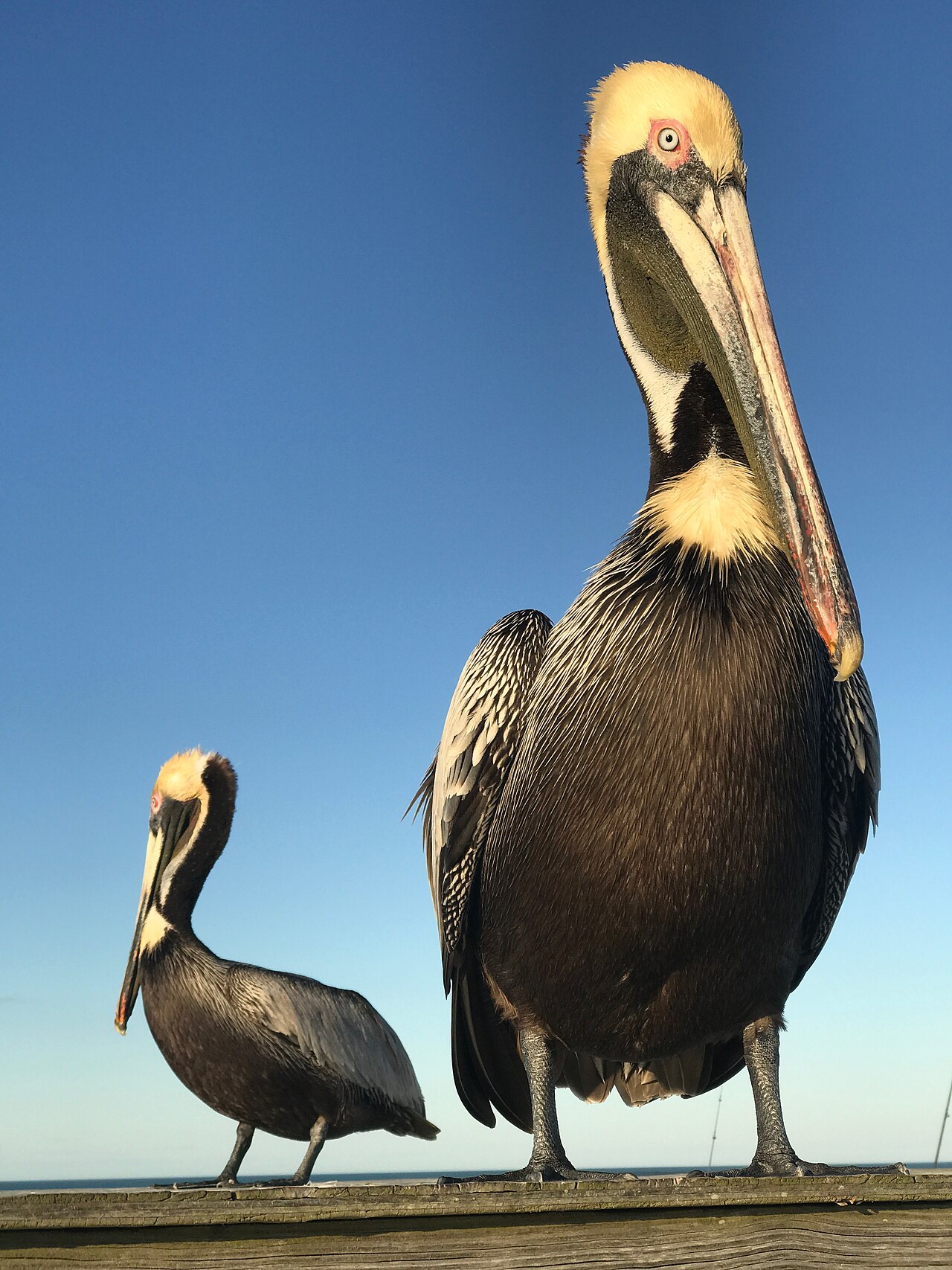
A large, dark seabird with a long bill and a stretchable throat pouch, short legs and a heavy, stocky build. The adult has a grey-brown body with a silvery back; outside the breeding season the head and neck are white with a yellowish crown, while in the breeding season the hindneck turns dark chestnut and a bright yellow patch appears at the base of the foreneck. On the Pacific the pouch turns bright red in the breeding season, on the Atlantic side olive green to black. Young birds are plain grey-brown on head and neck with a dirty white belly, and take three to five years to become adult. In flight it is recognisable by its posture and flight action: head drawn back between the shoulders, slow beats alternating with long glides, usually in a line just above the waves.
Confusion species
American White Pelican (Pelecanus erythrorhynchos) is larger still and pure white with black flight feathers; it does not dive but herds fish together while swimming, and it keeps mainly to inland lakes. Young Brown Pelicans are so pale below that at a distance they are taken for that species, but their head and neck stay dark. A line of cormorants just above the water resembles a line of pelicans from afar, until you see that they hold a thin straight neck stretched out and are far smaller. A perched pelican, with that bill, can be confused with nothing.
Habitat
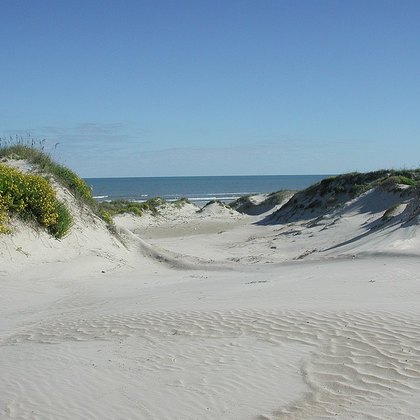
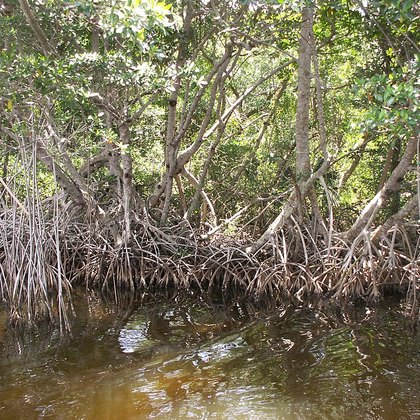
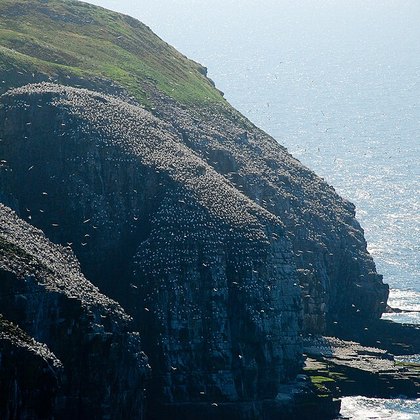
Shallow coastal water: bays, lagoons, river mouths, harbour basins and the surf just off the beach, where shoals of small fish come within reach of the surface. It does not use deep ocean far offshore, and fresh inland water only in the rarest of cases. To breed it needs an island without ground predators: a sand bar, a mangrove islet, a rock island or a dredge-spoil island, where it nests on the ground or in low bushes. Outside the breeding season it likes to sit on posts, jetties and in fishing harbours, waiting for the waste of the catch.
Where the bird is most often found, arranged by the USNVC — the vegetation classification of the United States and Canada — and CMECS for sea and coast.


Range and movements
Occupies the coasts of both oceans all year: on the Atlantic side from Maryland and Virginia south along the Gulf of Mexico and through the Caribbean to Venezuela and Brazil, on the Pacific from central California to Ecuador and Peru. After the breeding season young birds especially wander north, up the west coast to British Columbia and up the east coast into New England. The interior is not used, apart from stray birds that turn up far inland after a hurricane. The northern limit has moved over the past fifty years: on the Atlantic coast new colonies have appeared as far as Maryland, where the species did not breed before 1987.
- Resident
- Breeding (summer)
- Winter
- Passage
- dark = core range, pale = thinly spread
Where and when to look
Look for it where fishermen clean their catch: at a jetty or a fish dock pelicans sit at arm's length, and that is exactly where you see how the pouch works. For the diving, better to stand on a pier in calm weather and scan the water for silvery ripples; over such a shoal the birds hang at twenty metres before they let themselves fall. In late spring look at the neck: the chestnut hindneck and the yellow patch give away a bird in full breeding dress.
Conservation
The world population is put at about 370,000 breeding birds and has been slowly increasing since the 1970s. It was once otherwise: endrin killed the birds outright and DDT made the eggshells so thin that they broke under the incubating parent, so that the species all but vanished from the Gulf coast and California — in Louisiana, which carries the pelican on its flag, not one was left by about 1963. After the DDT ban of 1972 and the release of birds from Florida it climbed back: in 1985 the Atlantic coast and eastern Gulf populations were taken off the United States list of endangered species, and in 2009 the rest followed. What is left in the way of threats is local: oil spills, discarded fishing line in which birds get entangled, and the erosion of the low islands they breed on.
Scientific name
Pelecanus occidentalis | Linnaeus, 1766
Linnaeus described the species in 1766, in the twelfth edition of his Systema Naturae, and gave it at once the name it still stands under; because it has not changed genus since, author and year stand without parentheses. The genus Pelecanus is the Latin word for pelican, borrowed from Greek pelekan, which is related to pelekys 'axe' — after the shape of the bill. occidentalis means 'western' and refers to the New World, as against the pelicans of Europe, Africa and Asia that Linnaeus already knew. The type locality is Jamaica, after the first source he cited in the description.