All species › Pelicans, herons and ibises › Pelicans › American White Pelican
American White Pelican | Pelecanus erythrorhynchos
Amerikaanse witte pelikaan | Pelícano norteamericano
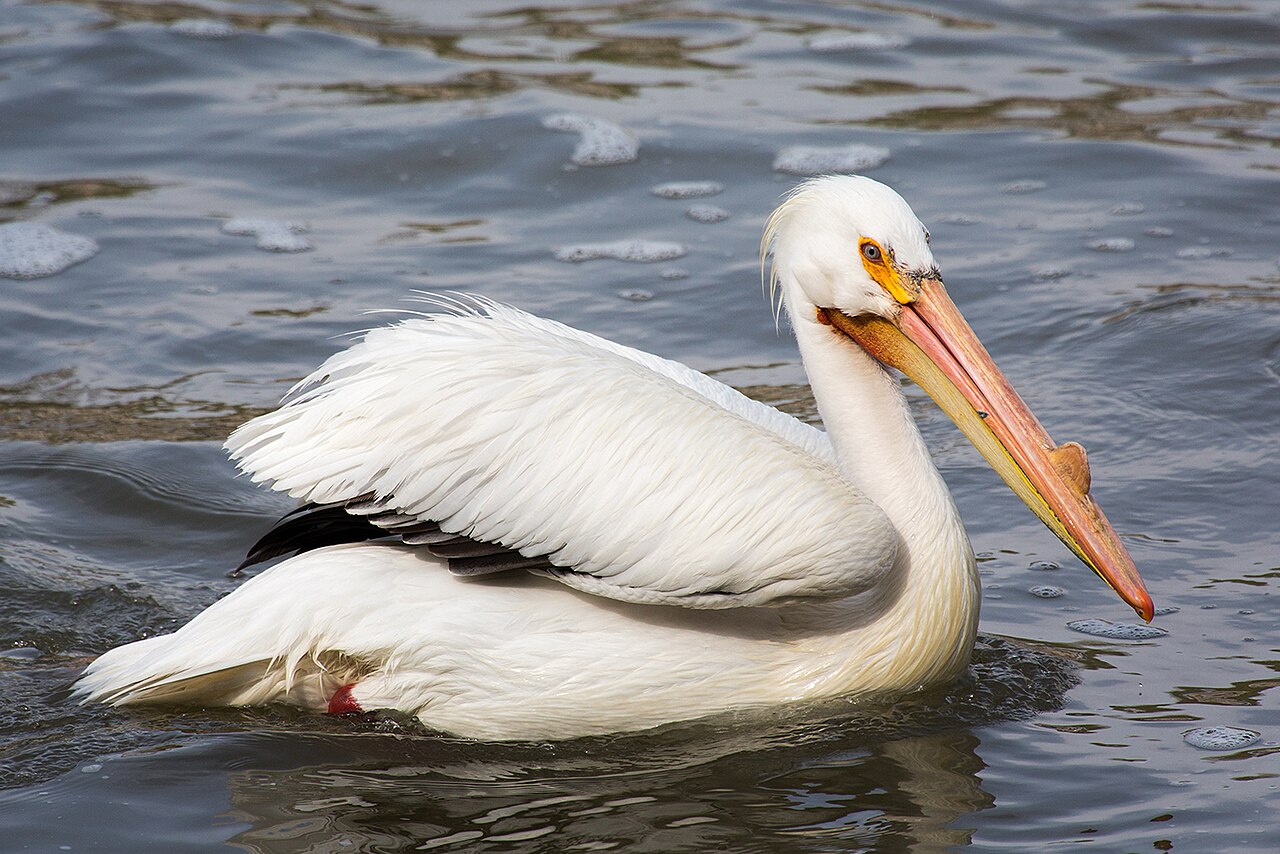
The American White Pelican, with a wingspan of close to three metres, is one of the largest birds on the continent: pure white, with an orange bill almost half a metre long and black flight feathers that show only in flight. It breeds on bare islets in shallow inland lakes and winters along the coasts and on the reservoirs of the south. In the breeding season both sexes grow a horny plate on the upper bill, which is shed once the eggs are laid.
Voice
Away from the colony it is silent: a flock passing overhead or resting on the water makes no sound that carries more than a few metres. On the breeding islands the adults grunt low and hoarse, a throaty smothered uh, usually on landing or in a dispute over a nest site. The young beg with a sustained high whine that carries across the water and suggests a piglet rather than a bird. In winter the most you hear is the clapping of bills and the splashing with which the fishing birds drive their prey together.
No freely licensed recording has been found for this species yet; what to listen for is described below.
Identification
Adults are entirely white, with black primaries and primary coverts that form a broad black trailing edge to the wing in flight and stay almost hidden on a perched bird. The bill is orange, straight, flat and enormous, with an elastic pouch beneath it; in the breeding season the orange deepens, a horny plate stands on the upper mandible, and crown and breast take on a yellow wash. Male and female are marked alike; the male is larger and longer-billed. Young birds carry a dusky wash over head and wing coverts and have a dull grey bill. In flight the head is drawn deep between the shoulders with the bill on the breast; flocks travel in a line or a V and bank together, so that the whole rank flashes white and then goes dark.
Confusion species
Wood Stork (Mycteria americana) soars in the same thermals and is as white with black in the wing, but is slimmer built, holds neck and legs outstretched, and carries a bare dark grey head with a bill that curves down at the tip — the pelican draws its head back between the shoulders instead. Brown Pelican (Pelecanus occidentalis) has the same build and the same bill but is grey-brown, stays at the sea, and plunges into the water from a height; this species never dives. Great Egret (Ardea alba) is as white but far slimmer, has no black in the wing, and flies with the neck folded into an S. At long range a soaring flock suggests swans or Snow Geese, until you see that the black is confined to the trailing edge of the wing.
Habitat
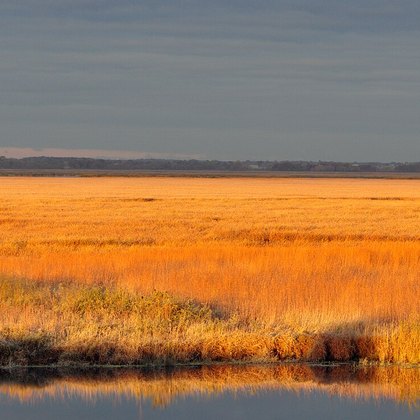
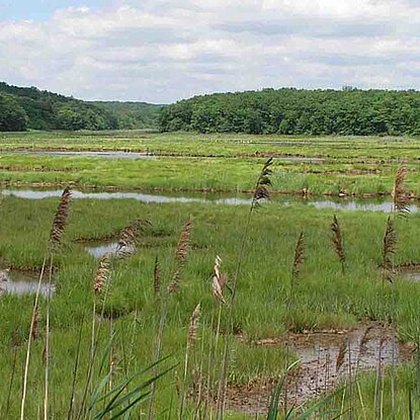
In the breeding season this is a bird of shallow, food-rich inland lakes with bare islets: prairie lakes, alkali lakes and reservoirs where the water stands high enough to keep a coyote or a fox off the colony. Fishing is often done tens of kilometres away, in shallow bays, marshes and slow rivers; unlike the Brown Pelican it takes its fish while swimming, with head and bill under water. In winter it moves to estuaries, lagoons, reservoirs and fish ponds along the Gulf of Mexico and the Pacific. It avoids the open sea, and deep water as well: where it cannot reach the bottom or the shoal while afloat, it does not go.
Where the bird is most often found, arranged by the USNVC — the vegetation classification of the United States and Canada — and CMECS for sea and coast.



Range and movements
It breeds inland in the west and on the prairies, from the southern Northwest Territories and central British Columbia east to western Ontario and south to California, Nevada, Utah and Colorado; the colonies are few and lie far apart. After nesting almost the whole population moves south, to the coasts of California, Texas and Florida, to both coasts of Mexico, and as far as Guatemala, El Salvador and Honduras. On migration it follows the river valleys of the Great Plains and appears over reservoirs where it is absent the rest of the year. In the first half of the twentieth century the colonies emptied through persecution, the draining of prairie lakes and later through DDT; since the 1970s the species has increased again, with new colonies as far east as Minnesota and Wisconsin.
- Resident
- Breeding (summer)
- Winter
- Passage
- dark = core range, pale = thinly spread
Where and when to look
Look for it on a winter morning on a shallow bay or a reservoir: ten to twenty birds form a half circle and swim side by side towards the shore, putting their bills into the water at the same moment. In the middle of the day they are more often in the air than on the water; watch then for a high, slowly turning column that flashes white and vanishes from sight as it banks. From below, the black trailing edge of the wing is the only mark that holds at a distance.
Conservation
The Red List treats the species as of least concern, and numbers have risen since the 1970s; the breeding population is put at about 180,000 birds. Because nearly all of it is concentrated in a few dozen colonies, each colony weighs heavily: one lake that dries out, one fox that reaches the island, one disturbance at the wrong moment costs a whole season. Botulism in shallow, warm lakes kills birds every year, and where migration leads past fish farms pelicans are still shot.
Scientific name
Pelecanus erythrorhynchos | Gmelin, 1789
Johann Friedrich Gmelin described the species in 1789 as Pelecanus erythrorhynchos; because it has stayed in that genus ever since, author and year stand without parentheses. Pelecanus is the Latin word for pelican, taken from the Greek pelekan. erythrorhynchos is built from the Greek eruthros, 'red', and rhunkhos, 'bill', after the orange-red bill, at its brightest in the breeding season. Gmelin relied on the account John Latham had given of the bird; the type locality is therefore North America, given by Latham more precisely as Hudson Bay and New York.