All species › Pelicans, herons and ibises › Ibises and spoonbills › Roseate Spoonbill
Roseate Spoonbill | Platalea ajaja
Rode lepelaar | Espátula rosada
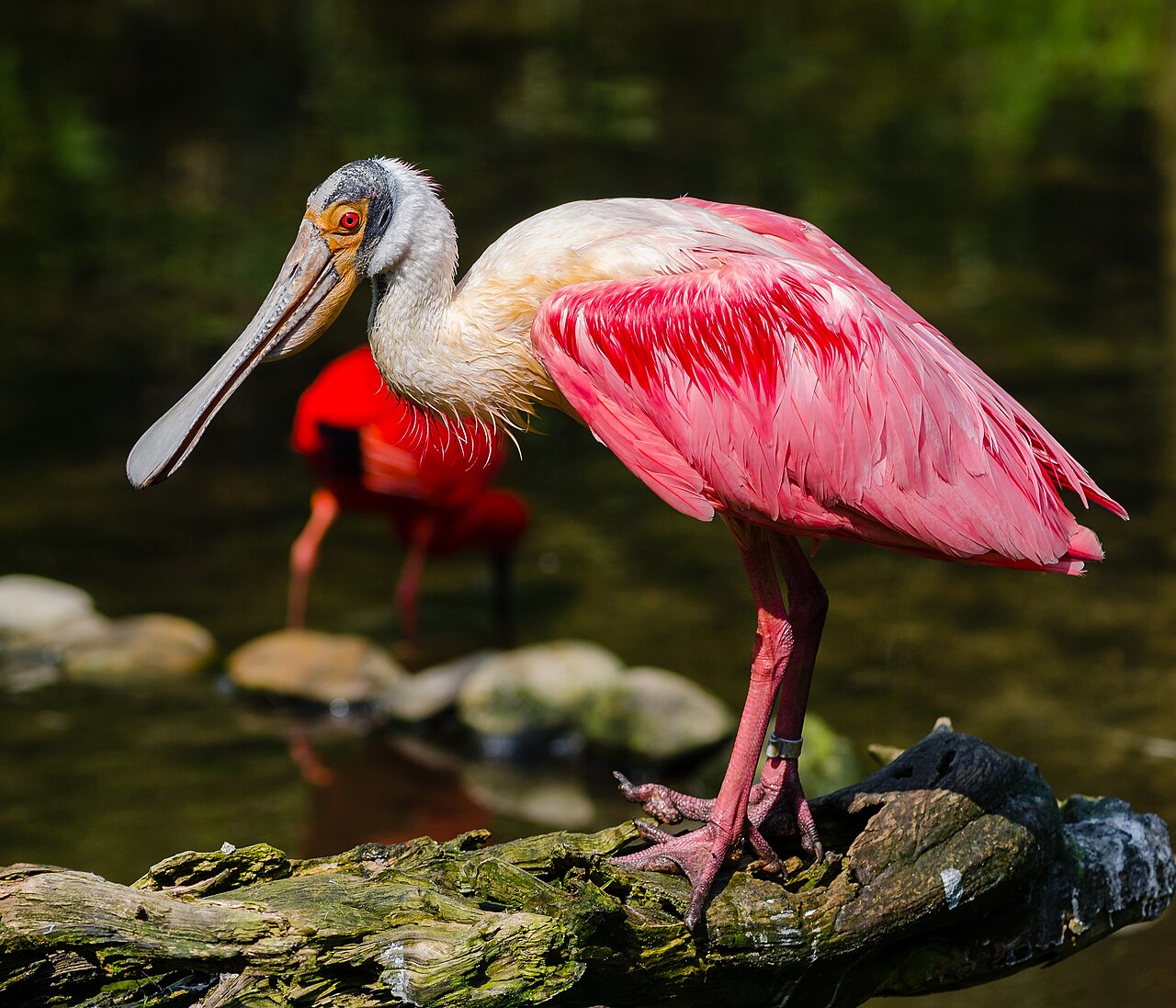
A pink wader with a bare, greenish head and a grey bill beaten flat into a spatula at the tip, which it sweeps half open through shallow water. The pink comes out of its food: shrimp and other crustaceans supply the pigments. Around 1900 it had almost gone from Florida because its wings were made into fans; the recovery since is one of the clearest in American bird protection.
Voice
Away from the colony it is all but silent. At the nesting site there is a low, throaty huh-huh-huh, a hoarse croak on arrival and departure, and the dry clattering of bills between neighbours. Young beg with a high, squealing rattle that rises out of the mangroves the moment a parent drops in. Anyone passing a colony by boat hears that rumble and nothing resembling a song.
Recording: Paul Marvin — CC BY-NC-SA 4.0 · River Lakes Conservation Area near Viera, Brevard Co, Florida, United States · xeno-canto
Identification
Adults are white on neck and back and pink elsewhere, with a carmine shoulder stripe and tail coverts, an orange tail and red eyes; the head is unfeathered and greenish, and the blue-grey bill widens into a spoon at the tip. Young birds are far paler, nearly white with a pink wash, with a feathered white head and a yellowish bill, and take three years to colour up. The legs are long and reddish pink; in shallow water the bird walks slowly forward while swinging the half-open bill through the water in arcs. In flight the neck is held out and the bill looks visibly heavy, with beats alternating with glides, often in single file.
Confusion species
American Flamingo (Phoenicopterus ruber) is the only other large pink bird of these coasts, but is much bigger, with a long neck and a bill kinked downwards, and in flight neck and legs project far further. Young spoonbills are often taken for White Ibis (Eudocimus albus), which has a long, evenly curved bill and black wingtips. At long range a party of spoonbills can pass for ibises until the bill is visible — that is a single field mark, but it settles the matter.
Habitat
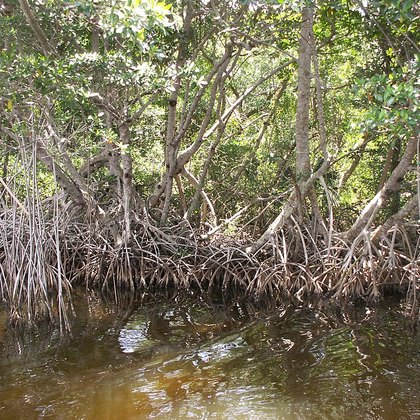
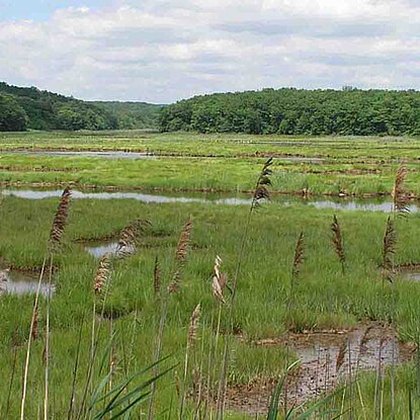
Shallow, quiet water over a soft bottom: mangrove bays, lagoons, salt marsh, tidal creeks and mudflats, and further inland freshwater marsh and flooded meadows. It prefers to sweep in water no more than a hand's breadth deep, where the bill reaches the bottom. Roosting and nesting take place in trees and shrubs just above the water, above all in red mangrove and willow. Deep open water and fast rivers it does not use.
Where the bird is most often found, arranged by the USNVC — the vegetation classification of the United States and Canada — and CMECS for sea and coast.



Range and movements
On the Gulf Coast of the United States it is present all year in Texas, Louisiana and Florida, and since the 1990s it has been spreading north into Georgia and South Carolina; wanderers regularly reach much further in late summer. Beyond that it occurs along both coasts of Mexico, through Central America and on Cuba, the Bahamas and Hispaniola, and south to Argentina, which lies outside this map. After breeding the birds disperse widely before returning to the colonies; true migration it does not have. The northward spread of the past thirty years coincides with milder winters and with the decline of the colonies in Florida Bay.
- Resident
- Breeding (summer)
- Winter
- Passage
- dark = core range, pale = thinly spread
Where and when to look
Look for it two hours either side of low tide in a shallow tidal creek or a lagoon: the water is then at the right depth for sweeping and the birds are working rather than resting. The best light is early morning and late afternoon, when the pink lights up and the red shoulder shows. Colonies are easily disturbed: watch from the water or from a path at a distance and do not enter.
Conservation
Least Concern (LC), with an estimated 170,000 birds worldwide and an increase in North America of nearly six per cent a year between 1966 and 2019. That figure hides an old collapse: in the nineteenth century the colonies were shot out for the feather trade — the wings were sold as fans — and by the 1930s five breeding pairs were left in Florida Bay. After protection and the founding of Everglades National Park in 1947 that grew to 1,260 pairs by 1979, after which the water management of south Florida drove it down again: 87 nests were counted in the 2010/11 season. The species as a whole is now widespread and numerous; what remains fragile is the Florida Bay colony.
Scientific name
Platalea ajaja | Linnaeus, 1758
Linnaeus described the species in 1758 as Platalea Ajaja, with the epithet still capitalised; because it has never been moved out of that genus, author and year stand without parentheses. Platalea is the Latin name for the spoonbill in Pliny, traceable to Greek platys, 'broad', for the bill. ajaja comes from Tupi, the language of the Brazilian coast, where the bird was called ajajá. Linnaeus gave the locality as 'in America australi'; Berlepsch fixed it in 1908 on the Rio São Francisco in eastern Brazil.