All species › Pelicans, herons and ibises › Ibises and spoonbills › White-faced Ibis
White-faced Ibis | Plegadis chihi
Witmaskeribis | Morito Cariblanco
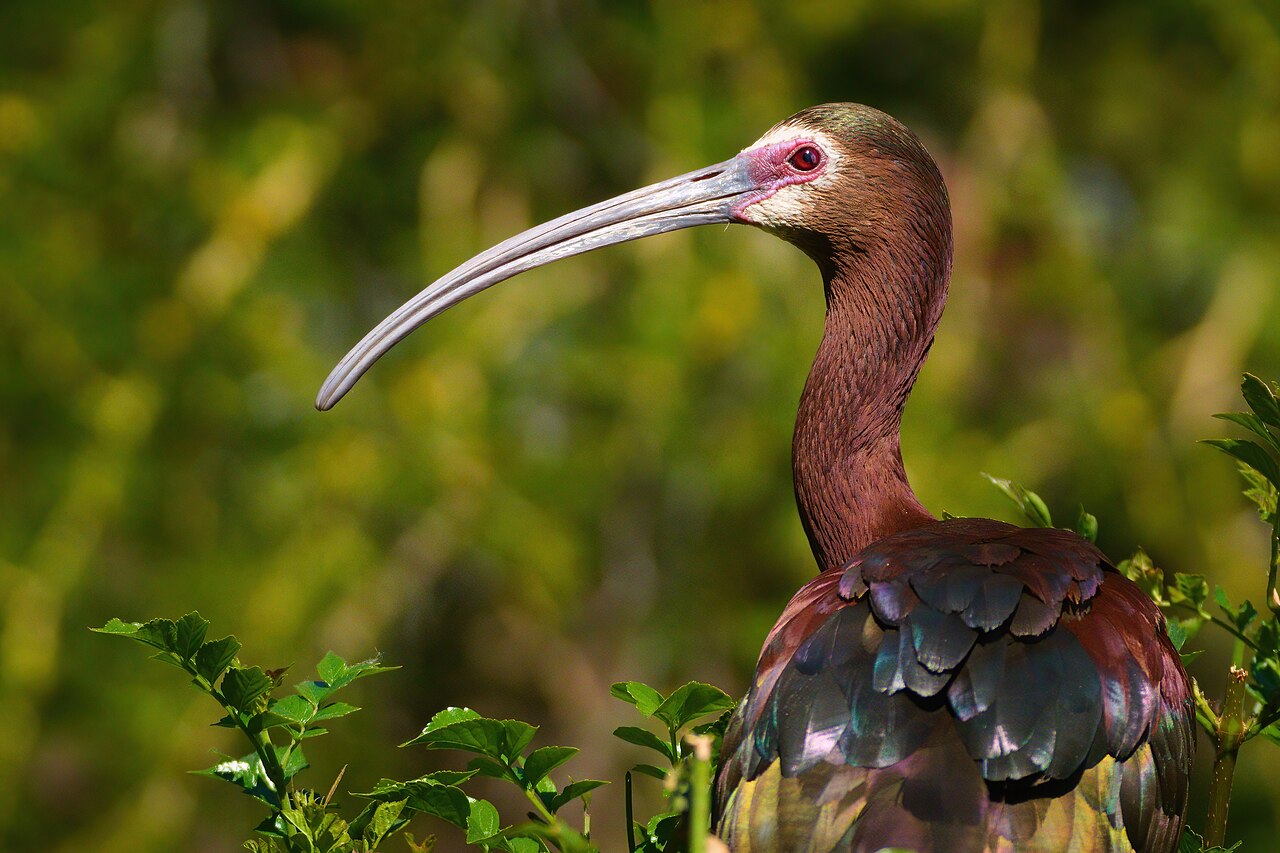
The White-faced Ibis is a dark, glossy chestnut ibis of marshes in western North America, with a long downcurved bill it uses to probe mud and shallow water. In breeding plumage it grows a narrow white feathered border around a bare pink patch at the base of the bill and a deep red eye — the feature behind its name. Large colonies nest on isolated marsh islands, often far from the nearest town.
Voice
Away from the colony the White-faced Ibis is largely silent; what can be heard is mostly around the nest. Courting birds and returning mates give a soft, grunted oink, repeated between partners and between adult and chick. Alarmed or squabbling birds in the colony give a drawn-out, nasal gheeeee, and males returning to the nest give a similar, repeated geeeek. From a distance a colony is therefore recognised more by a low, constant murmur than by any clear song.
Recording: Franco Vushurovich — CC BY-NC-SA 4.0 · Victoria, Entre Ríos, Argentina · xeno-canto
Identification
At a distance adults look dark and faintly glossy; up close they show a wash of purple, green and bronze over a chestnut-brown body. In breeding plumage a narrow white feathered border rims the bare pink skin at the base of the bill and the eye is bright ruby red; outside the breeding season that white border disappears and the skin around the bill turns dull grey-brown. The long, evenly downcurved brown-grey bill and long, thin legs shape the silhouette both standing and in the straight, fast flight with neck outstretched. Immature birds are duller brown, lacking the adult's colour sheen and with a greyer face.
Confusion species
By far the greatest confusion is with the Glossy Ibis (Plegadis falcinellus): in non-breeding and juvenile plumage the two are all but impossible to tell apart, and only breeding plumage gives a reliable clue — Glossy Ibis has a blue-grey base to the bill without a white border, and a dark brown eye rather than red. Where their ranges overlap, especially along the Gulf Coast, both species sometimes nest in the same colony, and even mixed pairs have been recorded. Immature White Ibises (Eudocimus albus) share a similar brown juvenile plumage and the same downcurved bill, but soon develop a white belly that sets them apart.
Habitat
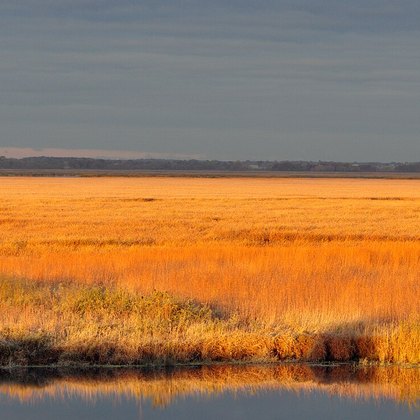
The White-faced Ibis seeks shallow, densely vegetated fresh and brackish marshes with reeds, cattail or bulrush, ideally a mosaic of open water and dense cover for nesting. Outside the breeding season it forages just as often in wet farmland — flooded rice fields and irrigated alfalfa have become almost a second habitat for the species — and along the margins of shallow saline lakes. It avoids deep open water and closed forest, and breeding colonies shift from year to year with water levels: after a wet winter they appear in temporarily flooded ground that lay dry the year before.
Where the bird is most often found, arranged by the USNVC — the vegetation classification of the United States and Canada — and CMECS for sea and coast.




Range and movements
Breeds from Oregon and the Great Salt Lake basin south through California, Nevada, Arizona, New Mexico and the Great Plains, with a second, separate stronghold of colonies on the Gulf Coast of Louisiana and Texas; it also breeds locally in interior Mexico. Southern California and the coasts of Texas and Louisiana hold birds year-round; northern breeders move south in winter into the southern United States and Mexico. Apart from the North American population, the species also breeds in South America, south to southwestern Brazil and central Argentina — the type locality of its scientific name lies in Argentina itself. Twentieth-century persecution and DDT use pushed numbers down sharply, but since the 1972 ban on that pesticide the range has been expanding again, with nesting now recorded further east than before.
- Resident
- Breeding (summer)
- Winter
- Passage
- dark = core range, pale = thinly spread
Where and when to look
Look for it in western wetlands in spring, when colonies are active and groups shuttle back and forth over the reeds between nest and feeding ground. Check the base of the bill and the eye of every group carefully before ruling out Glossy Ibis — in the Gulf states that is far from a given. Low morning light shows the chestnut sheen best; in harsh midday sun the bird can look simply black.
Conservation
The population is large — well over a million birds — and has been growing for decades, helped by the 1972 DDT ban and wetland restoration. The IUCN accordingly rates the species as Least Concern (LC). Remaining risks are water scarcity and the conversion of marshland to farmland in the western United States, where many colonies depend on water levels that vary from year to year.
Scientific name
Plegadis chihi | (Vieillot, 1817)
Vieillot described the species in 1817 as Numenius chihi, among the curlews — an understandable mistake, since the long, downcurved bill strongly recalls that group. Because the species has since been moved to another genus, author and year stand in parentheses. Kaup introduced the genus Plegadis in 1829; the name comes from the Greek plegas, 'sickle', after the curved bill shared by every ibis in this genus. The type locality lies in Paraguay and the campos near Buenos Aires, Argentina — far outside the North American range covered by this guide; the origin of the epithet chihi itself is not firmly established.