All species › Pelicans, herons and ibises › Ibises and spoonbills › Glossy Ibis
Glossy Ibis | Plegadis falcinellus
Zwarte ibis | Morito común
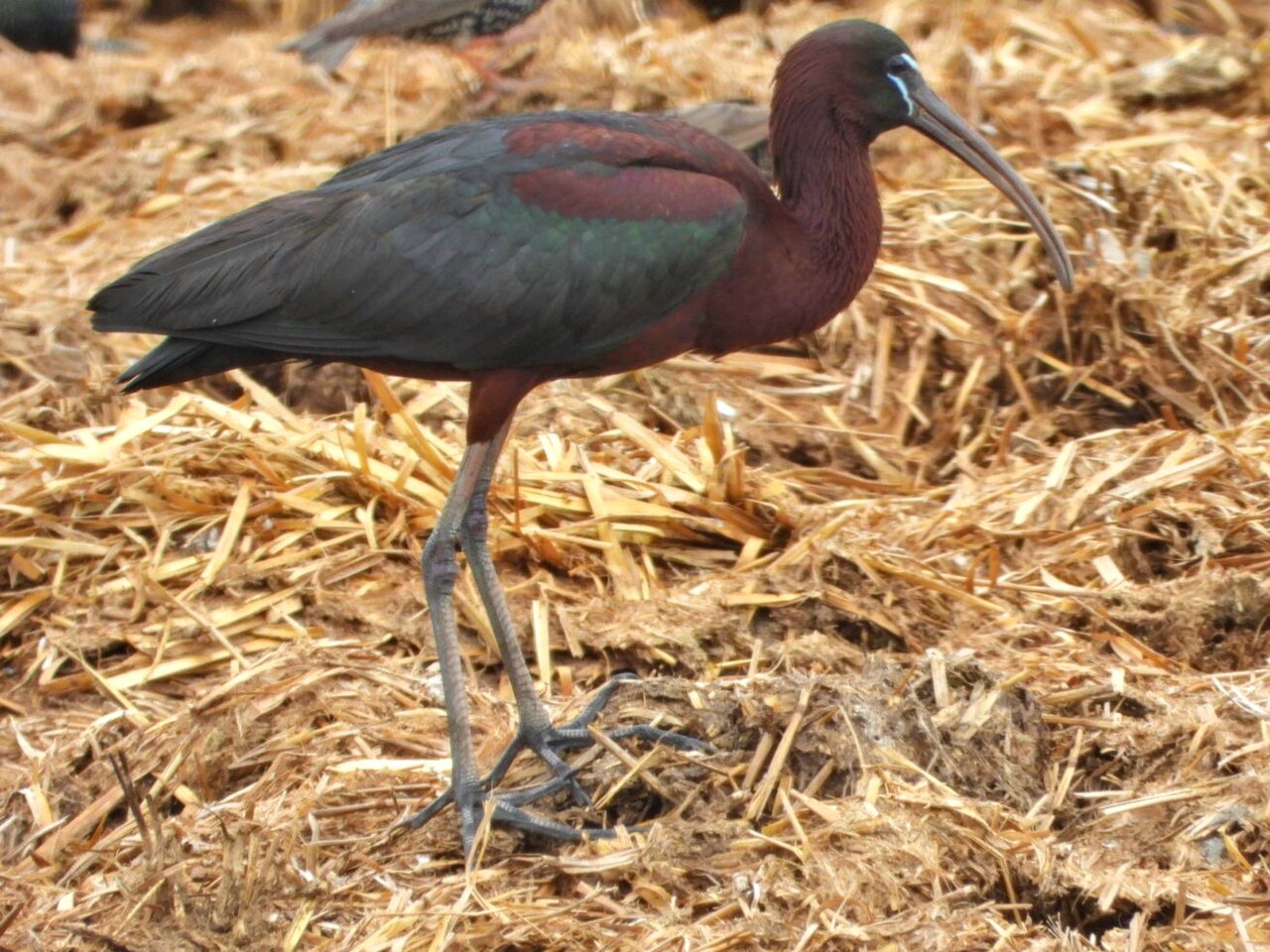
Glossy Ibis is the most widespread ibis species in the world, breeding on four continents, and the only member of the genus Plegadis found outside the Americas. At a distance it looks uniformly dark, but at close range the plumage glows deep chestnut with metallic green and violet tones. In eastern North America it is a relatively young colonist, one that in two centuries has gone from a single stray record to an established breeding bird.
Voice
Glossy Ibis is a quiet bird; at the colony it gives mostly hoarse grunting and croaking sounds, including a rasping grrrr during courtship and nest-building. Away from the breeding season the species is barely heard at all. In flight, with the neck stretched forward, groups are usually completely silent.
Recording: Xavier Riera — CC BY-NC-SA 4.0 · Montsià (near El Poble Nou del Delta), Tarragona, Catalonia, Spain · xeno-canto
Identification
In breeding plumage the bird is deep chestnut with a metallic sheen of green, bronze and violet on the wings, and a narrow pale blue-grey line above and below the base of the bill that does not encircle the eye. Outside the breeding season the plumage is duller and less glossy. Young birds are greyish brown with white streaking on the head and neck and uniformly dark underparts. In flight the outstretched neck stands out — unlike herons, which pull the neck in — and groups often fly in a long, slanted V formation.
Confusion species
White-faced Ibis, with which Glossy Ibis mixes and even hybridizes in the southern United States and along the Gulf Coast, has white plumage running all the way around the eye, bare pink facial skin, and reddish legs; in Glossy Ibis the pale lines do not encircle the eye and the legs are darker. At greater range, where the facial pattern cannot be seen, the two are otherwise difficult to tell apart. From herons and Roseate Spoonbill, the down-curved, slender bill sets Glossy Ibis apart immediately.
Habitat
It uses almost any wetland with shallow water or exposed mud: freshwater marsh, brackish and salt marsh, flooded farmland, shallow ponds and estuaries. For nesting it chooses low willows and shrubs surrounded by marsh, ground nests in cordgrass marsh or dense thickets on higher ground, and occasionally mangroves. Rice fields and other flooded farmland have become an important additional food source.
Where the bird is most often found, arranged by the USNVC — the vegetation classification of the United States and Canada — and CMECS for sea and coast.





Range and movements
The first North American record dates from 1817 in New Jersey; the species became established in Florida in 1832. From the 1940s onward the range expanded strongly northward along the Atlantic coast, and in the 1980s also westward along the Gulf Coast into Texas. Northern breeders move south for winter; in Florida and along the Gulf Coast the species remains present year-round.
- Resident
- Breeding (summer)
- Winter
- Passage
- dark = core range, pale = thinly spread
Where and when to look
Look for it in a freshwater marsh or flooded rice field early in the morning, when groups probe actively in the mud with the bill; the curved bill and the outstretched neck in flight are visible from a distance. To check the facial pattern — the key to separating it from White-faced Ibis — good binoculars and close, favourable light are needed.
Conservation
Least Concern (LC), with a world population of roughly 550,000 birds; after severe declines from hunting and habitat loss in the nineteenth and early twentieth centuries, the species increased strongly during the twentieth century, though a slight decline has been reported in some areas since the 1970s. The main ongoing threat is the loss of wetland habitat through drainage, increased salinity, and groundwater extraction.
Scientific name
Plegadis falcinellus | (Linnaeus, 1766)
Linnaeus described the species in 1766 as Tantalus Falcinellus; it has since been moved to another genus, hence the parentheses around author and year. Kaup established the genus Plegadis in 1829, with this species as its type. Both the genus and species names refer to the same shape: Plegadis comes from the Greek word for 'sickle', and falcinellus is the Latin diminutive of falx, also 'sickle' — both after the long, curved bill. The type locality, Java and Celebes, reflects the species' broad range across the Old World.