All species › Waders, gulls and terns › Oystercatchers › American Oystercatcher
American Oystercatcher | Haematopus palliatus
Amerikaanse scholekster | Ostrero americano
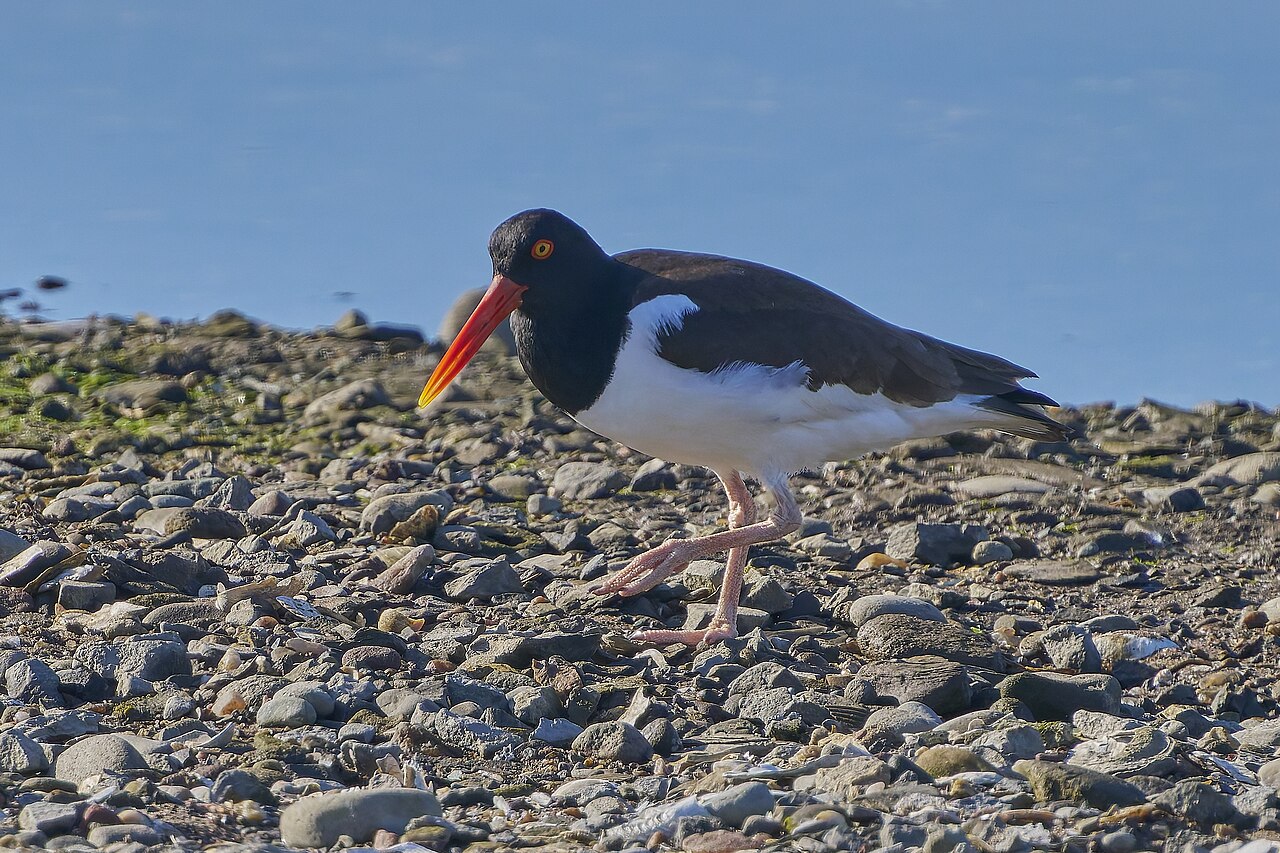
A crow-sized black-and-white wader with a chisel-shaped orange-red bill and a yellow iris set in a red ring. It opens shellfish on beaches, shell rakes and oyster reefs and is seldom found more than a few hundred metres inland. By 1900 it had gone from the northeast; since then it has worked its way back up the coast as far as Maine.
Voice
A loud, piercing wheep that carries over the surf and is usually the first sign of the bird. In excitement the call runs into an accelerating series ending in a shivering rattle, while two or more birds stride side by side along the sand. Parents warn their chicks with a short, soft note, at which the young flatten themselves against the shell grit. In flight the call is sharper and clipped, a hard wik.
Recording: Jonas Nilsson — CC BY-NC-SA 4.0 · Galapagos, Fernandina, Punta Espinosa, Ecuador · xeno-canto
Identification
Head and breast are black, the back dark brown, the underparts white, with a dead straight line between black breast and white belly. The bill is long, straight and flattened sideways, bright orange with a paler tip; the eye is yellow within an orange-red ring and the legs are dull pink. In flight a broad white wing stripe, a white rump and a black tail band show up. The sexes look alike, though the female is slightly larger and longer-billed. Juveniles have a dark bill tip and scaly-looking upperparts.
Confusion species
Black Oystercatcher (Haematopus bachmani) of the west coast is dark from head to tail and lacks the white in wing and belly; the two meet only in southern California and Baja California, where mixed pairs produce piebald intermediates. Eurasian Oystercatcher (Haematopus ostralegus), a rare stray to the Atlantic coast, shows a white wedge running up the back and has a red rather than a yellow iris. Beyond that there is nothing on the beach to confuse it with.
Habitat
Sandy beaches, shell rakes, oyster reefs and the flats of estuaries — wherever bivalves lie on or just below the surface. Nesting is above the tideline, on bare sand or shell grit, by preference on islands that foxes and raccoons cannot reach. Scrub, woodland and farmland are avoided; unlike its European counterpart it does not move inland to take earthworms. In the south it also occurs on mangrove coasts.
Where the bird is most often found, arranged by the USNVC — the vegetation classification of the United States and Canada — and CMECS for sea and coast.





Range and movements
The Atlantic coast from Maine to Florida, the whole Gulf coast to Texas, on the Pacific side from the Gulf of California to Oaxaca, and beyond that the Bahamas, the Turks and Caicos, Puerto Rico, small numbers on Hispaniola, and Aruba and Curaçao. North of New Jersey it is a summer bird only; further south it stays all year. Through the nineteenth century it was shot and its eggs taken until it had gone from the coast between Virginia and Canada; after the Migratory Bird Treaty Act of 1918 the northern limit moved back up, reaching Massachusetts around 1970 and Maine in the 1990s. Along the coasts of Central America it is scarce and local.
- Resident
- Breeding (summer)
- Winter
- Passage
- dark = core range, pale = thinly spread
Where and when to look
Look for it on a falling tide at the edge of an emerging shell bank or oyster reef: that is when it leaves the beach and works for three hours or so. Sound comes before sight — if a shrill wheep carries across the water, scan the waterline. In spring, stay away from bare sand islands: the eggs lie open on the sand there and simply cannot be seen.
Conservation
Partners in Flight puts the world population at fewer than forty-three thousand birds, few for a bird that occupies two ocean coasts. More than half was lost over fifty years; since sixteen states coordinated their management, breeding numbers there have risen by forty-three per cent. The pressure is on the beach itself: recreation, dogs and vehicles, gulls, raccoons and foxes taking eggs and chicks, and storm tides washing clutches away.
Scientific name
Haematopus palliatus | Temminck, 1820
Temminck described the species in 1820 as Haematopus palliatus, in the same genus it still stands in, which is why author and year carry no parentheses. The genus Haematopus was introduced by Linnaeus in 1758, from Greek haima 'blood' and pous 'foot', after the red legs. palliatus is Latin for 'wearing a cloak', after the dark mantle over the white body. The described specimen came from South America; Brabourne and Chubb restricted that type locality to Venezuela in 1912.