All species › Waders, gulls and terns › Oystercatchers › Black Oystercatcher
Black Oystercatcher | Haematopus bachmani
Amerikaanse zwarte scholekster | Ostrero negro
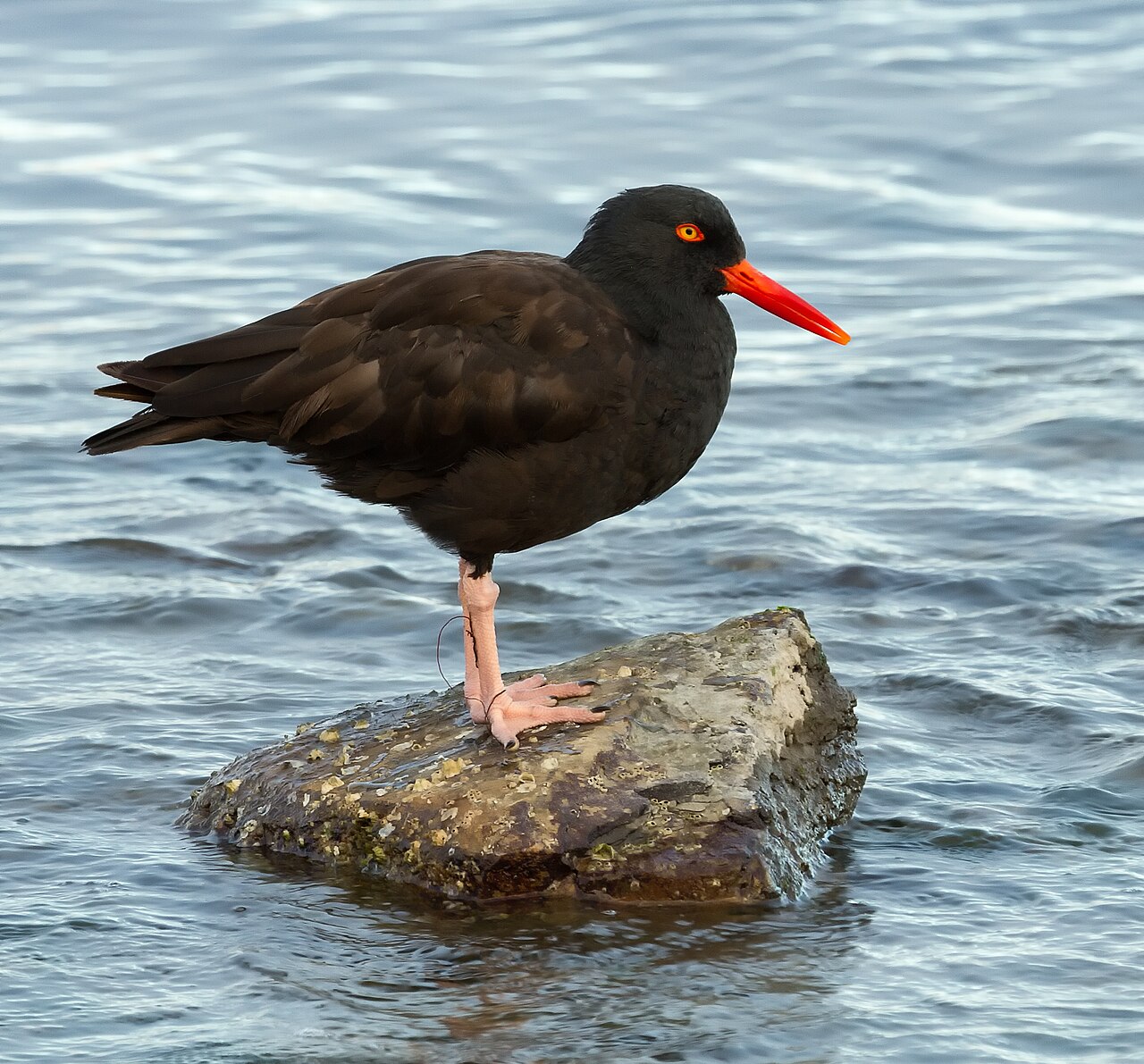
An all-dark oystercatcher of the rocky Pacific shore, with a long red bill, a yellow iris in an orange-red ring and dull pink legs. It lives on the mussels, barnacles and limpets that the falling tide uncovers, and for that it stays on the same strip of rock all its life. The world population is only about ten thousand birds.
Voice
A loud, piercing wheep that carries above the surf and usually comes before any sight of the bird. In boundary disputes between neighbours the call runs into an accelerating series ending in a long trill, while two or more birds walk side by side over the rock with heads bowed and bills held down. That display often ends in a short chase in the air, the calling continuing through it. Disturbed at the nest the bird gives a short, hard wik, at which the chicks flatten themselves against the grit.
Recording: Barry Edmonston — CC BY-NC-SA 4.0 · Victoria, Capital, British Columbia, Canada · xeno-canto
Identification
The whole plumage is sooty black, deepest on head and breast, a little browner on back and belly — in low light the bird reads as a black silhouette with a red line in it. The bill is long, straight and flattened sideways, orange-red with a paler tip; the iris is yellow within an orange-red eye-ring and the legs are dull pink and heavy. The sexes look alike, though the female is slightly larger and longer-billed. Juveniles are duller, with a dark bill tip and scaly-looking upperparts, and keep that dark tip through their first winter. In flight there is no pattern at all: no wingbar, no white rump, no tail band, so identification rests on shape and on the bill.
Confusion species
American Oystercatcher (Haematopus palliatus) has a white belly, a broad white wing stripe and a white rump, and is separated at once even in flight. The two meet only in southern California and Baja California, and it is exactly there that mixed pairs produce intermediates on which the white breaks through as irregular blotches on belly and wing — such birds cannot be named without looking at the whole pattern. A black crow or raven on the rocks can pass for it at distance, but the straight red bill and the heavy build settle it the moment the bird moves. Beyond that there is no wader of this size on the rocky shore.
Habitat
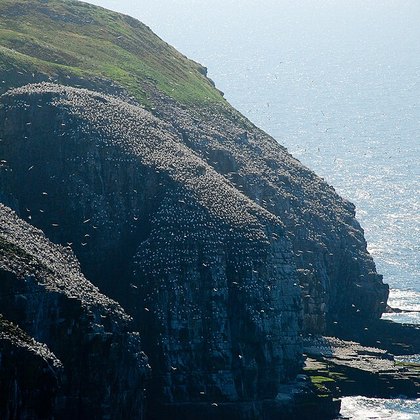
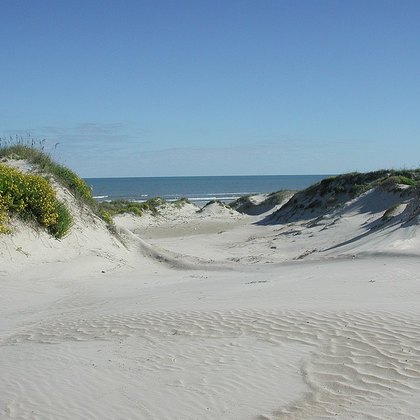
The rocky intertidal: wave-cut benches, boulder beaches, cliffs with a foot that dries out, and above all the islets and stacks offshore, where no fox or raccoon comes. It feeds on the mussel beds and on the barnacle and limpet zone that the falling tide lays bare, following the retreating waterline down with the ebb. The nest is a scrape in shell grit or gravel just above the high-tide line, on a rock ledge or a pocket beach between the rocks. It makes little use of sandy beaches, estuaries and mudflats, and does not go inland.
Where the bird is most often found, arranged by the USNVC — the vegetation classification of the United States and Canada — and CMECS for sea and coast.


Range and movements
From the western Aleutians along the coasts of Alaska, British Columbia, Washington, Oregon and California to the middle of the Baja California peninsula and the Coronado Islands. It stays all year; only the birds of the northernmost coasts shift a little when ice forms there, and they go no further than a few hundred kilometres. Pairs hold their territory year after year, often the same rock point for life, while young birds gather meanwhile in small parties at places without breeders. In the Aleutians it has returned to islands where it had long been absent, after introduced foxes were removed.
- Resident
- Breeding (summer)
- Winter
- Passage
- dark = core range, pale = thinly spread
Where and when to look
Look for it at low water on a rock point or a mussel bed: it works the waterline then and comes up with the rising tide until it stands on a rock above the surf. Sound comes before sight — if a shrill wheep carries over the noise of the breakers, scan the rocks at the level of the water. If in June or July an adult carries a limpet away in its bill instead of emptying it on the spot, there is a chick among the rocks; stay where you are.
Conservation
The world population is put at some ten thousand birds, spread over a narrow strip of rocky coast from Alaska to Baja California; in this guide's data the Red List does not assess the species separately. That narrow strip is the vulnerability: anything that reaches the intertidal zone reaches the whole species. Oil from shipping and from accidents is the heaviest threat — after the Exxon Valdez disaster of 1989 both the birds and their mussel beds were affected for years. Besides that, storm tides wash clutches away, introduced rats and foxes on islands take eggs and chicks, and the traffic of boats and kayaks pushes breeding birds off the lowest ledges.
Scientific name
Haematopus bachmani | Audubon, 1838
Audubon described the species in 1838 as Haematopus bachmani, in the same genus it still stands in, which is why author and year carry no parentheses. The genus Haematopus was introduced by Linnaeus in 1758, from Greek haima 'blood' and pous 'foot', after the red legs of the European species. bachmani honours John Bachman, the minister and naturalist from Charleston with whom Audubon worked. The described specimen came from the mouth of the Columbia.