All species › Falcons › Falcons and caracaras › Aplomado Falcon
Aplomado Falcon | Falco femoralis
Aplomadovalk | Halcón Aleto
The Aplomado Falcon is a slender, long-tailed falcon of open grassland with scattered yuccas and mesquite, once widespread across the southwestern United States but nearly eliminated there during the twentieth century. Since the 1990s, thanks to a long-running reintroduction programme, it once again breeds at a handful of sites in southern Texas.

Voice
At the nest and during courtship the Aplomado Falcon gives a rapid series of sharp, chattering cries, louder and more sustained than those of the American Kestrel. Outside these situations the species is largely silent.
Recording: JAYRSON ARAUJO DE OLIVEIRA — CC BY-NC-SA 4.0 · Reserva do Setor Sítio de Recreio Caraíbas-Goiânia, Goiás, Brazil · xeno-canto
Identification
A slender falcon with a black-and-white striped head, a pale breast giving way to a broad black chest band and a rusty-orange lower belly. The upperparts are dark brown to slate-blue, and the long tail is finely banded black and white. Juveniles are browner with more streaking on the breast.
Confusion species
American Kestrel is considerably smaller and lacks the broad black chest band and sharply marked head stripes. Peregrine Falcon is larger and stockier, with a broad moustache rather than the Aplomado's thin, double head stripe, and lacks its distinct tricoloured underside.
Habitat
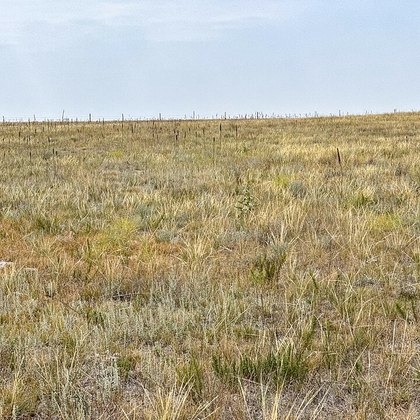
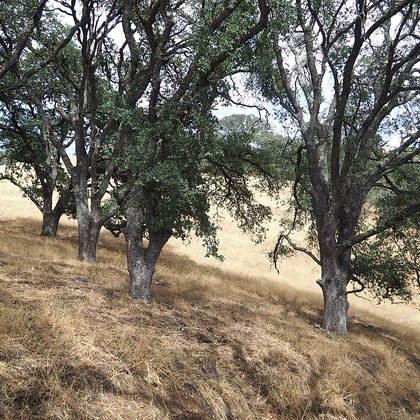
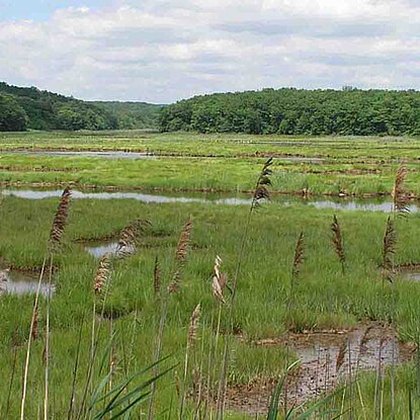
Open, dry grassland with scattered yuccas, mesquite (a thorny pod-bearing shrub of the Southwest that forms dense thickets) and agave forms the core habitat, often near coastal plains of salt grass in southern Texas. The species hunts large insects, lizards and small birds from low perches, preferring to nest in old crow or raptor nests in a scattered tree or yucca.
Where the bird is most often found, arranged by the USNVC — the vegetation classification of the United States and Canada — and CMECS for sea and coast.

Range and movements
The historical range in the United States extended across the dry grasslands of Texas, New Mexico and Arizona, but habitat loss and pesticide use nearly eliminated the species there during the first half of the twentieth century. Since 1985, large numbers of captive-bred birds have been released in southern Texas, where a small, self-sustaining population now breeds; most of the range still lies in Mexico, Middle America and South America south to Tierra del Fuego.
- Resident
- Breeding (summer)
- Winter
- Passage
- dark = core range, pale = thinly spread
Where and when to look
The best chance in the United States is on the coastal salt-grass plains of the Laguna Atascosa peninsula in southern Texas, where the released population is densest; look for a slender falcon hunting low over the grassland from a yucca or post.
Conservation
Globally the species is not threatened (LC), given its extensive range through Middle and South America, but in the United States the Aplomado Falcon is listed as endangered. Decades of reintroduction through the release of captive-bred birds have produced a small breeding population in southern Texas, still dependent on continued protection of the remaining coastal prairie.
Scientific name
Falco femoralis | Temminck, 1822
Temminck described the species in 1822 as Falco femoralis; the genus has remained unchanged since, hence no parentheses around author and year. Falco is Latin for 'falcon'; femoralis means 'of the thigh', referring to the rusty-orange feathering on the thighs and lower belly.