All species › Passerines › Mockingbirds and thrashers › Bahama Mockingbird
Bahama Mockingbird | Mimus gundlachii
Bahamaspotlijster | Sinsonte de las Bahamas
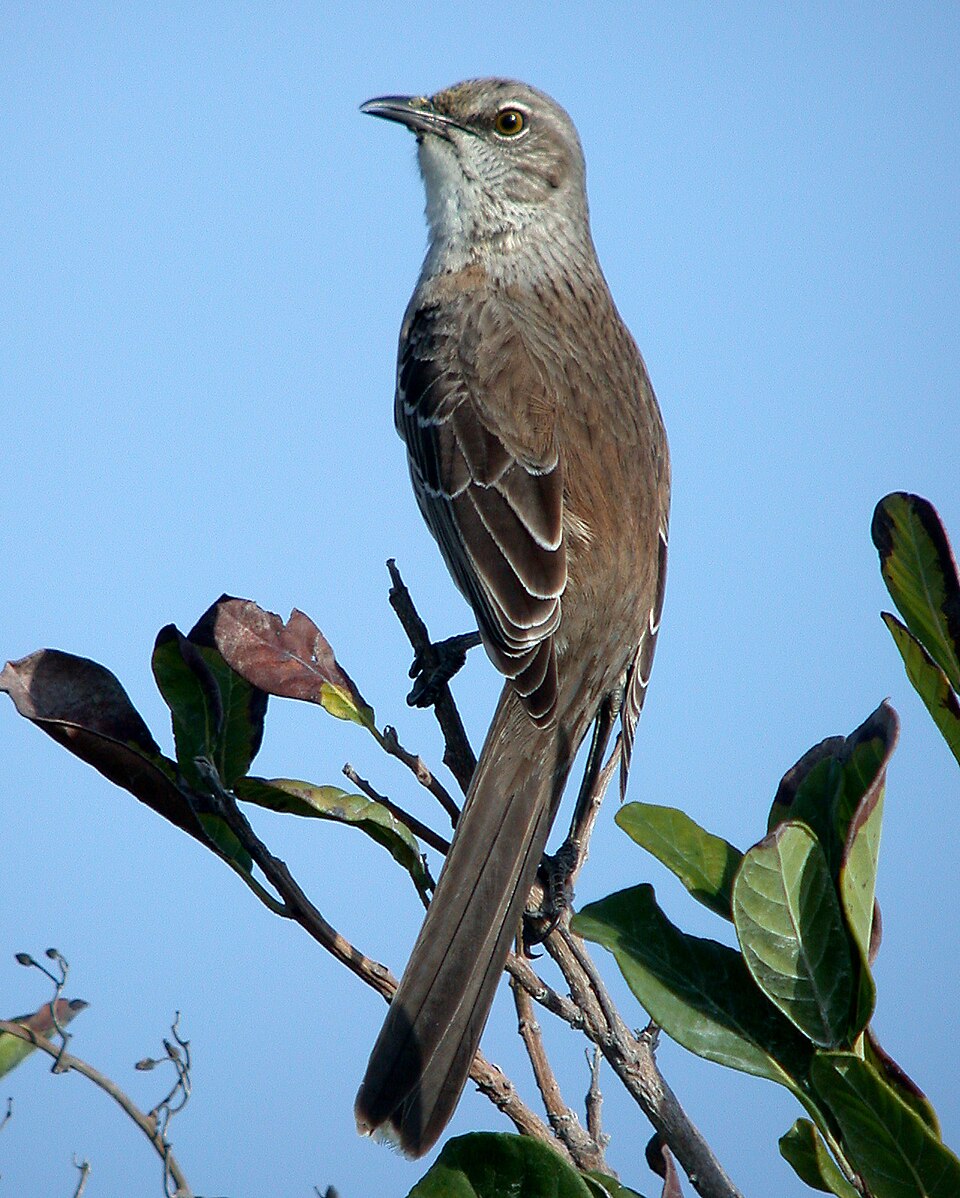
The Bahama Mockingbird is a large, streaked mockingbird of the dry scrub of the Bahamas, Cuba, Jamaica and the Turks and Caicos. In this guide's area it is a vagrant: since the early 1970s it has turned up with some regularity in southern Florida and the Keys, almost always in spring.
Voice
The song consists of short, abrupt and strongly varied phrases, usually repeated two or three times, loud and carrying from an exposed branch tip. Unlike Northern Mockingbird it does not take over the sounds of other species; the song is entirely its own. The call is a hard, rasping chak.
Recording: PT xiao — CC BY-NC-SA 4.0 · Bill Baggs Cape Florida State Park , Miami-Dade County, Florida, United States · xeno-canto
Identification
Larger and duller than Northern Mockingbird, grey-brown above with dark streaking across mantle and crown. The underparts are dingy white with heavy dark streaking on the sides of the breast and the flanks. In flight the large white wing patches are absent; the tail is long and dark, with only small white tips to the outer feathers. The face is irregularly mottled, with a faint dark malar stripe.
Confusion species
Northern Mockingbird is smaller, plain grey and unstreaked, and has a white wing patch and broad white outer tail feathers — both lacking in Bahama Mockingbird. Young Northern Mockingbirds do show breast streaking, but keep the white wing patch and white tail sides; on any streaked bird, check the wing in flight first. Greater size, browner plumage and streaking extending onto the flanks are decisive together.
Habitat
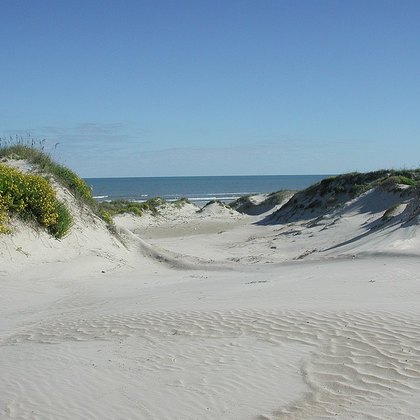
Dry coastal country with shrub belts, coppice (low, dense scrub of the Caribbean and southern Florida) on limestone, semi-open woodland with palms and a parched shrub layer, and the edges of settlement. On the islands this is often the driest, stoniest ground, right down to the beach. It forages mainly on the ground and up to a few metres high, taking invertebrates, nectar, small fruit and occasionally a small lizard, and defends feeding places against its own kind.
Where the bird is most often found, arranged by the USNVC — the vegetation classification of the United States and Canada — and CMECS for sea and coast.


Range and movements
Resident in the Bahamas and the Turks and Caicos, on the Sabana-Camagüey Archipelago and a few dry coastal strips of Cuba, and — as the subspecies hillii, with heavier back streaking — in southern Jamaica. In North America it is a vagrant: nearly all records come from southern Florida and the Keys, peaking in April and May, when birds cross on southeasterly winds. One male returned to Key West in several successive springs and may have paired there with Northern Mockingbirds.
- Resident
- Breeding (summer)
- Winter
- Passage
- dark = core range, pale = thinly spread
Where and when to look
In Florida the best chance is in April and May in coastal scrub on the Keys, at Bill Baggs Cape Florida or Fort Zachary Taylor, usually after a report has gone out — the birds sometimes stay several days in one spot. On the islands themselves you hear it before you see it: look for the singing bird on the highest bare twig above the scrub.
Conservation
The species is listed as not threatened (LC) and is common through most of its range. That range is nonetheless small and entirely insular, and the dry coastal scrub it occupies is under pressure from tourism and building. On several islands Northern Mockingbird is expanding into landscaped and planted ground; what that expansion means for Bahama Mockingbird in the long run has not been measured.
Scientific name
Mimus gundlachii | Cabanis, 1855
Jean Cabanis described the species in 1855 as Mimus Gundlachii, from a specimen from Cuba; author and year stand without parentheses, since it has always remained in Mimus. Mimus is Latin for 'mimic', a name that in this species does not refer to mimicry at all. The epithet honours Juan Gundlach (1810–1896), the German-born naturalist who spent most of his life working on the birds of Cuba and Puerto Rico. The Dutch, English and Spanish names all cite the Bahamas, where the bulk of the range lies.