All species › Passerines › Mockingbirds and thrashers › Northern Mockingbird
Northern Mockingbird | Mimus polyglottos
Spotlijster | Sinsonte norteño
The Northern Mockingbird is the best-known voice of the American suburb: a slim grey bird that delivers the sound of its whole neighbourhood from a chimney, a lamp post or a telephone wire. Five states chose it as their state bird, and on warm spring nights it simply keeps going until it is light again.
Voice
Each phrase comes three to six times over before the next one is due, and that rhythm gives the singer away even when the bird being copied does not. The repertoire runs from a cardinal's chip and a jay's scream to a squealing car alarm, a doorbell and a barking dog. The ordinary call is a hard, scraping chack, turning into a dry rattle when a cat appears. Females sing too, more quietly, mainly in autumn when they are holding a berry bush of their own.
Recording: Scott Crabtree — CC BY-NC-SA 4.0 · Molino Basin, Pima County, Arizona, United States · xeno-canto
Identification
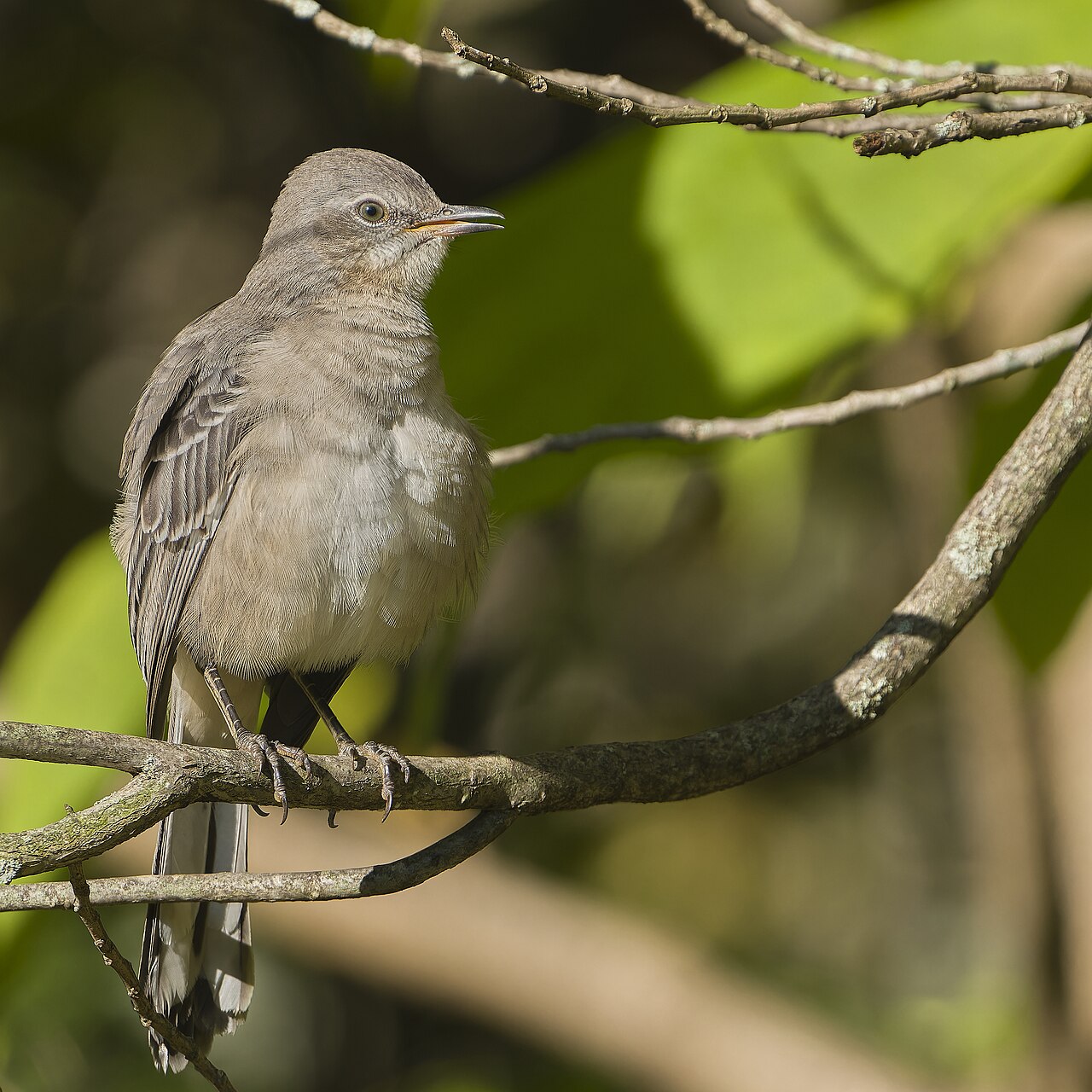
A slim, long-tailed grey bird, pale grey above and dirty white below, with two narrow white wing bars and a blackish, slightly decurved bill. In flight two large white wing patches and white outer tail feathers flash out, so that a bird which looked plain while perched suddenly looks boldly pied. Male and female are alike; juveniles have a spotted breast and a dark eye, where adults have a pale yellow one. On a lawn it jerks its half-open wings upward in stages so that the white patches flare — a movement recognisable at a distance.
Confusion species
Loggerhead Shrike (Lanius ludovicianus) is as grey and white and also shows white in wing and tail, but wears a black mask, has a heavy hooked bill and a far shorter tail, and perches upright instead of leaning forward. Bahama Mockingbird (Mimus gundlachii), which reaches southern Florida, is streaked on breast and flanks and lacks the white wing patches. In southern Mexico Tropical Mockingbird (M. gilvus) takes over: it shows only a narrow white edge to the wing and has longer, thinner legs. Spotted juveniles are taken for thrushes, but already have the long tail and the fine bill.
Habitat
Open, short-cropped ground with scattered bushes: lawns, parks, cemeteries, road verges, planted car parks, and at the edge of it a dense shrub to nest in. In the southwest and in Mexico that means thorn scrub with mesquite (a thorny pod-bearing shrub of the Southwest that forms dense thickets) and cactus, with the same alternation of bare and dense. Closed forest it avoids entirely; it needs open ground to run and feed on. Berry bushes decide where it spends the winter — a single bird may hold one holly or firethorn for months.
Where the bird is most often found, arranged by the USNVC — the vegetation classification of the United States and Canada — and CMECS for sea and coast.




Range and movements
Resident across almost the whole of the United States south of the Great Lakes, in Mexico as far as Oaxaca and Veracruz, and in the Bahamas and the Greater Antilles, where it belongs naturally. The northern limit moved during the twentieth century into southern Ontario and New England, following suburban planting, road verges and ornamental berry shrubs. It hardly migrates; only the most northerly birds shift south in severe weather. In the 1920s it was released on Hawaii, where it has established itself on all the main islands.
- Resident
- Breeding (summer)
- Winter
- Passage
- dark = core range, pale = thinly spread
Where and when to look
In March and April scan the high, free-standing perches — a ridge tile, an aerial, the top wire on a pole: that is where the singer sits, usually the same bird every day. Anyone who wants to know what breeds nearby can listen to one mockingbird for a quarter of an hour and keep count. In winter it is quieter but not gone: find the berry bush it is guarding, and listen for the hard chack.
Conservation
Numerous and widespread, with a population in the tens of millions, listed as Least Concern (LC). Numbers have slipped a little since the 1960s, but on balance the species gains from towns, road verges and planted ornamental shrubs. As a bird that nests in low shrubs beside houses it is vulnerable to domestic cats, and on Hawaii it counts as an introduced species itself.
Scientific name
Mimus polyglottos | (Linnaeus, 1758)
Linnaeus described the species in 1758 as Turdus polyglottos, among the thrushes; because it was later moved to another genus, author and year stand in parentheses. The genus Mimus was introduced by Boie in 1826 and is the Latin word for a mime, an imitator. polyglottos is Greek for 'many-tongued', from polus 'many' and glossa 'tongue'. The type locality reads simply 'in Virginia'.