All species › Passerines › Rhabdornis, starlings and mynas › European Starling
European Starling | Sturnus vulgaris
Spreeuw | Estornino pinto
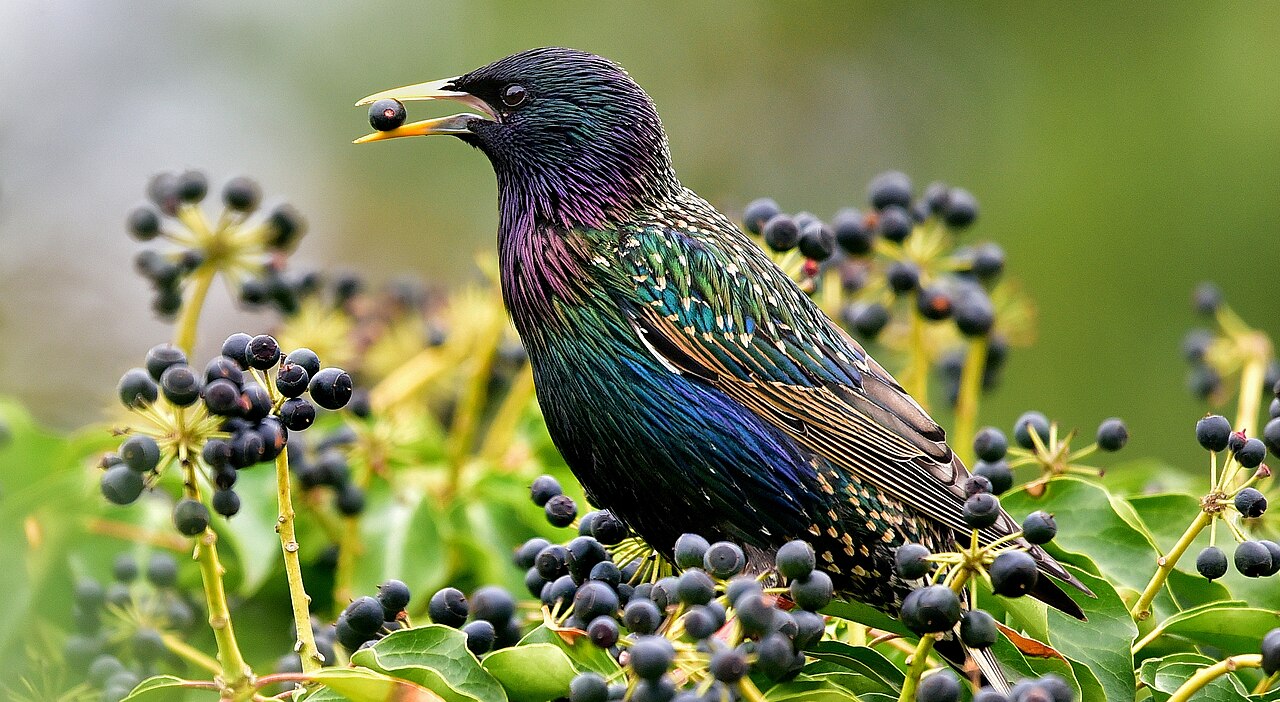
A stocky, short-tailed black bird with a sharp yellow bill and a plumage that flashes purple and green in the sun. It does not belong here by nature: a few dozen birds were released in New York in 1890, and within sixty years it occurred from Alaska to Baja California. It has become one of the most numerous birds on the continent.
Voice
It sings from a roof edge, an aerial or a bare branch, bill raised and wings held wide and quivering — a posture that identifies the singer from a distance. Through the stream of whistles and rattles run imitations that differ from bird to bird: the call of a Killdeer, a kestrel, a car alarm, a boiling kettle. Characteristic is a long, rising tcheeoo that often closes a sequence. The ordinary call is a hard chirr; at a passing hawk a sharp shriek is given, at which the whole flock collapses together.
Recording: Philippe_Grange — CC0 · Arrondissement de la Roche-sur-Yon (near La Roche-sur-Yon), Vendée, Pays de la Loire, France · xeno-canto
Identification
At a distance a black bird; close to, the plumage gleams green and purple over head, breast and back. In autumn it is thickly set with white and buff feather tips and by spring almost uniformly dark, and the bill changes over that period from horn-brown to bright yellow. The male has a blue-grey patch at the base of the bill, the female a pale pink one. First-year birds are plain mouse-grey with a pale throat and are often taken for another species. The silhouette is unmistakable: a short tail, a pointed head and, in flight, triangular wings.
Confusion species
Brown-headed Cowbird (Molothrus ater) is as dark but has a short, thick conical bill, a longer tail and, on the male, a brown head. Common Grackle (Quiscalus quiscula) is much larger, has a long tail carried folded into a keel at the tip, and a bright yellow eye. Red-winged Blackbird has red shoulders and usually keeps to reeds and rough ground rather than the street. Anyone who sees a plain grey-brown bird with a yellow bill walking across a lawn in late summer is almost certainly looking at a young starling.
Habitat
Arable land, pasture and livestock farms, gardens, parks, city squares, industrial estates and landfills — anywhere with short vegetation and a cavity to nest in. Food is taken by preference on short grass: the closed bill is driven into the turf and then forced open, so that the bird can look between the roots. Closed forest, extensive scrub, marsh and desert are avoided. For a nest a woodpecker hole, a roof tile or a lamp post will do.
Where the bird is most often found, arranged by the USNVC — the vegetation classification of the United States and Canada — and CMECS for sea and coast.




Range and movements
A European and western Asian bird by origin; the North American population goes back to a release in Central Park, New York, in 1890 and a second the following year, about a hundred birds in all. By 1900 it was still confined to the surroundings of the city, by 1928 it had reached the Mississippi, by 1942 the Pacific coast, and in the 1950s Alaska and northern Mexico. It now breeds from southern Alaska and the settled parts of Canada to southern Florida, southern Texas and Baja California, with a separate population around Mexico City; in winter northern birds move south as far as Veracruz, the Bahamas and eastern Cuba. Separate releases on Bermuda, Jamaica and Puerto Rico have also held.
- Resident
- Breeding (summer)
- Winter
- Passage
- dark = core range, pale = thinly spread
Where and when to look
In November, watch a reedbed, a road bridge or a stand of trees beside a shopping centre in the hour before sunset: starlings come in from kilometres around. To take the song apart, stand under a singing male in March and count the imitations; three or four recognisable other species in a minute is not unusual. On a mown lawn it can be found all year, and that is also the best place to learn to tell summer from winter plumage.
Conservation
Partners in Flight puts the world population at two hundred and fifty million birds. In North America numbers have fallen by more than one per cent a year since 1966, amounting to a halving by 2023. As a cavity nester it takes nest holes from native species, and for that reason it falls outside the Migratory Bird Treaty Act; a study in 2003 found that among twenty-seven native species only the sapsuckers showed a measurable decline.
Scientific name
Sturnus vulgaris | Linnaeus, 1758
Linnaeus described the species in 1758 as Sturnus vulgaris, in the same genus it still stands in, so author and year carry no parentheses. Sturnus is the ordinary Latin word for a starling and vulgaris means 'common, everyday'. The type locality is in Sweden, and in that it differs from almost every other species in this guide: it was described from a European specimen, because in 1758 it did not yet occur in North America. The genus Sturnus goes back to the same edition of 1758.