All species › Passerines › Rhabdornis, starlings and mynas › Common Myna
Common Myna | Acridotheres tristis
Treurmaina | Miná común
The Common Myna is an Asian starling established as an introduced bird in Hawaii, where it is among the most visible birds of towns, car parks and hotel lawns. It is on the IUCN list of the hundred most invasive species in the world, one of only three birds there.
Voice
The repertoire consists of croaks, chattering runs, clicks, short whistles and a low growling note, often in long series with no fixed structure. Before settling at a communal roost a flock produces a prolonged, simultaneous babble that carries tens of metres. Alarm calls are loud and sustained; imitation of other sounds occurs but is limited.
Recording: David Darrell-Lambert — CC BY-NC-SA 4.0 · Al Mamzar Park, Dubai, United Arab Emirates · xeno-canto
Identification
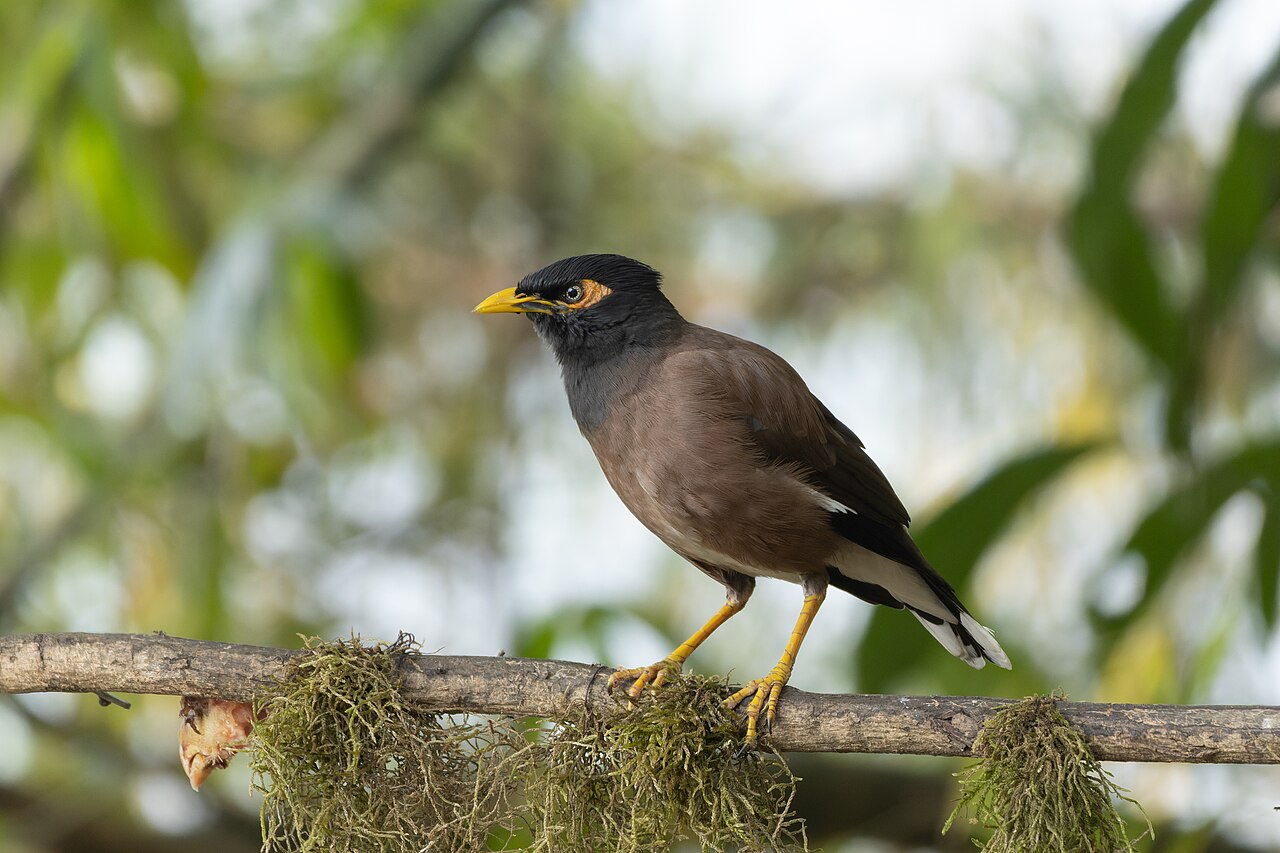
A stocky, starling-sized bird with a chestnut body, a black head and breast and a bare, bright yellow patch of skin behind the eye. Bill and legs are yellow. In flight large white patches in the primaries and a white tail tip stand out. On the ground it walks with short, purposeful steps rather than hopping. The sexes look alike; young birds are duller brown with a smaller yellow eye patch.
Confusion species
European Starling is smaller and shorter-tailed and in winter plumage black with white spots, without chestnut and without a yellow skin patch. In Hawaii the Common Myna is the only established myna, so confusion there is mainly with its own young. In southern Florida and southern California other introduced mynas have escaped locally, among them the crested, black-and-white-headed Brahminy Starling.
Habitat
Almost always near people: towns and villages, parks and gardens, cropland, pasture with stock, rubbish tips and dock areas. It nests in cavities in buildings, in dead palm trunks and in hollow trees, and will use nest boxes. Closed native forest it hardly uses, so in Hawaii it stays largely in the lowlands; it does carry the seeds of invasive shrubs such as lantana to new sites.
Where the bird is most often found, arranged by the USNVC — the vegetation classification of the United States and Canada — and CMECS for sea and coast.




Range and movements
The native range runs from Iran and Afghanistan through Pakistan, India and Nepal to southern China and Southeast Asia. The species has been introduced to Australia, New Zealand, South Africa and numerous islands in the Indian and Pacific Oceans. In Hawaii it was released from India in 1865 to control armyworm outbreaks in sugar cane, and it is now resident in the lowlands of all the main islands. In southern Florida a population has been established since the 1980s, mainly around Miami and the farmland near Homestead; in southern California and southern Texas there are small local groups.
- Resident
Where and when to look
In Hawaii no searching is needed: almost any car park or beachside lawn produces one, all year. On the mainland a supermarket car park or a livestock market in southern Florida is the most reliable place. Towards evening, watch for the noisy communal roost trees, often palms along a through road.
Conservation
Worldwide the species is listed as Least Concern (LC) and is still expanding. As an introduced bird it is instead a management question: it occupies nest cavities that native hole-nesters need, takes eggs and young, spreads the seeds of invasive shrubs and, on islands, helps carry parasites and pathogens. In Hawaii management concentrates on keeping mynas away from seabird colonies and on limiting food waste around buildings; full removal from the main islands is not on the table.
Scientific name
Acridotheres tristis | (Linnaeus, 1766)
Linnaeus described the species in 1766 as Paradisea tristis; because it later moved to Acridotheres, author and year stand in parentheses. The type locality is given as the Philippines, which according to Stresemann (1952) rests on an error: the specimen described almost certainly came from Pondicherry in southern India. Acridotheres is from Greek akris 'locust' and thēras 'hunter'; tristis is Latin for 'sad' or 'gloomy', and that word returns in the Dutch name treurmaina, 'mourning myna'. Myna itself is a Hindi word.