All species › Passerines › Dippers › American Dipper
American Dipper | Cinclus mexicanus
Amerikaanse waterspreeuw | Mirlo acuático norteamericano
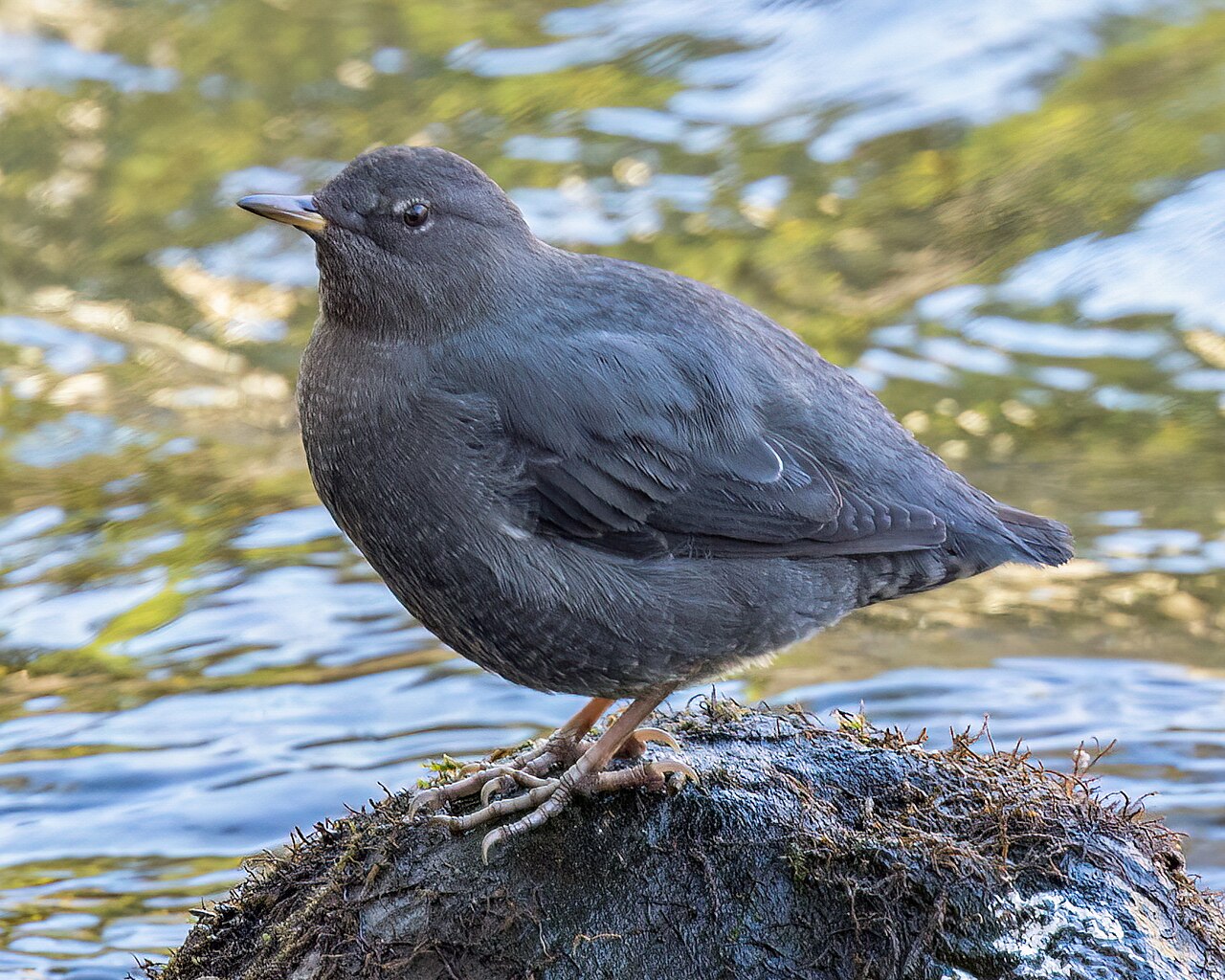
A uniformly slate-grey bird on a boulder in midstream that steps into the white water without hesitating and comes out again ten metres further on. It is the only dipper of the continent, and it holds its stretch of stream from Alaska to the mountains of Central America.
Voice
Male and female both sing, and the song is not short: a loud, run-on series of whistles, rolls and trills that can carry on for minutes, with each motif repeated two or three times over. The sound heard first in practice is the call: a hard, short, sharp dzeet, usually several times running, as the bird shoots past low over the water. That call carries through the roar and precedes almost every sighting. At close range a soft rattling churr is given as the bird comes to the nest.
Recording: Yoann Blanchon — CC BY-NC-SA 4.0 · Gold Cord Lake Trailhead (near Fishhook), Matanuska-Susitna Borough, Alaska, United States · xeno-canto
Identification
Fourteen to twenty centimetres and forty-three to sixty-seven grams, on a stocky, short-tailed body. The plumage is plain slate grey, with head and neck often washed browner; in fresh feather the flight feathers and belly carry narrow white fringes. The bill is dark and slender, the legs grey-pink and heavy. Juveniles are paler and greyer, with a pale yellowish bill and a mottled or scaled belly, and are regularly reported as some other bird. In flight it is a dark bullet going low over the water, following every bend of the stream rather than cutting the corner.
Confusion species
No other bird in the region shares its shape and its place; the confusion comes from the species itself. The pale, scaly juvenile on a rock is taken at a distance for a young thrush or an outsized wren, until it starts bobbing or walks into the water. For readers of the European guide: the White-throated Dipper there (Cinclus cinclus) has exactly the same build and stance but wears a white throat and breast, while the American bird is grey throughout. On a distant boulder in midstream the movement decides it sooner than the colour.
Habitat
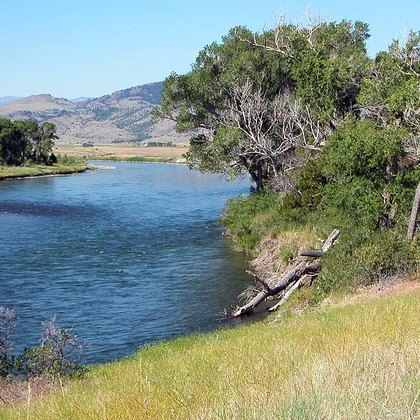
Fast, cold, clear streams with a stony bed, rapids and waterfalls, from sea level in the coastal ranges of Alaska and British Columbia to above three thousand five hundred metres in the Rockies and the Mexican mountains. Lake outlets and glacier-fed rivers belong to it too. In winter it needs open water, and for the nest a firm ledge, boulder or bridge. Where a stream silts up, is dammed or warms, it goes; it does not use slow lowland rivers.
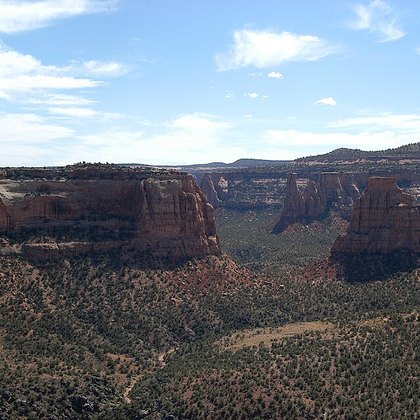
Where the bird is most often found, arranged by the USNVC — the vegetation classification of the United States and Canada — and CMECS for sea and coast.


Range and movements
Resident from western Alaska and the Yukon south through British Columbia and Alberta and the mountains of the western United States to the Black Hills of South Dakota, and on through the Sierra Madre of Mexico, Guatemala and Honduras into the mountains of northwestern Nicaragua. Beyond that the range continues in Costa Rica and western Panama, which fall outside the area covered by this guide. It does not migrate: birds on high streams drop to lower water as soon as their own reach freezes over, and are back in spring. Five subspecies are recognised, becoming smaller and darker southward.
- Resident
- Breeding (summer)
- Winter
- Passage
- dark = core range, pale = thinly spread
Where and when to look
Stop at every bridge over a fast mountain stream and look at the boulders in midstream: a dark speck going up and down is one. Follow the water and not the bank — it flies along the stream rather than through the wood beside it, so a bird that vanishes upstream comes back past you within a few minutes. In winter it pays to search the open, fast stretches just below a lake outlet, where the water does not freeze.
Conservation
Not threatened (LC), with an estimated breeding population of a hundred and sixty thousand birds. What threatens it is not the bird but the stream: dams that take away the fast water, logging and road building that deliver sand and silt, and mining that puts heavy metals into the water. It leaves a polluted reach before other signs are visible, and is therefore used as a gauge of a stream's condition; ledges fitted under bridges give it new nest sites.
Scientific name
Cinclus mexicanus | Swainson, 1827
Swainson described the species in 1827 as Cinclus mexicanus, from a bird taken at Temascaltepec in Mexico; the name has stood unchanged since, which is why author and year are not in parentheses. The genus Cinclus was introduced by Borkhausen in 1797 and goes back to Greek kinklos, the name ancient writers gave to a tail-bobbing bird of the waterside. mexicanus means 'of Mexico'. That the bird is thus named after the southern end of a range reaching to Alaska follows simply from where the first described specimen came.