All species › Passerines › Thrushes and allies › Eastern Bluebird
Eastern Bluebird | Sialia sialis
Roodkeelsialia | Azulejo gorjicanelo
The Eastern Bluebird is the bluebird of eastern North America: a small cavity nester of open country with scattered trees, which takes its food from the ground from a low perch. Numbers fell sharply in the first half of the twentieth century and then recovered through the building of nest-box trails.
Voice
The song is a low, slightly squeaky warble of about two seconds, usually three or four short notes falling a little. The contact call is a soft, liquid tu-a-wee, used by pairs in flight as well, and often the first sign of their presence. Disturbance at the nest brings a hard, rattling chek, sometimes in long series.
Recording: Stanislas Wroza — CC BY-NC-SA 4.0 · La Côte-de-Beaupré (near La Barrière-du-Maurice), Capitale-Nationale, Québec, Canada · xeno-canto
Identification
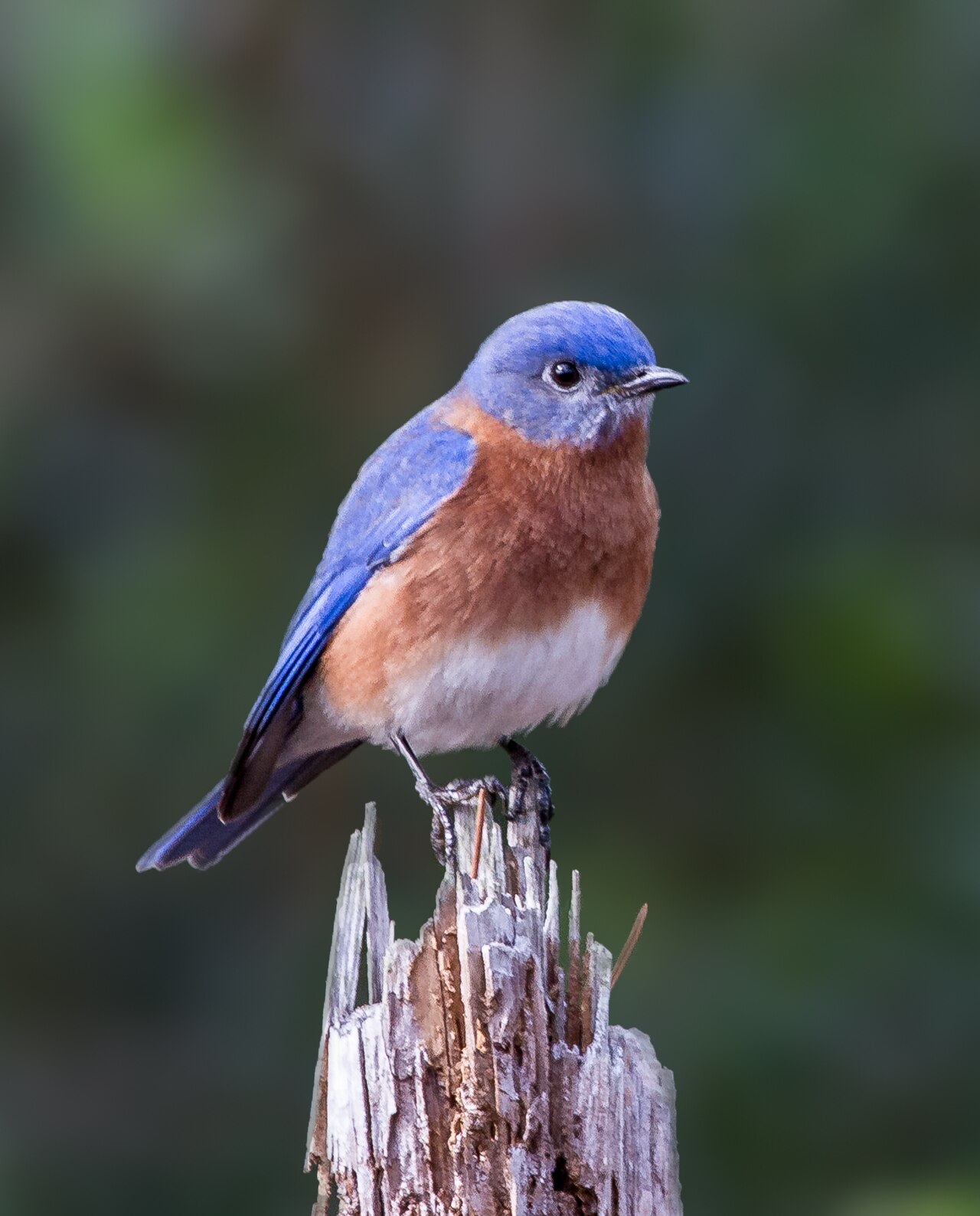
The male is deep blue on head, back, wing and tail, with a rusty red throat, breast and flanks and a white belly and undertail. The female is grey-brown above with blue showing through in wing and tail, a paler orange-brown breast and a narrow white eye-ring. Young birds are grey with white spotting on back and breast and already show blue in the wing. On a wire or post the bird perches upright, with the head angled slightly down.
Confusion species
Western Bluebird has a blue rather than rusty throat and often a chestnut patch on the back; the ranges overlap only in the Southwest. Mountain Bluebird lacks the rust entirely and in the male is plain sky-blue with a white belly. Females of the three are more alike: in Eastern the orange-brown runs up onto the throat, in Western the throat is grey-blue, and in Mountain it is nearly white.
Habitat
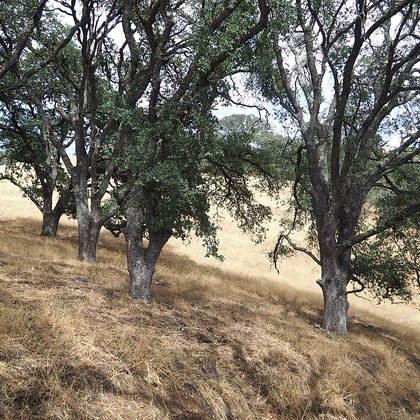
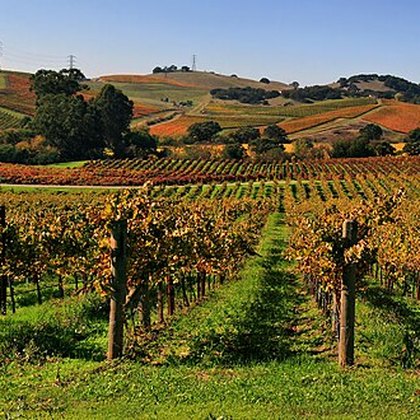
Semi-open country: pasture with scattered trees, open oak woodland and savanna, orchards, hedgerows and woodland edge, field margins, golf courses and wide verges. What matters is the combination of short vegetation to hunt over from a perch and cavities to nest in — old woodpecker holes, hollow fence posts or nest boxes. It avoids closed forest, but settles quickly after logging or fire; in winter it also uses berry-bearing scrub.
Where the bird is most often found, arranged by the USNVC — the vegetation classification of the United States and Canada — and CMECS for sea and coast.




Range and movements
Breeds in eastern North America, from southern Canada and the edge of the Great Plains east to the Atlantic coast and south to Florida and eastern Texas. In the north of the range it is migratory and leaves in October and November; in the centre and south it stays all year. It is also resident in the mountains of eastern and southern Mexico, in Guatemala, Honduras, El Salvador and Nicaragua, and on Bermuda. The northern limit of the winter range moved north over the course of the twentieth century.
- Resident
- Breeding (summer)
- Winter
- Passage
- dark = core range, pale = thinly spread
Where and when to look
Drive a country road with fence posts and nest boxes in March or April and watch for small birds dropping from a post to the ground; in winter they form small parties around berry-bearing shrubs and along sheltered woodland edges. A nest box with an entrance hole of about 38 millimetres, on a post with a predator baffle and with the hole turned away from the prevailing wind, gives the best chance of a nesting pair in a garden.
Conservation
Partners in Flight puts the breeding population at about 23 million birds, and the Breeding Bird Survey shows an increase between 1966 and 2019; the species is listed as Least Concern (LC). Early in the twentieth century numbers fell steeply as introduced House Sparrows and European Starlings took over nest cavities and as old wooden fence posts and standard orchards disappeared. From the 1960s long lines of nest boxes were put up along roads and fields, with an entrance too small for a starling; numbers rose again after that. Shortage of cavities, cold wet springs and the lapse of maintenance on old box trails remain the pressures.
Scientific name
Sialia sialis | (Linnaeus, 1758)
Linnaeus described the species in 1758 as Motacilla Sialis, with the type area given as 'in Bermudis & America calidiore' and later fixed on South Carolina; author and year stand in parentheses because it now sits in Sialia. That genus was introduced in 1827 by William Swainson and goes back to Greek sialis, the name of an unidentified bird. The Dutch name points to the rusty throat, the English name to the blue, and the Spanish name combines both: azulejo 'little blue one' and gorjicanelo 'cinnamon-throated'.