All species › Pigeons and doves › Doves and pigeons › Band-tailed Pigeon
Band-tailed Pigeon | Patagioenas fasciata
Bandstaartduif | Paloma Torcaza
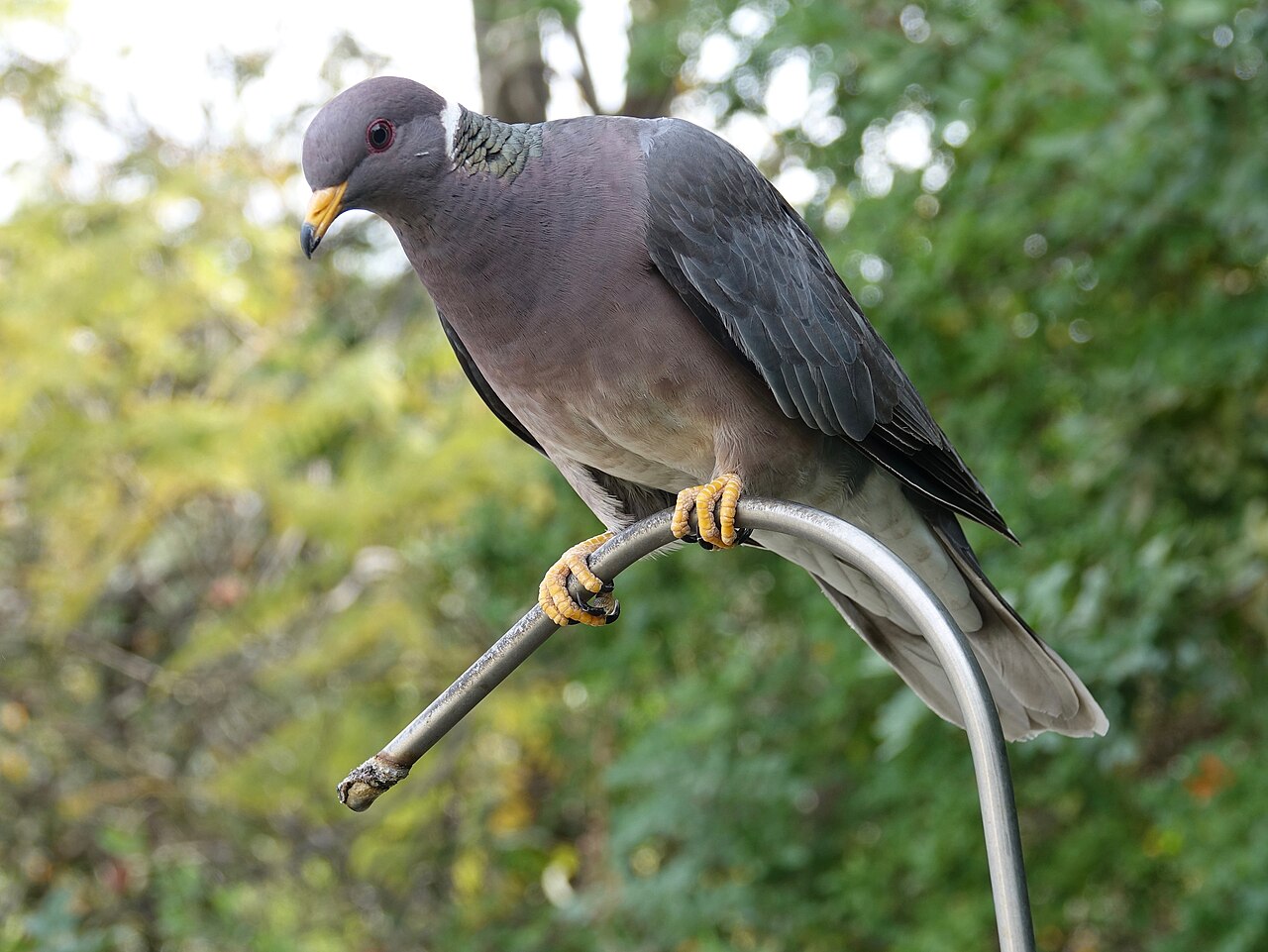
Band-tailed Pigeon is the big grey forest pigeon of the west: a heavy bird with a yellow black-tipped bill, a narrow white crescent across the nape and a broad pale band across the tip of the tail. It roams in flocks after acorns and berries and keeps no fixed home range. Since the 1960s its numbers have fallen steadily.
Voice
For a pigeon it is quiet. The call is a low, owl-like cooing of two syllables that rises and then falls, hoo-OOH, often repeated a number of times from a tall conifer. Now and then a harsh, squawking note is heard as well. On take-off the wings whistle and clap sharply, and in closed forest that is often the first sign that a flock is present.
No freely licensed recording has been found for this species yet; what to listen for is described below.
Identification
A large, heavy pigeon, evenly grey with a purplish grey wash over head and breast. A narrow white crescent crosses the nape, and below it lies a patch of green iridescent, scale-patterned feathers. The bill is yellow with a black tip and the legs are yellow. The tail shows a darker band at the base and a broad, pale grey band across the tip — the mark that gives the bird its name. Juveniles lack the crescent and the gloss and look scaly through their pale feather edges.
Confusion species
Rock Pigeon is shorter-tailed and almost always shows black bars across the wing, a pale rump and a pale underwing; its bill is grey, not yellow. Red-billed Pigeon of the lowlands is darker, maroon on head and breast, with a red bill and an unbanded tail. Mourning Dove is much smaller and slimmer, with a long pointed tail. On a passing flock the pale tail band is the quickest mark to catch at long range.
Habitat
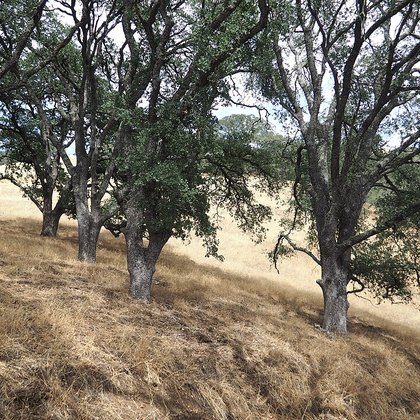
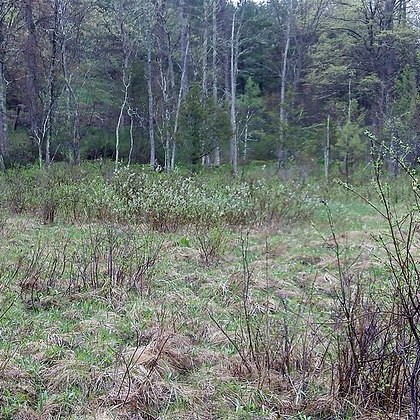
Along the Pacific it lives in damp conifer forest of Sitka spruce and Douglas-fir at low elevations, with an understorey of cascara, elderberry, madrone and huckleberry in which it finds its fruit. Inland it sits higher, roughly between 1,500 and 3,000 metres, in pine and oak forest and in dry juniper woodland. On the west coast the birds visit regular mineral springs, where they drink and peck at the soil. In winter they also come to garden feeders, sometimes dozens at a time.
Where the bird is most often found, arranged by the USNVC — the vegetation classification of the United States and Canada — and CMECS for sea and coast.



Range and movements
There are two separate populations: one along the Pacific, from southwestern British Columbia through Washington, Oregon and California, and one in the interior, from Utah and Colorado through Arizona and New Mexico into western Texas. The interior birds move to Mexico in autumn; on the coast part of the population stays all year, though those flocks also wander without a fixed range. Southward the range runs through the mountains of Mexico into Guatemala, El Salvador, Honduras and northern Nicaragua; the pigeons of Costa Rica and further south are now counted as a separate species. Between 1966 and 2014 numbers fell by about two per cent a year, close to two-thirds in all.
- Resident
- Breeding (summer)
- Winter
- Passage
- dark = core range, pale = thinly spread
Where and when to look
In September find a woodland edge or ridge with fruiting madrone, elderberry or oaks and wait there through the first hour after sunrise: the flocks come in high and fast and then drop in all at once. At the moment they land the white crescent lights up. In winter a garden feeder in a western suburb is the easiest place of all.
Conservation
The world population is estimated at around two million birds, of which roughly two-fifths are in the United States and as many again in Mexico. The trend has been negative for decades: an average of two per cent a year since 1968. Hunting is permitted in six states and takes some twenty-five thousand birds a year; the loss of old forest and outbreaks of disease at drinking places also play a part.
Scientific name
Patagioenas fasciata | (Say, 1822)
Say described the species in 1822 as Columba fasciata, in the account of Long's expedition to the Rocky Mountains; since the American pigeons stand in the genus Patagioenas, author and year go in parentheses. The species name fasciata is Latin for 'banded' and refers to the pale band across the tail tip. The specimen described came from a tributary of the Platte: Plum Creek near Castle Rock, in Douglas County, Colorado.