All species › Pigeons and doves › Doves and pigeons › Spotted Dove
Spotted Dove | Spilopelia chinensis
Parelhalstortel | Tórtola Moteada
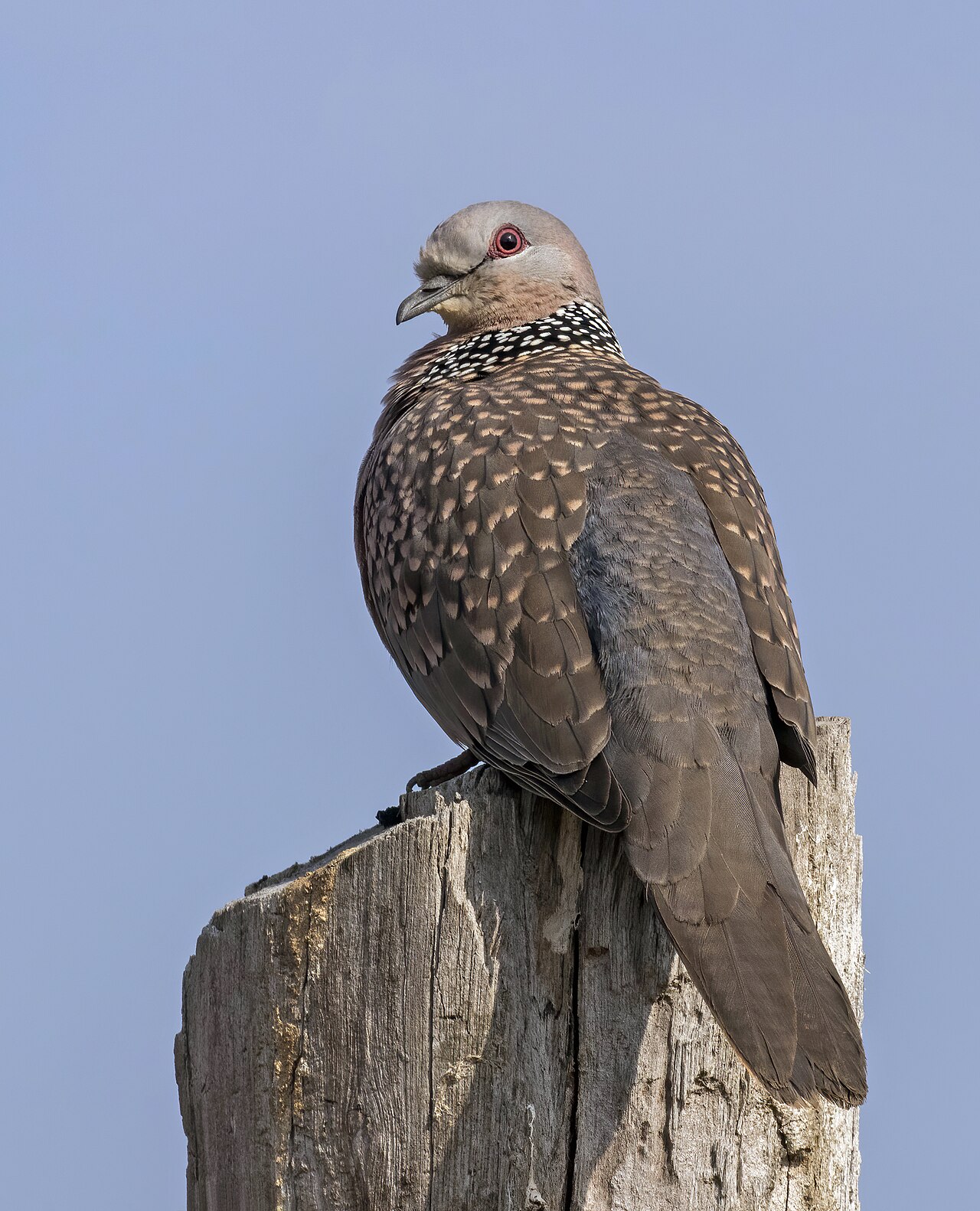
Spotted Dove is an Asian dove that has lived in North America for more than a century: released in Los Angeles around 1917 and brought to Hawaii during the nineteenth century. In the gardens of Hawaii it is one of the commonest birds; in California, after a long heyday, it has fallen away sharply. It is known by the broad black neck patch full of white spots.
Voice
The call is a low, rolling coo of three syllables, coo-coo-coooo, the last note sagging away. A rougher, more rolled version is heard as well, kroo-krook-krookroo, with a varying number of closing notes. In Hawaii it sounds the year round from gardens, roadsides and rooftops. The sound carries further than the bird shows itself, for it often calls from dense foliage.
Recording: Sam Hambly — CC BY-NC-SA 4.0 · Gateway at Bang Sue (near Bangkok), Bang Sue, Krung Thep Maha Nakhon, Thailand · xeno-canto
Identification
A solidly built dove with a long tail that looks square-cut at rest and opens like a fan in flight. The head is grey, the underparts pink to mauve and the upperparts brown with pale feather edges. The mark is the neck patch: a broad black field on the side and back of the neck, thickly set with white spots. In flight the white corners of the tail catch the eye. Male and female look alike; juveniles are duller and do not yet have the neck patch.
Confusion species
Eurasian Collared-Dove (Streptopelia decaocto) is paler and greyer, carries a narrow black half-collar without spots, and has a shorter, square-cut tail. Mourning Dove is slimmer and warmer brown, with a tapering tail edged in white and black spots on the wing. In Hawaii, Zebra Dove (Geopelia striata) is much smaller and finely barred across breast and flanks. The white spots on the black neck field are the decisive mark at any distance.
Habitat
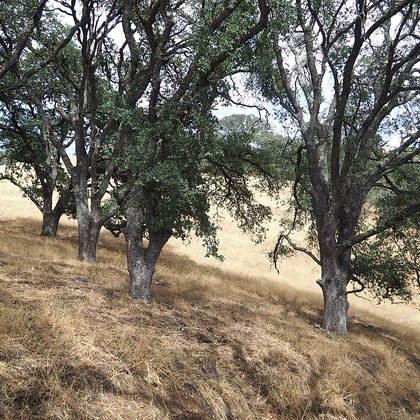
It is a bird of settled land: gardens, parks, lawns with trees, older residential streets, and the groves of eucalyptus and poplar along creeks in the coastal basin of California. In Hawaii it uses roadsides, fields, pasture and open woodland as well, from the coast up into the lower mountains. It avoids closed forest and dry desert. It feeds on foot on the ground, taking mostly seeds and small fruit.
Where the bird is most often found, arranged by the USNVC — the vegetation classification of the United States and Canada — and CMECS for sea and coast.



Range and movements
In North America it occurs in two places, both by human hand. In Hawaii it was introduced during the nineteenth century and is now common on all the main islands; it breeds there the year round and is locally hunted. In California everything goes back to birds released in the Los Angeles area around 1917; from there it spread to Santa Barbara and Bakersfield in the north and San Diego in the south. Since the end of the twentieth century numbers there have dropped sharply and it has disappeared from part of that area.
- Resident
Where and when to look
In Hawaii there is no need to search: it walks over every lawn and every car park, and at close range the white spots are seen to stand separately. In California the best chance is in older residential districts of the Los Angeles basin, with tall trees and plenty of lawn. Listen there first for the rolling coo, because the bird is more often heard than seen.
Conservation
Globally the species is listed as Least Concern (LC). As an introduced bird it does not count in the protection of the native bird population; in Hawaii it is numerous and its numbers steady, and there it is hunted as game. The Californian population has collapsed since the 1990s, and no conclusive explanation has been found for it. Eurasian Collared-Dove occupied California in those same years; whether the two are connected has not been shown.
Scientific name
Spilopelia chinensis | (Scopoli, 1786)
Scopoli described the species in 1786 as Columba chinensis, after a bird from China; because the species has since changed genus, author and year stand in parentheses. The genus Spilopelia is formed from Greek spilos, 'spot', and peleia, 'dove' — a name that renders the spotted neck patch. The type locality is China, later restricted to Canton. Scopoli published the name in his Deliciae Florae et Faunae Insubricae.