All species › Passerines › Wrens › Bewick's Wren
Bewick's Wren | Thryomanes bewickii
Bewicks winterkoning | Chivirín de cola oscura
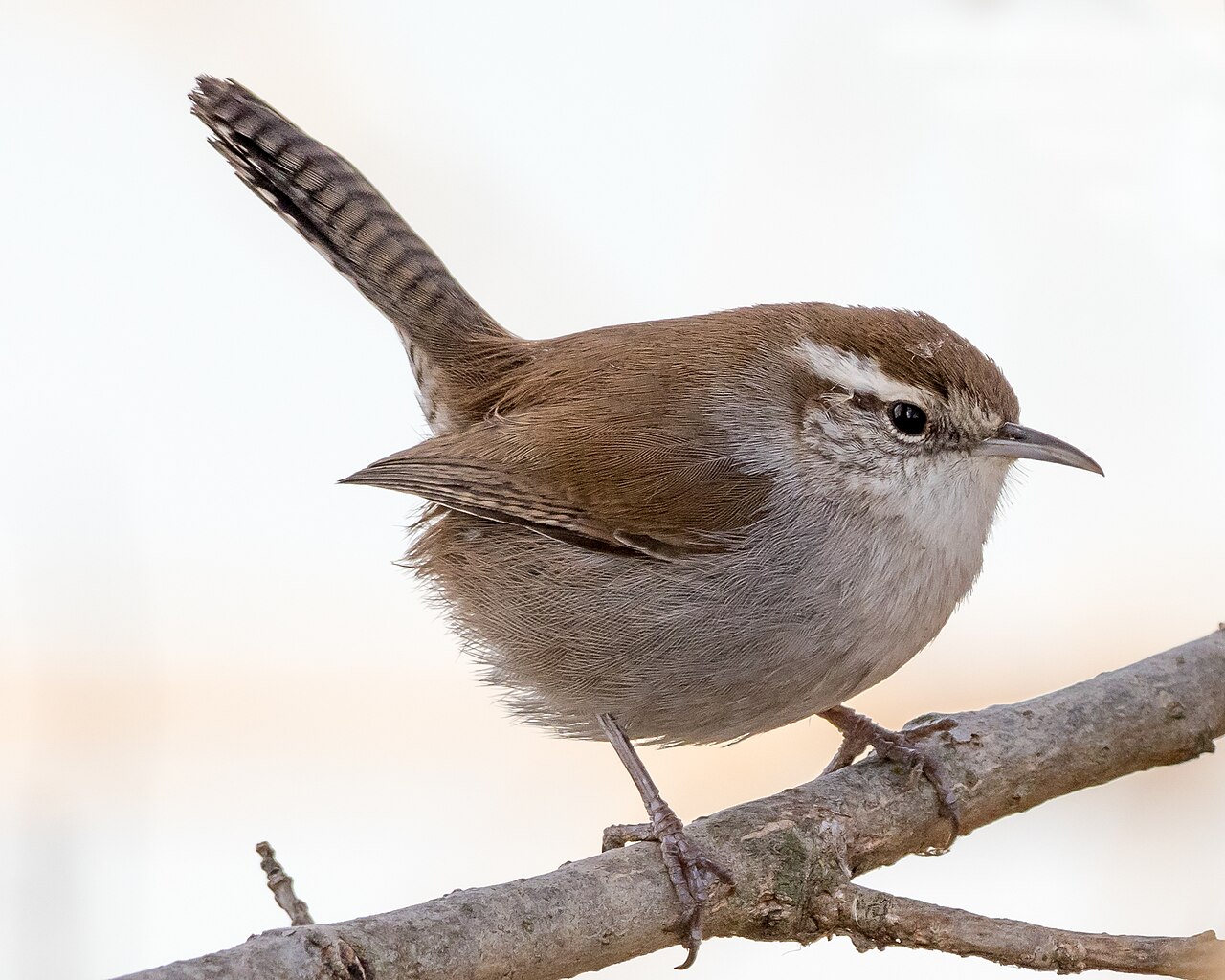
Bewick's Wren is a slim wren of dry scrub, with a long white eyebrow and a long tail that it swings constantly from side to side. In the West it is common; east of the Mississippi it has all but vanished over the course of the twentieth century.
Voice
The song comes in two or three parts: one or two high thin opening notes, then a low buzzy note, and finally a clear trill. A single male commands up to about twenty variants of that pattern and alternates them. Young males learn their song not from their father but from the neighbours on the territory where they settle, so each district develops its own dialects. Calls are a hard, rasping jaap and a dry rattle when disturbed.
Recording: Ed Pandolfino — CC BY-NC-SA 4.0 · Blue Ridge Road, Solano County, California, United States · xeno-canto
Identification
Upperparts plain grey-brown — darker and greyer in the West, more rufous in the Southeast — and underparts pale greyish white without markings. A long, sharply drawn white eyebrow runs over the eye onto the nape. The tail is long for a wren, barred black, with white corners and white tips to the outer feathers; the bird often holds it up and sweeps it slowly left and right. The bill is long, thin and slightly decurved. It usually forages below three metres, in shrubs, brush piles and along shed walls.
Confusion species
Carolina Wren is bulkier, warm rufous above and buff below, with a shorter tail lacking white corners. Northern House Wren has no clear eyebrow, is stockier and finely barred on flanks and tail. Rock Wren has a speckled throat and a buff tail band and sits on bare rock. The sideways tail-swinging together with the white eyebrow and white tail corners identifies Bewick's Wren in the field.
Habitat
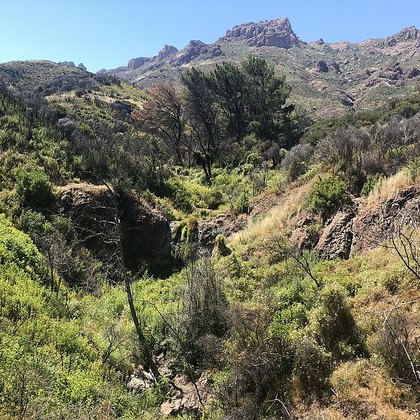
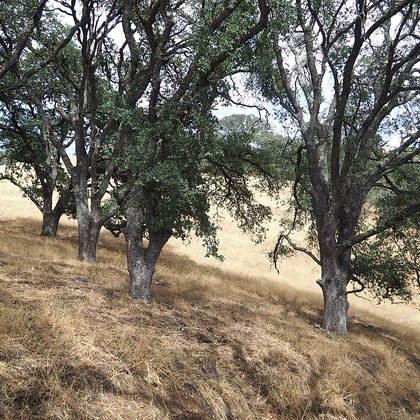
Shrubby, half-open ground: hillside chaparral (dense, hard-leaved scrub of California's Mediterranean climate), oak woodland, desert scrub with cactus and mesquite (a thorny pod-bearing shrub of the Southwest that forms dense thickets), willow-lined gullies, the cut edges of conifer forest, hedgerows and overgrown farmsteads. Gardens, parks and town edges with plenty of cover are taken too. It avoids continuous tall forest. The nest goes in a cavity — a tree hole, crevice, nest box, mailbox, tin can or rolled-up tarpaulin — often close to human buildings.
Where the bird is most often found, arranged by the USNVC — the vegetation classification of the United States and Canada — and CMECS for sea and coast.





Range and movements
Resident almost throughout the year. The present range runs from southwestern British Columbia south along the Pacific coast, through the Great Basin and the Southwest to Texas, Oklahoma and the Ozarks of Arkansas and Missouri, and on across the Mexican highlands to Oaxaca, with separate forms on the Baja peninsulas. Historically it also bred across the Midwest and the Appalachians to Pennsylvania and Ohio; there it is now essentially gone. In the northern part of the western range a few birds move short distances south.
- Resident
- Breeding (summer)
- Winter
- Passage
- dark = core range, pale = thinly spread
Where and when to look
Look for it along the edge of a bramble thicket or an old farmyard and watch for movement first: a small brown bird swinging its cocked tail slowly from side to side is, in the West, almost always this species. It responds strongly to imitation of its rattle call and will then come within a few metres in open shrub.
Conservation
Partners in Flight puts the global breeding population at 7.9 million birds and the Continental Concern Score at 11 out of 20, but those figures mask the collapse in the East. Its main cause is the Northern House Wren, which uses the same cavities and in doing so ejects eggs and destroys nests; reforestation of abandoned farmland, pesticides and competition from European Starling, House Sparrow and Carolina Wren added to it. Several eastern states list the species as endangered; in the West the trend is stable.
Scientific name
Thryomanes bewickii | (Audubon, 1827)
John James Audubon described the species in 1827 as Troglodytes bewickii, from a specimen taken eight kilometres outside St. Francisville, Louisiana; because it later moved to another genus, author and year stand in parentheses. He named it after his friend Thomas Bewick, the English wood engraver whose bird illustrations he admired. Philip Lutley Sclater introduced the genus Thryomanes in 1862, from Greek thruon 'reed' and -manes 'fond of', thus 'reed-lover' — a name that fits this scrub species less well than its relatives.