All species › Passerines › Wrens › Carolina Wren
Carolina Wren | Thryothorus ludovicianus
Carolinawinterkoning | Chivirín de Carolina
The Carolina Wren is the largest wren of the east and the loudest bird of its size: twenty grams that carry through a closed window. It does not migrate, and after a winter with deep snow it takes years before the northern edge of the range is occupied again.
Voice
Only the male sings, a short, far-carrying phrase of three or four repeated syllables: tea-kettle tea-kettle tea-kettle, or wheedle-wheedle-wheedle. He keeps it up all year, January included, and one bird runs through several dozen different phrase types before returning to the first. The female does not sing but rattles through his phrase, a dry chrrr that falls exactly across it, so that the pair sounds like one voice. There is also a sharp chink and a drawn-out grating cheeer as soon as a cat or a snake comes near.
Recording: Rory Nefdt — CC BY-NC-SA 4.0 · Lusby, Calvert County, Maryland, United States · xeno-canto
Identification
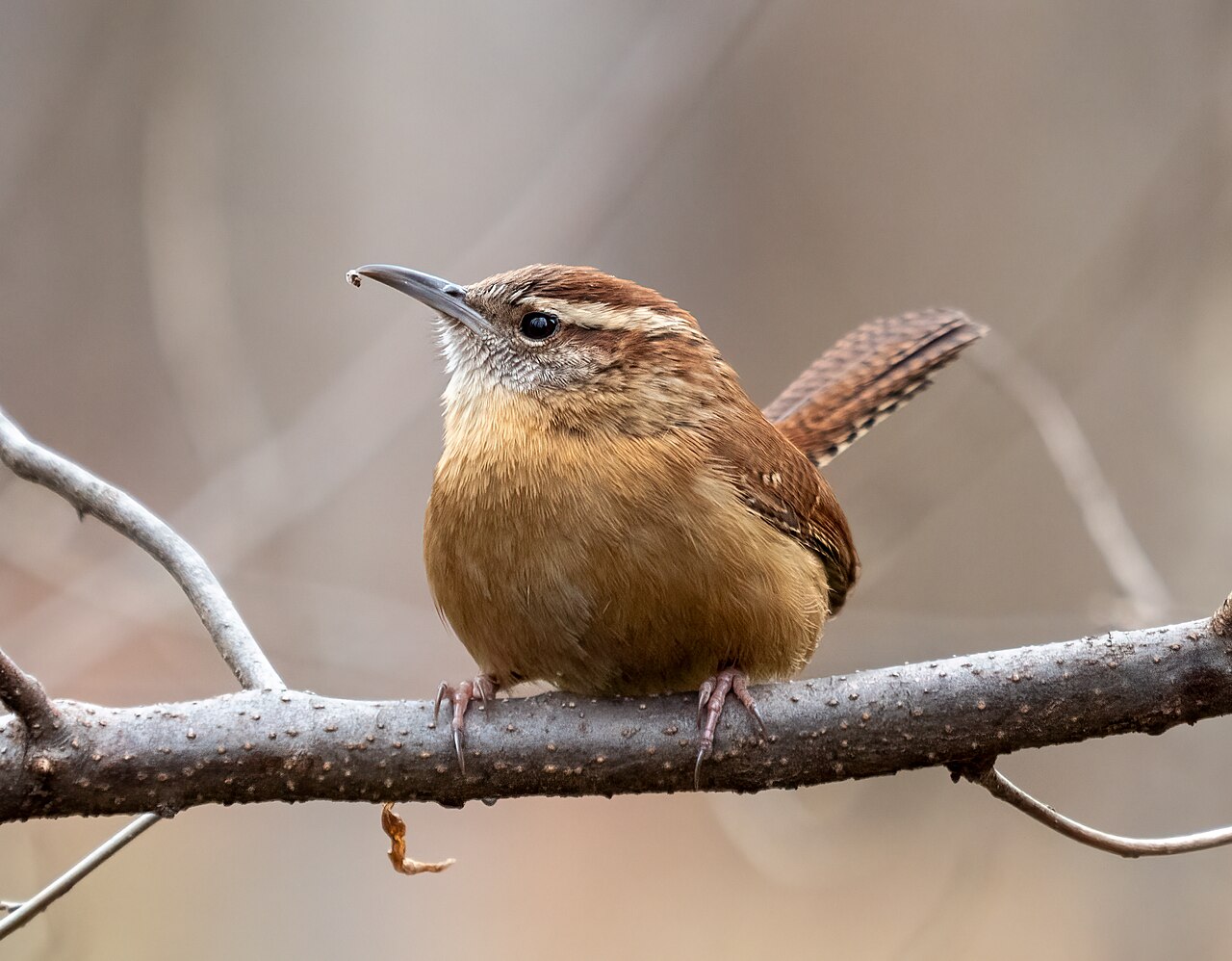
Rusty brown above, warm buff to cinnamon below, with a white throat and a broad white eyebrow running from the bill back into the nape. The bill is long and slightly decurved; the tail is long, finely barred black and usually carried at an angle above the back, but held straight down while singing. The wings carry the same fine dark barring, and the undertail coverts are barred black and white. Male and female are alike; juveniles are duller, with a less sharply drawn eyebrow and a greyer throat. At twelve to fourteen centimetres and close to twenty grams it is nearly twice the weight of the house wren.
Confusion species
Northern House Wren (Troglodytes aedon) is smaller, grey-brown instead of rusty, and has at most a faint line over the eye where Carolina Wren carries a broad white band. Bewick's Wren (Thryomanes bewickii) also has a white eyebrow, but is grey below rather than buff and has white corners to the tail, which it swings from side to side. Wrentit of the west coast cocks its tail in the same way but is plain brown-grey without an eyebrow, and the two ranges nowhere meet. A phrase that sounds too loud for the thicket it comes out of is, in the east, almost always this species.
Habitat
Dense thicket with clutter on the ground: brambles, fallen trunks, brush piles, ivy against a wall, the overgrown back corner of a garden. It stays lower than any other songbird of the deciduous wood and rarely rises above head height except to sing. In the south it goes into cypress and gum swamp forest and into the dense lower layer of bottomland woods. It does not use open farmland or closed high forest without an understorey. It nests in almost any cavity: a stump, a mailbox, a boot on a porch, a flowerpot in a shed.
Where the bird is most often found, arranged by the USNVC — the vegetation classification of the United States and Canada — and CMECS for sea and coast.





Range and movements
Resident across the eastern United States, from southern Ontario and New England to Florida and the Gulf coast, west into Texas and eastern Kansas and Nebraska, and south along the eastern slope of Mexico to Veracruz and Oaxaca. It does not migrate: most birds spend their lives within a few hundred metres of where they fledged. The northern limit moved far north during the twentieth century, into Maine, Vermont and Michigan, but falls back after every winter with long-lying snow, to be retaken within a few years. The birds of Yucatán, Belize and Guatemala, which have a narrower white eyebrow, are treated in some lists as a separate species.
- Resident
- Breeding (summer)
- Winter
- Passage
- dark = core range, pale = thinly spread
Where and when to look
Walk a woodland edge with plenty of dead wood in February or March and wait for the phrase: it is in full song while most other songbirds are still silent. If nothing comes, make a soft hissing sound through your teeth — it approaches that sound more readily than almost any other bird, and the female often answers with her rattle before you see the singer at all. Look low: at eye level and below, in the darkest corner of the tangle.
Conservation
Not threatened (LC) on the Red List. The North American Breeding Bird Survey has shown an increase since 1966, and the range has expanded northward over the same period. Mortality in severe winters is the main brake: after the winters of 1977 and 1978 it disappeared from large parts of the northeast, and numbers took about ten years to return. Clearing dead wood and brush piles takes away its nest sites and its cover.
Scientific name
Thryothorus ludovicianus | (Latham, 1790)
Latham described the species in 1790 as Sylvia ludoviciana, among the warblers; because it was later placed in another genus, author and year stand in parentheses. The genus Thryothorus was introduced by Vieillot in 1816 and is built from Greek thryon, 'reed', and thouros, 'rushing': the bird that storms through the reeds. ludovicianus means 'of Louisiana', from the Latin form of the name Louis. The type locality is Louisiana, which in 1790 denoted a territory covering the whole Mississippi basin.