All species › Passerines › Wrens › Cactus Wren
Cactus Wren | Campylorhynchus brunneicapillus
Cactuswinterkoning | Cucarachero desértico
At eighteen to nineteen centimetres the Cactus Wren is the largest wren in the United States, and with its coarse spotting and broad white eyebrow it suggests a thrasher more than a wren. It builds football-shaped nests in cholla and saguaro (the giant columnar cactus of the Sonoran Desert), and is the state bird of Arizona.

Voice
The call is a harsh, rasping series of char-char-char notes on almost one pitch, rising in volume and pace; birdwatchers sometimes liken it to a car that will not start. The male sings from a high perch, often before dawn. Besides this main call at least eight other sounds are described, including a scraping rack as an alarm and soft contact notes between partners. Calling goes on all year.
Recording: Pat Goltz — CC BY-NC-SA 4.0 · Tucson, Pima County, Arizona, United States · xeno-canto
Identification
Large and long-tailed, brown above with dense black and white streaking on back and wings. A broad white eyebrow runs from the bill onto the nape and separates the brown crown from the dark eyeline. The breast is white with a dense concentration of black spots, grading on flanks and belly into cinnamon-buff with scattered dots. The tail is long, barred black and spread wide when foraging on the ground. The sexes are alike; juveniles are paler and have muddy grey eyes against the red-brown eye of the adult.
Confusion species
No other wren in the region is this large or this coarsely spotted. Curve-billed and Bendire's Thrashers of the same desert scrub are markedly bigger and lack the white eyebrow; Curve-billed Thrasher has a longer, strongly curved bill, while Bendire's Thrasher has a shorter, straighter bill, and both have a plain or more finely streaked breast. Brown Thrasher is rufous and unmarked above. Bewick's Wren and Rock Wren are far smaller and lack the dense black breast spotting. The rasping call alone rules out every other wren.
Habitat
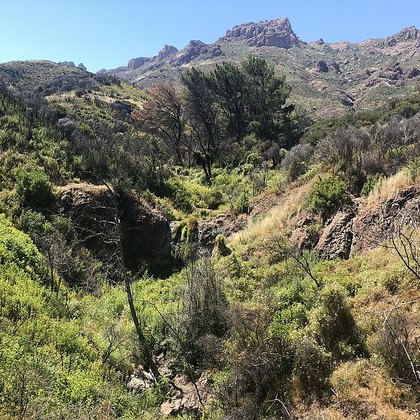
Arid and semi-arid country with spiny cacti: the Sonoran and Chihuahuan Deserts with cholla, prickly pear, saguaro, yucca, mesquite (a thorny pod-bearing shrub of the Southwest that forms dense thickets) and acacia, and on the Californian coast coastal sage scrub and prickly pear. The species does not migrate and holds a territory of roughly 1.3 to 1.9 hectares all year. Parks, gardens and suburbs with planted cactus are occupied too. The nest is an elongated ball of grass, twigs and feathers with a tubular entrance about fifteen centimetres long, usually a metre up in a cholla or prickly pear; nests are built all year, including for roosting, and juveniles begin imitative building within two weeks of fledging.
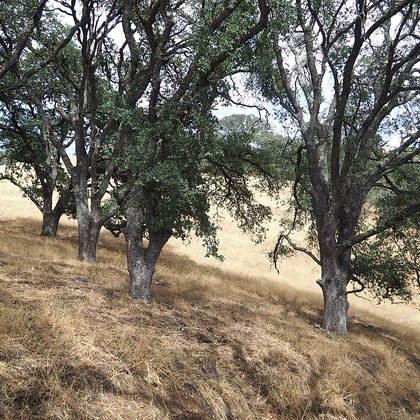
Where the bird is most often found, arranged by the USNVC — the vegetation classification of the United States and Canada — and CMECS for sea and coast.




Range and movements
Resident in southern California, southern Nevada, southwestern Utah, Arizona, New Mexico and West Texas, south over both Baja peninsulas and through northern and central Mexico to about Hidalgo, Querétaro and Michoacán. Drinking water is not needed: moisture comes from insects and fruit. The coastal form of southern California, sandiegensis, lives in a fragmented range separated from the desert population.
- Resident
- Breeding (summer)
- Winter
- Passage
- dark = core range, pale = thinly spread
Where and when to look
Look for it early in the morning on the top of a cholla or a mesquite (a thorny pod-bearing shrub of the Southwest that forms dense thickets) along a desert trail: it perches high and open and calls for long stretches. Outside those hours the nests give it away — the elongated balls in the cactus are visible all year and mark an occupied territory, even while the bird itself forages on the ground among the scrub.
Conservation
Partners in Flight puts the global breeding population at 8.5 million birds; the Continental Concern Score is 12 out of 20. The Breeding Bird Survey shows a decline of about 1.3 per cent per year between 1966 and 2019, some fifty per cent in total, steepest in Texas, Arizona and California; the species is listed as a Common Bird in Steep Decline. Urban and agricultural expansion costs habitat where cacti and desert shrubs are removed altogether. The coastal form sandiegensis is a California Species of Special Concern; fragmentation and fire in the coastal sage scrub are the pressures there.
Scientific name
Campylorhynchus brunneicapillus | (de Lafresnaye, 1835)
Frédéric de Lafresnaye described the species in 1835 as Picolaptes brunneicapillus; because it later moved to another genus, author and year stand in parentheses. He gave California as the type locality, which was an error: Bangs designated the coastal region of southern Sonora in 1930. Johann Baptist von Spix introduced the genus Campylorhynchus in 1824, from Greek kampylos 'curved' and rhunkhos 'bill'. The species name is Latin, from brunneus 'brown' and capillus 'hair of the head', thus 'brown-crowned'.