All species › Waterfowl › Ducks, swans and geese › Black-bellied Whistling-Duck
Black-bellied Whistling-Duck | Dendrocygna autumnalis
Zwartbuikfluiteend | Suirirí piquirrojo
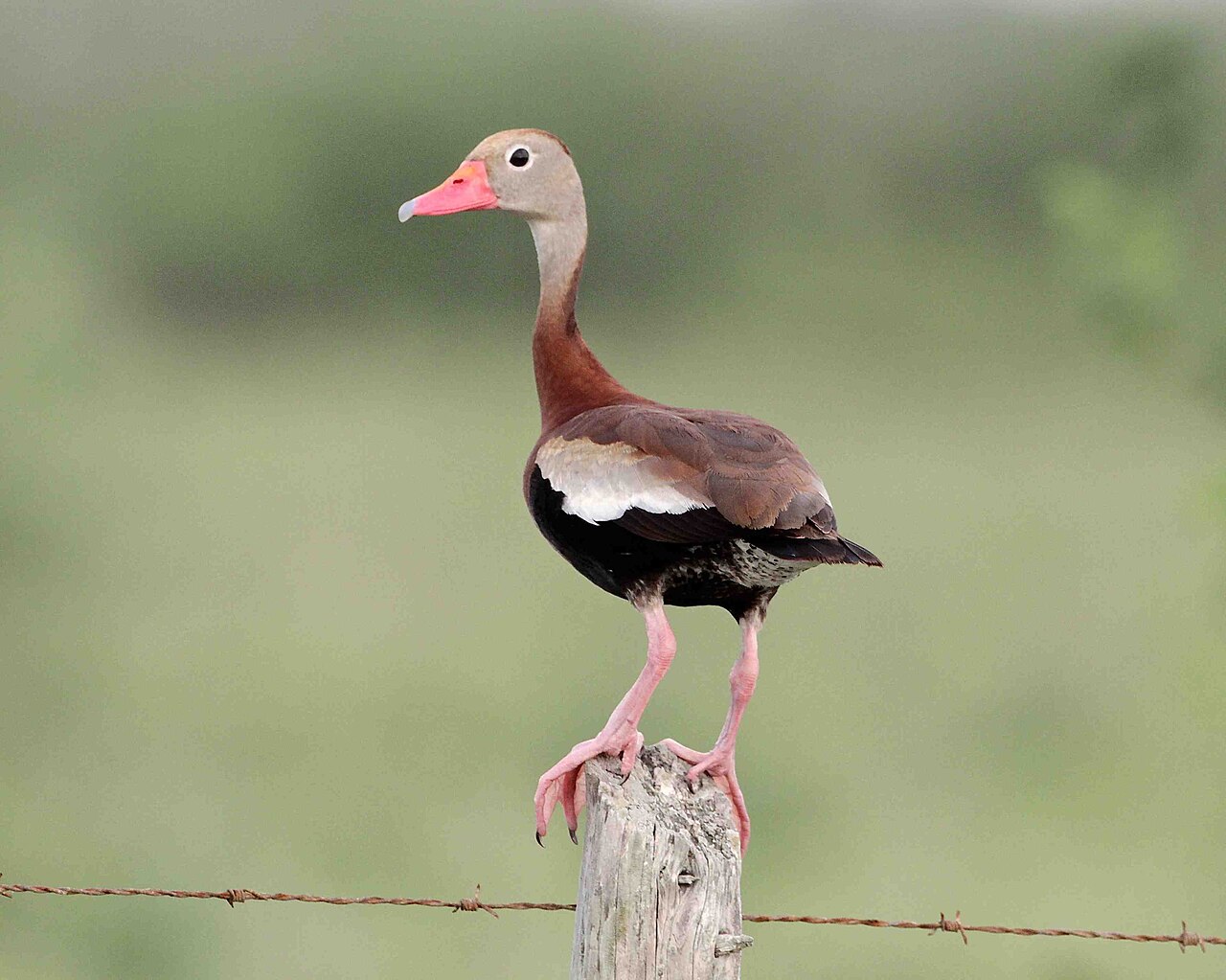
The Black-bellied Whistling-Duck pairs a long, bright pink bill and a grey face with a chestnut breast and a black belly — a pattern no other duck in this region shares. It stands on long pink legs, perches and nests in trees, traits that recall a goose more than a duck. Since the mid-twentieth century its range within the United States has expanded greatly, from the southern tip of Texas far to the north and east.
Voice
The call is a soft, high whistle with a long first note followed by a series of shorter ones: whee-chi-chi-chi. It carries in flight as well as while standing or swimming, and often gives the bird away before it is seen — especially at night, when flocks call as they move between roost and feeding grounds. In flight a drier chit-chit-chit is added, and a short yip on takeoff. Both sexes call equally; there is no silent sex as in most ducks.
Recording: Peter Mundale — CC BY-NC-SA 4.0 · South Padre Is, Birding and Nature Center, Cameron County, Texas, United States · xeno-canto
Identification
Male and female look alike: a grey face and a long, bright pink bill above a chestnut breast and back, with an entirely black belly and black tail. In flight the wing shows a broad white band across mostly black flight feathers, one of the clearest marks of the species. The legs are long and pink and project well beyond the tail in flight — only Fulvous Whistling-Duck shares that silhouette. Juveniles are duller, with a grey rather than pink bill and a pale brown rather than black belly, so the contrast between upperparts and underparts is far less marked than in the adult. The body is carried longer and more upright than in most ducks, on a long neck that suggests a small goose.
Confusion species
Fulvous Whistling-Duck (Dendrocygna bicolor) is the region's other whistling-duck and shares much of its habitat: it lacks the grey face and black belly entirely, is uniformly cinnamon over the whole body with a dark rather than pink bill and legs, and shows a white band across the rump in flight instead of across the wing. Young Black-bellied Whistling-Ducks are trickier: they lack the adult's black belly, but the grey face and the white wing band in flight still separate them from a Fulvous. Muscovy Duck, which occurs feral across parts of the same range, is far bulkier and heavier-built, with a bare, swollen face and none of the long pink legs.
Habitat
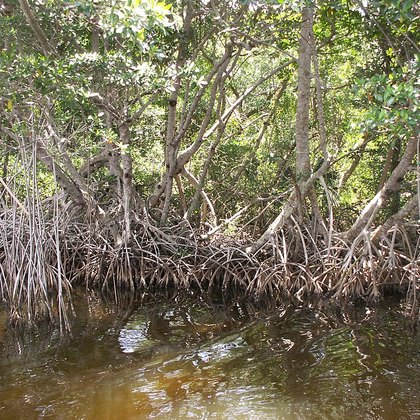
It seeks shallow fresh water with aquatic plants — ponds, ditches and small lakes with water hyacinth or cattail — alongside open grass and cropland where it forages at night on corn, rice and sorghum. For a nest cavity it depends on mature trees — mesquite (a thorny pod-bearing shrub of the Southwest that forms dense thickets), hackberry, willow and live oak along the water — or nest boxes where these are put up. City lawns, golf courses and park ponds serve it as readily as natural marsh, so long as cover and a nearby tree are present. It avoids closed, treeless farmland without open water, and in the south of its range it also uses mangroves and lagoons.
Where the bird is most often found, arranged by the USNVC — the vegetation classification of the United States and Canada — and CMECS for sea and coast.




Range and movements
Resident from the southern tip of Texas and from Florida deep into Mexico, Central America and South America as far as Ecuador, Peru and northern Argentina; in Louisiana and southeastern Arizona it breeds mainly in summer. During the twentieth century it was confined in the United States to the extreme southern edge of Texas; since then it has spread gradually north and east, aided by warmer winters, stock ponds and nest-box programmes, with a self-sustaining population established in Florida since the 1950s. Two subspecies are recognised: the larger, brown-breasted Dendrocygna autumnalis fulgens from southeastern Texas to Panama, and the smaller, grey-breasted Dendrocygna autumnalis autumnalis farther south, the two intergrading in Panama. Farther north still, into most inland states, it now also turns up as an irregular vagrant.
- Resident
- Breeding (summer)
- Winter
- Passage
- dark = core range, pale = thinly spread
Where and when to look
Look for it at sunset on a golf-course or park pond in south Texas: flocks gather there calling before setting off for the feeding grounds, and the whistle carries far over open water. By day the birds often sit still in waterside trees or on a fence or power line, something no other duck does so readily.
Conservation
Least Concern (LC) and increasing: the global breeding population is estimated at about one million birds, growing by more than six per cent a year since 1966. Nest boxes, stock ponds and golf-course ponds have on balance helped rather than harmed the species. The main losses fall at the nest and the duckling stage: raccoons and snakes take eggs, and fire ants and fish take young.
Scientific name
Dendrocygna autumnalis | (Linnaeus, 1758)
Linnaeus described the species in 1758 as Anas autumnalis, among the ducks in the broad sense he then used, giving simply 'America' as the locality; because it was later placed in another genus, author and year stand in parentheses. The genus Dendrocygna was introduced in 1837 by William Swainson for the whistling-ducks, from Greek dendron, 'tree', and Latin cygnus, 'swan' — 'tree swan', after their habit of perching in trees and the long neck and legs that recall a swan or goose more than a duck. autumnalis is Latin for 'autumnal', after the season of the type material.