All species › Waterfowl › Ducks, swans and geese › Fulvous Whistling-Duck
Fulvous Whistling-Duck | Dendrocygna bicolor
Rosse fluiteend | Suirirí bicolor
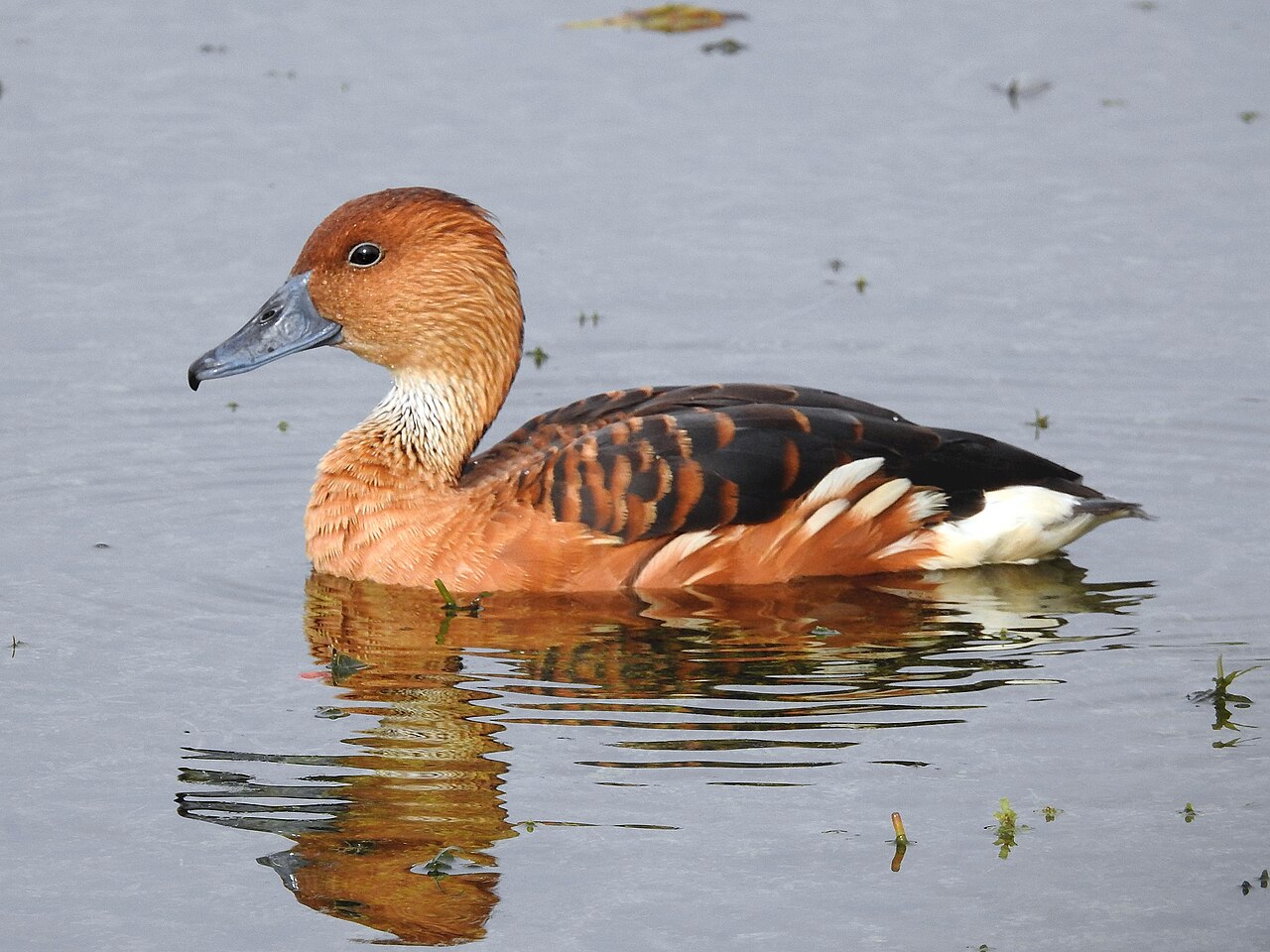
Fulvous Whistling-Duck is a duck with almost no pattern to its body: uniformly cinnamon all over, broken only by a white flank stripe and a white band across the rump. On long grey legs it wades and swims in shallow, densely vegetated water, and its whistled call carries far across rice fields and marsh at night. Of all the ducks on this continent it shows the most erratic movements: flocks can shift hundreds of kilometres within a single season, far outside the breeding range.
Voice
The call is a clear, two-note whistle, kee-wee-ooo, given from the ground, while swimming or in flight, and often heard specifically at night. Birds in dispute give a harsher, repeated kee. The wings make a dull, humming sound in flight, distinct from the sharper wingbeat of Black-bellied Whistling-Duck. A calling flock over a rice field in the dark is for many people the first encounter with the species, long before anything is seen.
No freely licensed recording has been found for this species yet; what to listen for is described below.
Identification
The whole body is cinnamon to reddish-brown, with a dark stripe over the crown and down the back of the neck and a blackish back scaled with chestnut. The flanks carry long, creamy-white stripes, and in flight a white band across the rump stands out sharply against the black tail. Bill and legs are grey, not pink as in Black-bellied Whistling-Duck, and the legs are somewhat shorter, projecting less far beyond the tail in flight. The female is slightly duller and carries more black on crown and hindneck than the male; juveniles are paler below and lack the adult's sharp contrast.
Confusion species
Black-bellied Whistling-Duck (Dendrocygna autumnalis) is the main confusion species: it has a grey face, a bright pink bill and legs, and a black rather than cinnamon belly, and shows white on the wing in flight rather than on the rump. Young Black-bellied Whistling-Ducks lack the black belly and can superficially resemble a Fulvous, but their grey bill and the absence of white flank stripes still set them apart. A Mallard or Gadwall in eclipse plumage can look briefly cinnamon-toned from a distance, but lacks the long neck, long legs and white rump band of a whistling-duck entirely.
Habitat
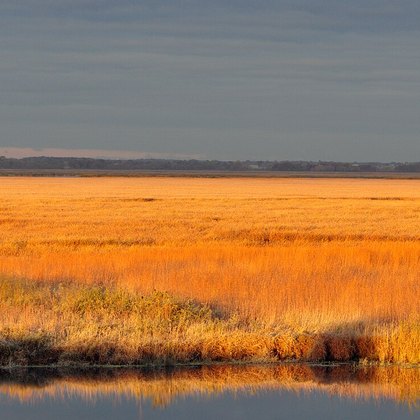
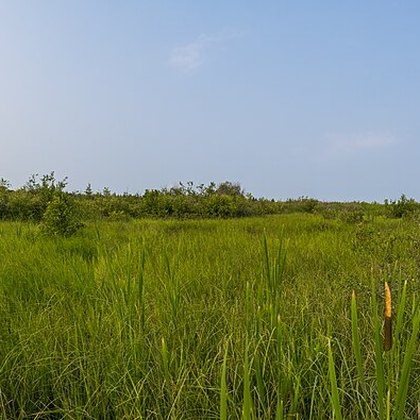
It seeks shallow fresh water with dense vegetation: flooded rice fields are the primary habitat in Texas and Louisiana, supplemented by marsh, wet meadow and shallow ponds. Unlike Black-bellied Whistling-Duck it rarely nests in a tree cavity; the nest is a woven platform of bent stalks, built on floating vegetation or among reeds and rushes, with water directly beneath. It does not use closed forest, and on migration to Mexico it gathers in coastal lagoons before moving on or moulting.
Where the bird is most often found, arranged by the USNVC — the vegetation classification of the United States and Canada — and CMECS for sea and coast.



Range and movements
Breeds along the coastal strip of Texas and Louisiana and, since the 1960s, in Florida southeast of Lake Okeechobee; most birds move on after breeding to Mexico, where they moult and winter, and the Florida population winters partly in Cuba. In Mexico, Central America and parts of South America the species is largely resident. Remarkably, the same species — quite apart from the American population — also occurs in eastern Africa, Madagascar and southern Asia, a distribution shared by no other duck on this continent. In California it once bred in numbers through the Central Valley and at the Salton Sea; since the 1990s that has dwindled to a single pair in some years, and the species now occurs there only irregularly.
- Resident
- Breeding (summer)
- Winter
- Passage
- dark = core range, pale = thinly spread
Where and when to look
Check flooded rice fields west of Houston or at Anahuac in late summer, toward evening: flocks are often first known by their call rising above the tall crop, before a bird is seen. Patient listening pays off here more than scanning with binoculars.
Conservation
The global breeding population is estimated at 1.4 million birds and was broadly stable to slightly increasing between 1966 and 2015, though a Southern California population disappeared almost entirely over the same period. Drainage, channelisation and development of wetlands are the main threat, and agricultural pesticides have caused sharp local declines in the past. Hunting is permitted worldwide; its effect on the population is not well known.
Scientific name
Dendrocygna bicolor | (Vieillot, 1816)
Vieillot described the species in 1816 as Anas bicolor, with Paraguay as the locality; because it was later placed in another genus, author and year stand in parentheses. The genus Dendrocygna was introduced in 1837 by William Swainson for the whistling-ducks, from Greek dendron, 'tree', and cygnus, 'swan' — 'tree swan'. bicolor is Latin for 'two-coloured', after the contrast between the cinnamon underparts and the dark, chestnut-scaled back; the same colour also gives Latin fulvus, 'tawny', which the English name Fulvous Whistling-Duck refers to.