All species › Passerines › Tits, chickadees and titmice › Black-capped Chickadee
Black-capped Chickadee | Poecile atricapillus
Amerikaanse matkop | Carbonero cabecinegro
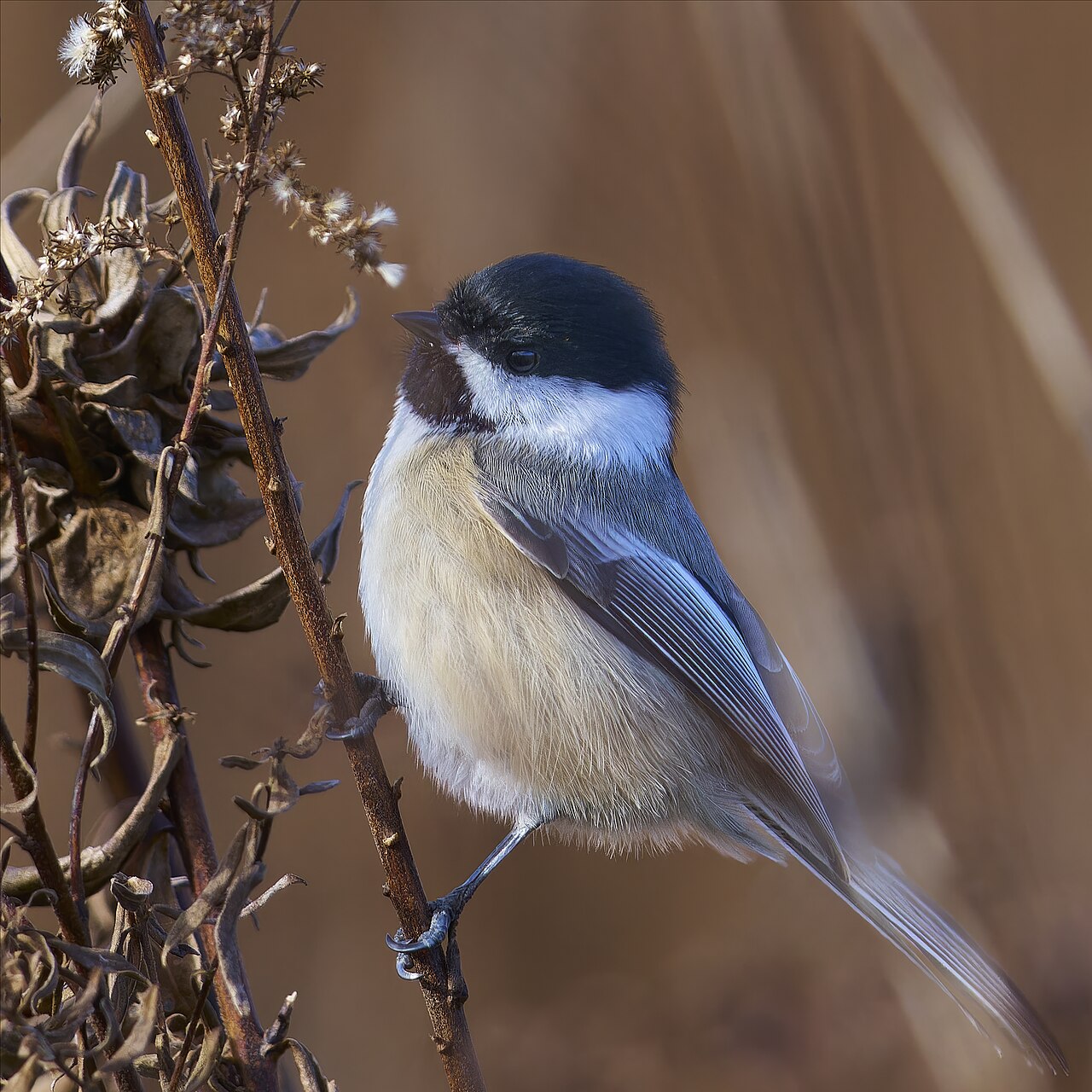
The Black-capped Chickadee is the fixture at every feeder north of the fortieth parallel: a small, round bird with a black cap and black bib, unfazed by almost anything. Its memory has been studied in detail — it hides thousands of seeds across its territory and can still recall the locations weeks later.
Voice
The song is a clear, descending two- or three-note whistle, fee-bee or fee-bee-ee, already heard in late winter. The call gives the whole family its name: a nasal chick-a-dee-dee-dee, in which the number of dee notes rises with how close or dangerous a predator is. Research on precisely this call gave the first hard evidence that birds encode specific information in an alarm call, not just intensity.
Recording: Jim Berry — CC BY-NC-SA 4.0 · City of Jamestown, Chautauqua County, New York, United States · xeno-canto
Identification
A small, compact bird with a large head, a short neck and a relatively long tail. Cap and bib are deep black, the cheeks sharply white, the back grey-brown and the flanks faintly buffy; males and females look alike. Juveniles resemble the adults from their first weeks, at most with a slightly softer black. In flight it shows short, quick wingbeats alternating with glides, low between the shrubs.
Confusion species
Along a narrow band of overlap, from New Jersey to Kansas, it meets the nearly identical Carolina Chickadee (Poecile carolinensis); there the only reliable difference is a slightly slower, less crisply defined song, and the two species even hybridise in the zone. Outside that band, the southern edge of the range is a more reliable guide than plumage. The Boreal Chickadee of the northern conifer forests is rustier on cap and flanks and lacks the sharp white cheek. Young birds of both species are harder to separate still than the adults.
Habitat
Mixed and deciduous woodland, forest edges, willow and alder thickets along water, and year-round gardens and parks with a feeder. It avoids unbroken dark conifer forest, the domain of the related Boreal Chickadee, and fully open, treeless country. In winter it roams in mixed foraging flocks with titmice, nuthatches and kinglets, which take its sharp alarm call as their first warning.
Where the bird is most often found, arranged by the USNVC — the vegetation classification of the United States and Canada — and CMECS for sea and coast.





Range and movements
Resident right across the continent, from Alaska to Newfoundland and south into the middle tier of the United States, without migrating, though young birds disperse farther in good years. The southern edge of its range follows roughly the same latitude everywhere, which researchers link to its tolerance of extreme cold. In recent decades that edge has shifted slightly north in places, where the more southerly Carolina Chickadee gains ground.
- Resident
- Breeding (summer)
- Winter
- Passage
- dark = core range, pale = thinly spread
Where and when to look
Whistle a fee-bee yourself at the edge of a winter wood, and within minutes a small group will almost certainly come to investigate. In autumn, watch for the mixed foraging flocks moving tree to tree — where chickadees gather, a handful of other species often travels with them.
Conservation
Common and stable, with a population in the tens of millions; the species benefits from feeders and is not threatened (LC). Cold, dry winters suit it better than mild, wet ones, which can spoil its stored seed.
Scientific name
Poecile atricapillus | (Linnaeus, 1766)
Linnaeus described the species in 1766 as Parus atricapillus, among the tits; it has since been moved to another genus, so author and year stand in parentheses. The genus Poecile was introduced by Kaup in 1829, from the Greek poikilos, 'many-coloured' — a name Aristotle originally used for a small bird. atricapillus is Latin for 'black-haired', for the black cap. The type locality was first given simply as 'Canada', later restricted to Quebec City.