All species › Gamebirds › Partridges, pheasants, grouse and allies › Black Francolin
Black Francolin | Francolinus francolinus
Zwarte frankolijn | Francolín ventrinegro
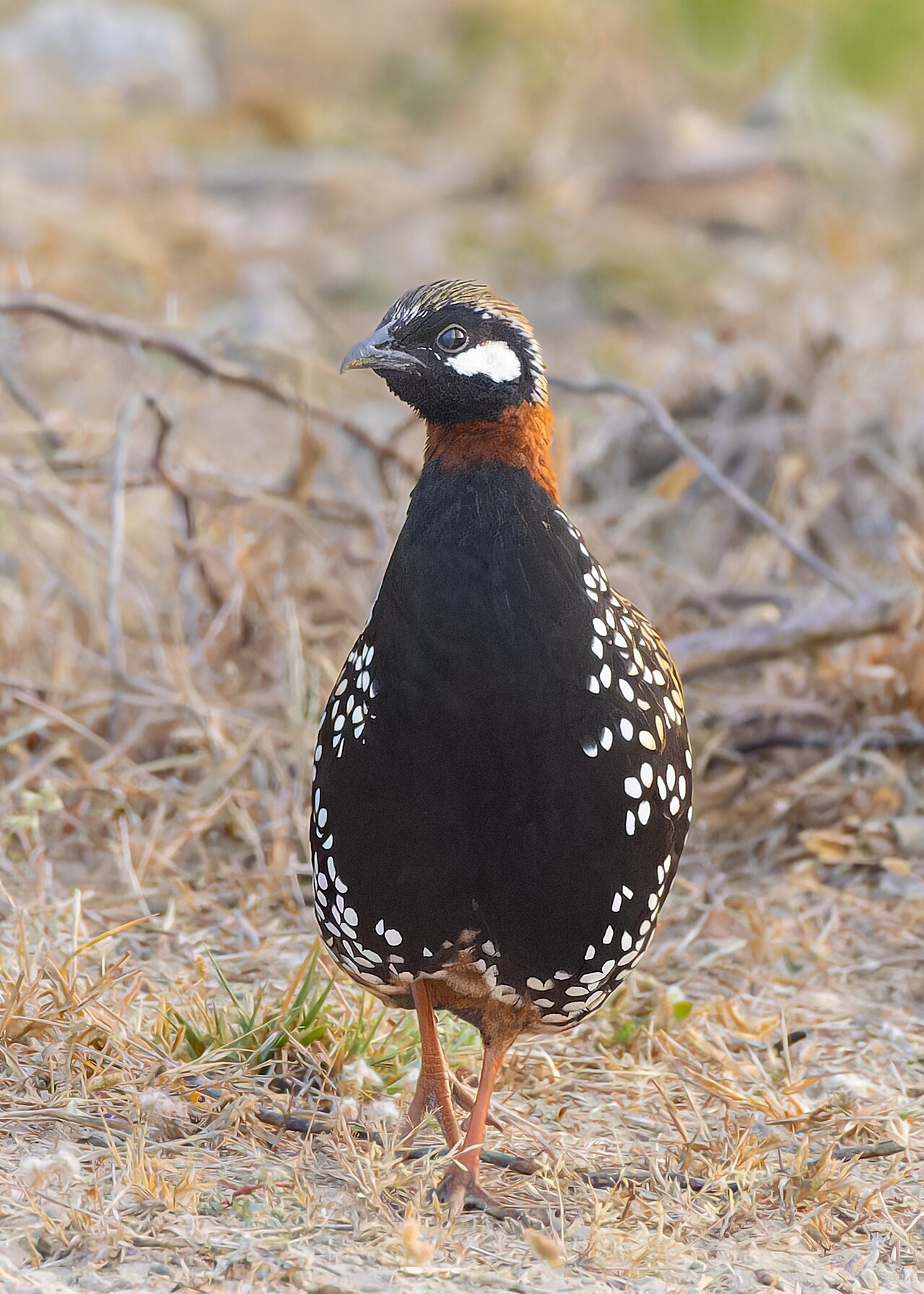
Black Francolin is a stocky gamebird that rarely shows its plumage: the male carries an almost entirely black breast dotted with white spots and a chestnut collar, but stays hidden in dense grass until his call gives him away. In North America the species occurs only as a released bird and has become established only on Hawaii; earlier populations in Louisiana and Florida have since disappeared. It originally ranges from Cyprus to north-eastern India, where it has been kept as a gamebird for centuries.
Voice
The male's call is how most birders find him, since seeing one rarely happens: a single sharp, metallic note followed by a short pause and then a series of four or five raspy, rattling notes — roughly tik... krek-krek-krek-krek. He usually calls from a slight rise at the edge of the grass, early in the morning and again towards sunset, repeating the sequence for minutes at a time. In flight the wings make a loud whirring sound that alone signals a francolin has been flushed. Outside these bouts he is largely silent.
Recording: Gary Elton — CC BY-NC-SA 4.0 · Akrotiri, Limassol, Cyprus · xeno-canto
Identification
The male is distinctive among North American gamebirds: head, neck and breast are almost solid black, broken by a broad chestnut collar and sharp white spots on the flanks, with a gold-and-black patterned back and a tail finely barred like a zebra's. The female is far plainer, warm brown with dense, fine black-and-white markings over the whole body, a small orange patch on the nape and a touch of chestnut. Both sexes share the round, compact shape and short tail of a gamebird, sized between a California Quail and a Ring-necked Pheasant. Young birds resemble the female but are duller and less sharply marked. On the ground he moves with his head low among the grass, and only flushes with a short, whirring burst when danger is close.
Confusion species
On Hawaii he shares the ground with Gray Francolin (Ortygornis pondicerianus), which is uniformly grey-brown and scaled and entirely lacks the male's black-and-white pattern. Chukar is larger and plain grey-brown with a sharp black necklace around a white throat and a red bill, instead of the black head and white spotting of Black Francolin. The female Ring-necked Pheasant (Phasianus colchicus) is markedly bigger, with a much longer pointed tail and plainer, less sharply black-and-white plumage. In Florida and Louisiana he is the only gamebird with this pattern, and confusion comes mainly from the bird's own shyness, since he rarely shows himself.
Habitat
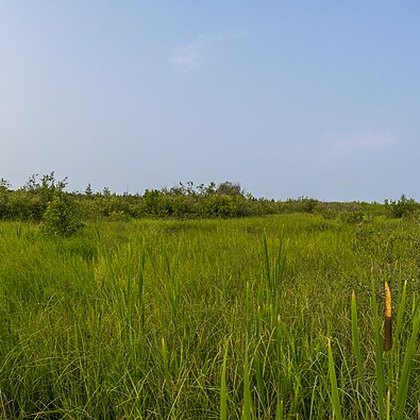
He seeks open grassland and low scrub with enough cover to hide in, often close to fields, sugarcane or irrigation canals. On Hawaii that means dry pasture and thorny kiawe (Prosopis pallida, an introduced South American thorn shrub) scrub on the lower slopes; in Louisiana and Florida it means damp grassland and the rough edges of rice fields and cattle pasture. He avoids both dense forest and bare, unvegetated ground. Water need not be present year-round, but he is rarely found far from a ditch, canal or damp hollow.
Where the bird is most often found, arranged by the USNVC — the vegetation classification of the United States and Canada — and CMECS for sea and coast.




Range and movements
In North America Black Francolin is an introduced species with a small, scattered range: resident on the islands of Hawaii, Maui, Molokaʻi and Kauaʻi, where he has been released as a gamebird since 1959. Following introductions from the 1960s onwards, small populations also arose in south-western Louisiana and in Florida, but these have since disappeared. The species originally occurs from Cyprus and the eastern Mediterranean through the Middle East to Pakistan, India and Myanmar. He does not migrate and barely disperses on his own, so every North American population stays confined to the ground where it was once released.
- Resident
Where and when to look
Look for him early in the morning along the edge of open grassland on Hawaii, where the male calls from a slight rise before the heat of the day sets in; following the call gives better odds than searching on foot. In Florida and Louisiana patience is needed: the small populations are scarce and wary, and a bird walking off through the grass is more often the day's only sighting than one that lingers in view.
Conservation
Worldwide Black Francolin is listed as Least Concern (LC), with a wide range across Asia. The North American populations are small and entirely dependent on the original releases: on Hawaii the species holds its own well, whereas the populations in Louisiana and Florida have since disappeared. He is hunted locally as a gamebird, which does not appear to threaten numbers as long as habitat remains.
Scientific name
Francolinus francolinus | (Linnaeus, 1766)
Linnaeus described the species in 1766 as Tetrao Francolinus, among the grouse; because it was later moved to another genus, author and year stand in parentheses. The genus Francolinus goes back to Italian francolino, used by medieval hunters for a prized gamebird; the origin of that word itself is uncertain. The specific name repeats the genus name. The type locality has been restricted to Cyprus, though Linnaeus himself gave no exact place.