All species › Passerines › Finches, euphonias and allies › Black Rosy-Finch
Black Rosy-Finch | Leucosticte atrata
Zwarte bergvink | Pinzón montano negro
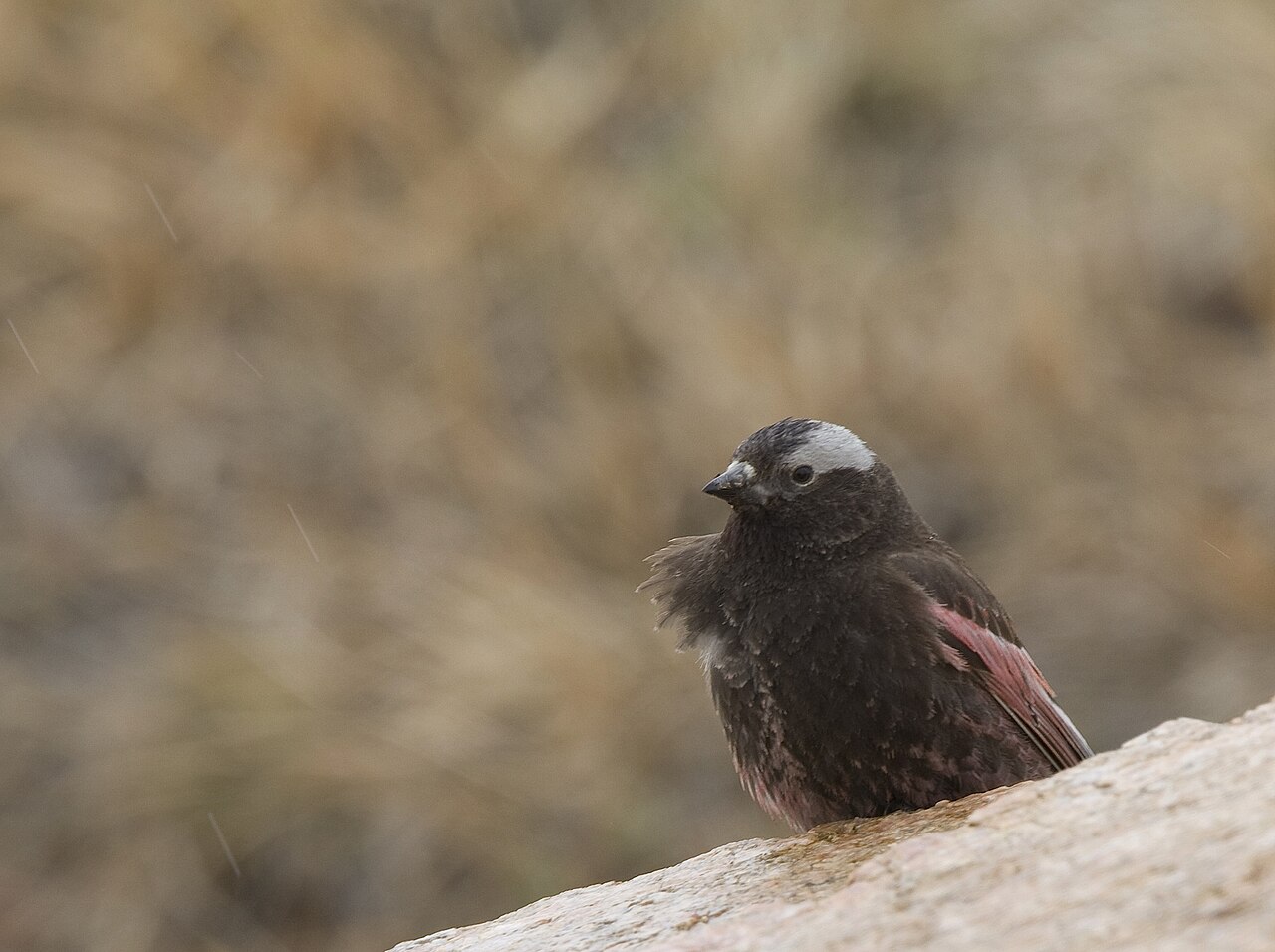
The Black Rosy-Finch is the darkest of the three North American rosy-finches: black on head, back and breast, with a grey band across the hindcrown and pink on belly, rump and wings. It breeds on bare summits and talus slopes of the northern Great Basin and the adjoining Rocky Mountains, from northeastern Nevada to southwestern Montana.
Voice
The voice is limited to a low, somewhat husky chew, repeated in flight and merging into an unbroken murmur from a flock. The song is no more than a slower, even series of those same call notes, without fixed build-up, given from a rock or during a short flight over the snowfield. The call cannot be told in the field from that of the other two rosy-finches, so a mixed winter flock can only be sorted out by eye.
Recording: Bill Pyle — CC BY-NC-SA 4.0 · Steens Mountain, East Rim Overlook, Harney Co., Oregon, United States · xeno-canto
Identification
A stocky finch with a long, forked tail and short black legs. The male has a black head, back and breast, a black forecrown and behind it a silver-grey band across the hindcrown, with pink on belly, rump, wing bend and tail base. The female is the same bird in a greyer, duller suit, with far less pink. The bill is yellow in winter and black in the breeding season. In flight the pink in the wing stands out against the otherwise almost uniformly dark body.
Confusion species
Gray-crowned Rosy-Finch, with which it shares winter flocks, has the same grey hindcrown but a clearly brown back and breast; the difference lies in the body, not the head. Brown-capped Rosy-Finch is brown and lacks the grey band on the hindcrown. Against the light all three look dark: wait for a bird that turns, and then judge whether the back reads black or brown. A stray dark finch with a pink wing in the breeding range is almost always this species, since the other two hardly breed there.
Habitat
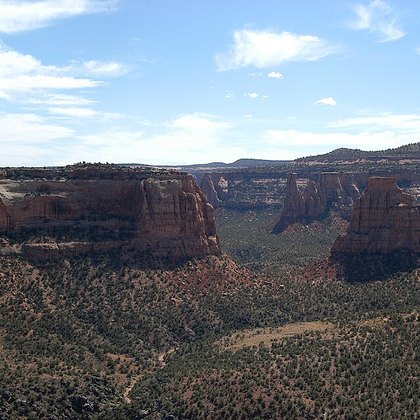
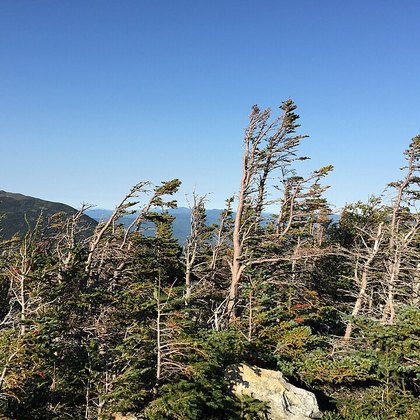
Alpine tundra, rock rubble, cliffs and snowfields above treeline, usually above 3000 metres, where it picks insects off the snow and takes seeds of alpine herbs. Nesting is in crevices of rock faces and in old mine adits and buildings. In winter it drops to the high valleys, open pasture and roadsides, often in large flocks, and then visits feeders at ski villages.
Where the bird is most often found, arranged by the USNVC — the vegetation classification of the United States and Canada — and CMECS for sea and coast.




Range and movements
The breeding range lies on the high ranges of the northern Great Basin and the adjoining Rockies: from northeastern Nevada through Utah, Idaho and western Wyoming to southwestern Montana, with an outpost in eastern Oregon. In winter the species leaves the summits and gathers in the valleys of the same area, with an extension to Colorado, northern New Mexico and northern Arizona, where the flocks mix with the other two rosy-finches. The range is small and hard to follow because the birds shift locations from winter to winter.
- Resident
- Breeding (summer)
- Winter
- dark = core range, pale = thinly spread
Where and when to look
From December to March the feeders in the Wasatch above Salt Lake City and at Sandia Crest in New Mexico give the best chance; there all three rosy-finches often occur in one flock and can be compared at close range. In summer the species asks for a climb above 3000 metres: look along the edge of a melting snowfield in the Ruby Mountains or on the Beartooth Plateau.
Conservation
The species is listed as Endangered (EN) on the Red List. The population is put at roughly 120,000 birds, but that estimate rests on few data: the breeding range lies above treeline, outside all roadside surveys, and in winter the birds wander. The range consists of separate mountaintops that cannot move upward as the climate warms; models foresee a strong contraction of suitable alpine ground. Winter counts and banding at feeders are the main source from which the trend is inferred.
Scientific name
Leucosticte atrata | Ridgway, 1874
Ridgway described the species in 1874 from a specimen from Canon City, Colorado, directly in the genus Leucosticte; author and year therefore stand without parentheses. Leucosticte comes from Greek leukos 'white' and stiktos 'speckled'. The species name atrata is Latin for 'clothed in black', beside ater 'black', after the male's plumage. Between 1983 and 1993 it was treated together with the Gray-crowned and Brown-capped Rosy-Finches as a single species; since then they again count as three.