All species › Passerines › Finches, euphonias and allies › Gray-crowned Rosy-Finch
Gray-crowned Rosy-Finch | Leucosticte tephrocotis
Grijskruinbergvink | Pinzón montano nuquigrís
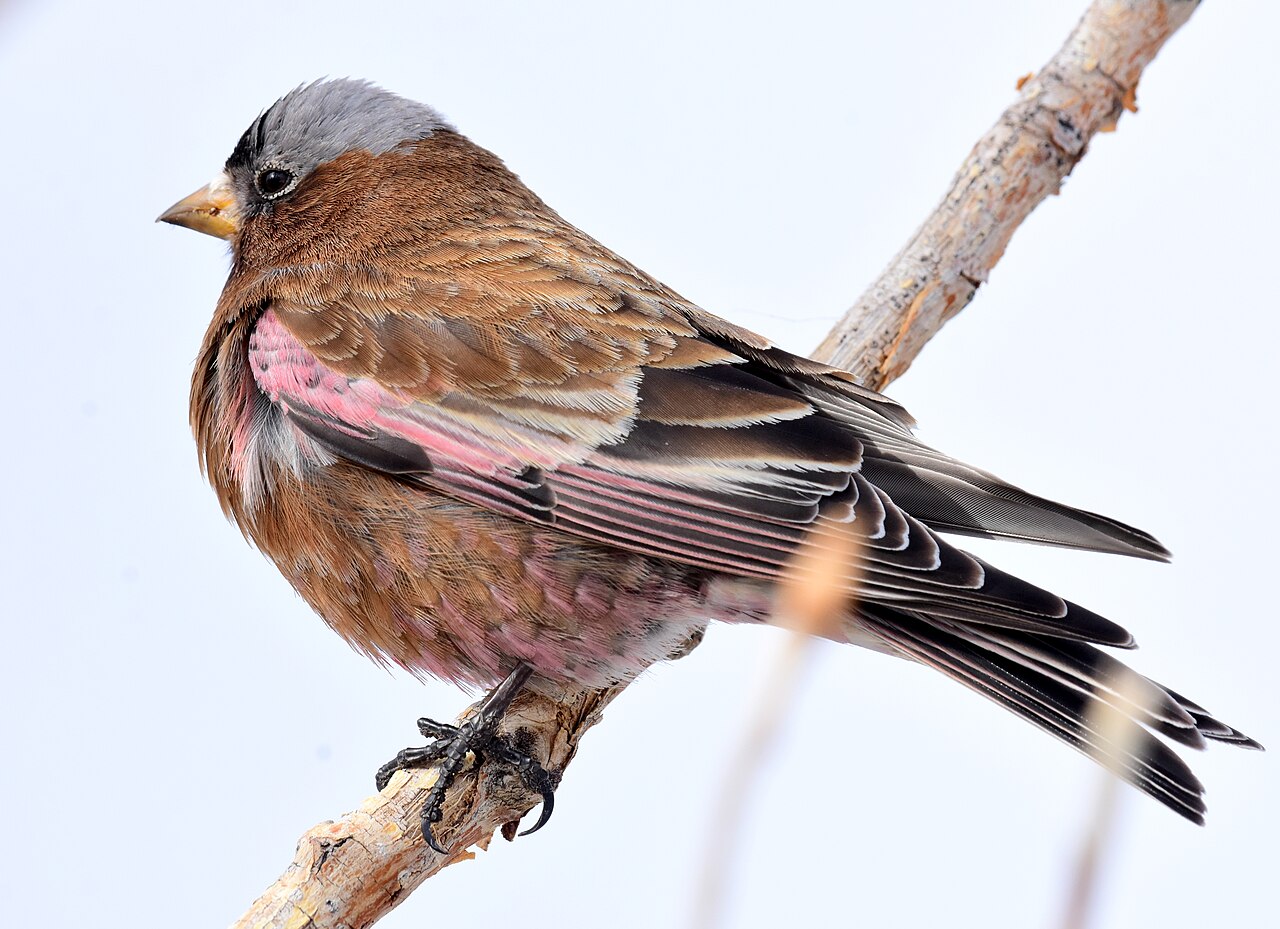
The Gray-crowned Rosy-Finch is the most widespread of the three North American rosy-finches: a brown finch with a black forecrown, a grey hindcrown and pink on belly, rump and wings. It breeds higher than any other North American songbird, up to the snowfields of Denali, and on the bare islands of the Bering Sea down to sea level.
Voice
The call is a low, slightly husky chew, which in a flying flock merges into a continuous murmur and is the first sign of a group arriving over a snowfield. The song consists of a series of those same notes, delivered more slowly and evenly, without clear build-up or ending; it is given both from a boulder and in flight. Nestlings call a thin, high peeping from the rock crevice, audible if you pass close to the nest site.
Recording: Yoann Blanchon — CC BY-NC-SA 4.0 · Fishhook, Matanuska-Susitna Borough, Alaska, United States · xeno-canto
Identification
A stocky finch with a long, slightly forked tail and short black legs. Head and breast are warm brown, the forecrown black and the hindcrown and side of the head ash-grey; belly, rump, wing bend and tail base are washed with pink, more strongly in the male than in the female. The bill is yellow in winter and black in the breeding season. The form of the Aleutians and the Pribilofs is markedly larger and darker than mainland birds; the coastal-mountain form ('Hepburn's') has the whole side of the head grey rather than only the hindcrown.
Confusion species
Black Rosy-Finch has a black, not brown, body with the same grey hindcrown; in mixed winter flocks the difference shows on the body and not on the head. Brown-capped Rosy-Finch lacks the grey on the hindcrown and is uniformly brown over head and body. At a flock on a feeder it pays to check back and face on each bird, since all three mix in winter. A female House Finch is streaked below and lacks any pink on the wing.
Habitat
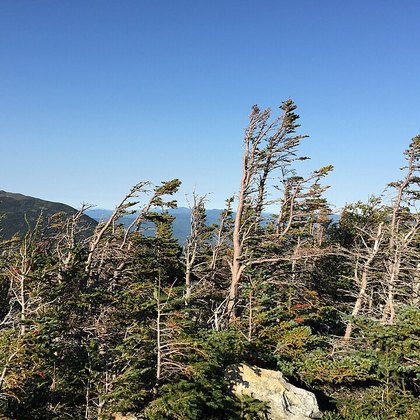
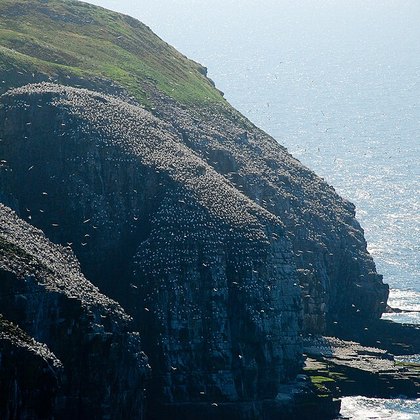
Alpine tundra, talus slopes, snowfields and glacier forelands above treeline, and on the Bering Sea islands rocky shores, cliffs and tundra down to just above the tideline. Nesting is in rock crevices, under boulders and in buildings or mine adits. In winter the species drops to open valleys, roadsides, livestock pasture and villages, where feeding stations can hold large flocks.
Where the bird is most often found, arranged by the USNVC — the vegetation classification of the United States and Canada — and CMECS for sea and coast.





Range and movements
From the Brooks Range and the Aleutians through southern Alaska, Yukon and the Northwest Territories to the mountains of British Columbia and Alberta, and south through the Cascades, the Sierra Nevada, the Blue Mountains of Oregon and the northern Rocky Mountains to Montana, Idaho and northeastern Nevada. Birds of the Bering Sea islands stay all year; mainland birds mainly drop in elevation in winter and partly move south, to Utah, Colorado and northern New Mexico. In occasional winters small groups reach the western Great Plains.
- Resident
- Breeding (summer)
- Winter
- Passage
- dark = core range, pale = thinly spread
Where and when to look
In summer a pass or summit above treeline is the place: look at the edge of a melting snowfield, where the birds pick wind-blown insects off the snow. In winter a feeder at a ski area in the Rocky Mountains or the Wasatch is the most reliable chance, usually between December and March and often together with the other two rosy-finches; check the colour of the back on each bird.
Conservation
The species is listed as Least Concern (LC); Partners in Flight puts the breeding population at about 200,000 birds and places it in the low concern category. Because the breeding range lies high and remote, ordinary roadside surveys barely cover it, and what is known of the trend rests mainly on winter counts. The shifting of treeline and the shortening of snow cover at altitude count as the main pressure; the alpine breeding range cannot move any higher.
Scientific name
Leucosticte tephrocotis | (Swainson, 1832)
Swainson described the species in 1832 as Linaria (Leucosticte) tephrocotis, from a specimen near Carlton House on the Saskatchewan; because he then treated Leucosticte as a subgenus of Linaria, author and year stand in parentheses. Leucosticte comes from Greek leukos 'white' and stiktos 'speckled', after the pale speckling in the plumage. The species name tephrocotis is Greek for 'ash-eared', after the grey side of the head. Between 1983 and 1993 the three mainland rosy-finches were treated as a single species; since then they have again been kept apart.