All species › Passerines › Finches, euphonias and allies › Brown-capped Rosy-Finch
Brown-capped Rosy-Finch | Leucosticte australis
Bruinkapbergvink | Pinzón montano coronipardo
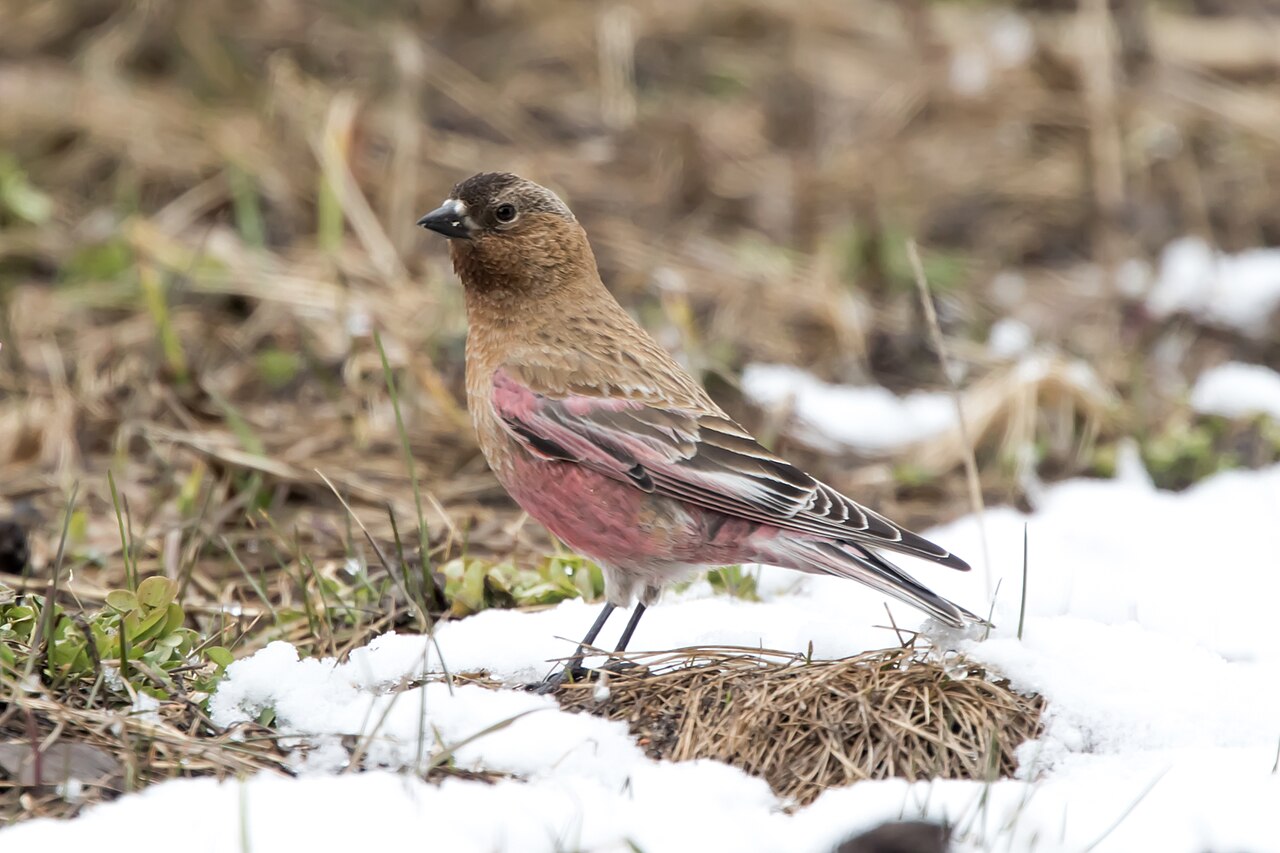
The Brown-capped Rosy-Finch is the southernmost of the three North American rosy-finches and has the smallest range: virtually the whole population breeds above treeline in the high Rocky Mountains of Colorado, with extensions to southeastern Wyoming and northern New Mexico. It is uniformly brown over head and body and lacks the grey band on the hindcrown of the other two.
Voice
The call is a low, slightly husky chew, repeated in flight and merging in a flock into a continuous murmur over the snowfield. The song consists of a slower, even series of the same notes without clear build-up, given from a boulder or in a short flight. In mixed winter flocks the voice is no help in identification, since the three rosy-finches have calls that can hardly be separated.
No freely licensed recording has been found for this species yet; what to listen for is described below.
Identification
A stocky finch with a long, forked tail and short black legs. Head, back and breast are warm brown; the forecrown is black or grey-brown, but the hindcrown is brown, without a grey band. Belly, rump, wing bend and tail base are washed with pink, far more strongly in the male than in the female; of the three species this one averages the most extensive pink below. The bill is yellow in winter and black in the breeding season.
Confusion species
The decisive mark against Gray-crowned and Black Rosy-Finch is the head: those two have a silver-grey band across the hindcrown, this species does not. Gray-crowned is otherwise brown like this species, Black Rosy-Finch black on back and breast. In a winter flock at a feeder, judge each bird on the hindcrown rather than on overall colour. The female is duller and greyer and can then resemble a female Gray-crowned; there too the plain brown hindcrown decides.
Habitat
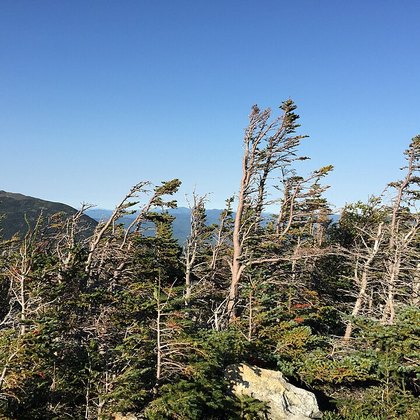
Alpine tundra, talus, cliffs and persistent snowfields above treeline, in Colorado usually above 3400 metres, with nests in rock crevices and under boulders. Food consists of seeds of alpine herbs and insects carried onto the snow by rising winds. In winter the species drops to valleys and valley edges with pine forest, open pasture and villages, where flocks gather around feeders.
Where the bird is most often found, arranged by the USNVC — the vegetation classification of the United States and Canada — and CMECS for sea and coast.





Range and movements
The breeding range covers the high ranges of central Colorado — the Front Range, the Sawatch, the Sangre de Cristo and the San Juan Mountains — plus the Snowy Range and Medicine Bow in southeastern Wyoming and a few summits in north-central New Mexico. That makes it one of the smallest breeding ranges of any North American songbird. In winter the species stays largely within the same area but at lower elevation; the flocks at Sandia Crest in New Mexico are the southernmost regular wintering groups.
- Resident
- Winter
- dark = core range, pale = thinly spread
Where and when to look
In winter, Sandia Crest near Albuquerque holds the most concentrated flocks, usually from November to March and often together with the other two rosy-finches. In summer the species asks for a trip above treeline: along Trail Ridge Road in Rocky Mountain National Park or on Mount Evans the birds can be seen in June and July at the edge of snowfields. Look at the hindcrown rather than at overall colour.
Conservation
The species is listed as Endangered on the Red List, mainly on account of its small, fragmented range. A Colorado-wide survey in 2023 arrived at 115,000 to 150,000 birds, more than three times the 2016 estimate, which above all shows how uncertain the earlier figures were. Models from the 2019 Audubon climate report project that with two degrees of warming nearly all suitable breeding ground disappears, since the alpine zone of the Colorado summits cannot move any higher. Winter counts and banding at feeders supply most of what is known about numbers.
Scientific name
Leucosticte australis | Ridgway, 1874
Ridgway described the bird in 1874 as Leucosticte tephrocotis, var. australis, that is as a variety of the Gray-crowned Rosy-Finch, from a specimen from Mount Lincoln in Colorado; because the genus has not changed since, author and year stand without parentheses. Leucosticte comes from Greek leukos 'white' and stiktos 'speckled'. The species name australis is Latin for 'southern', after the position of the range relative to the other rosy-finches. Between 1983 and 1993 the three species were treated as one.