All species › Tubenoses › Petrels, shearwaters and diving petrels › Black-winged Petrel
Black-winged Petrel | Pterodroma nigripennis
Zwartvleugelstormvogel | Petrel ala negra
Black-winged Petrel is one of the most numerous small petrels of the tropical Pacific and, thanks to regular trips from Hawaii, one of the most reliably found Pterodroma species within the guide area. It breeds on dozens of island groups between Australia and French Polynesia, but always far outside the map, and appears in American waters only as a non-breeding wanderer.
Voice
At the breeding colony high whistles carry — wees-wees-wees or wee-wee-wee — alternating with a deeper, short ha-ha-ha from the ground, usually at night when birds fly in and out of the colony. Around Hawaii, where the species does not breed but is present for most of the year, it is seen only by day and silently, from a boat.
Recording: David Boyle — CC BY-NC-SA 4.0 · Rangatira (below the summit), Chatham Islands, New Zealand, New Zealand · xeno-canto
Identification
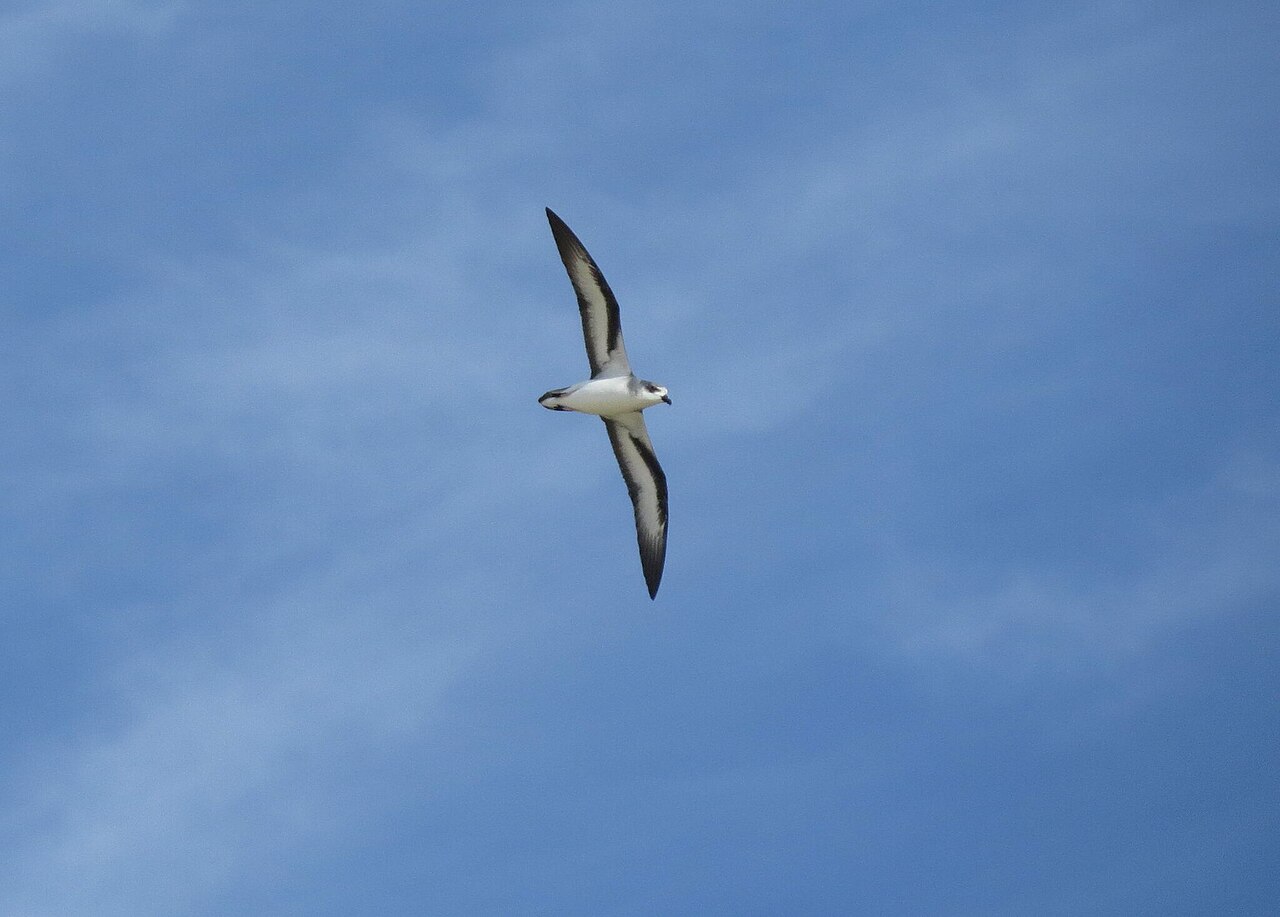
Black-winged Petrel is ash-grey above with a dark cap that blends vaguely into the grey back, white cheeks and a dark band around the hindneck. The underwing is white with a broad, dark band running diagonally inward from the leading edge of the outer wing — the mark that gives the species its English and Dutch names. Wingtips and wing edge are black. Male, female and juvenile are coloured alike. Flight is fast and light, with high, tumbling banks typical of smaller petrels of this genus.
Confusion species
Bonin Petrel (Pterodroma hypoleuca), of similar size and likewise common around Hawaii, has a sharply defined black cap rather than a vague grey one, lacks the dark hindneck band, and has pink rather than black legs. Cook's Petrel (P. cookii), which visits the same waters in smaller numbers, is paler, with a narrower, less conspicuous underwing pattern and a thinner bill. From the larger, uniformly grey-brown Murphy's Petrel (P. ultima), which lacks any white on the underparts, Black-winged Petrel is instantly told apart by its white belly.
Habitat
Outside the breeding season Black-winged Petrel is a bird of deep, warm ocean water, foraging alone or in small groups far from shore on squid and small fish. For breeding it digs a tunnel in the sandy soil of grassy slopes on subtropical islands; that habitat lies entirely outside the guide area. It therefore never comes ashore within North America.
Where the bird is most often found, arranged by the USNVC — the vegetation classification of the United States and Canada — and CMECS for sea and coast.
Range and movements
The species breeds on dozens of islands ranging from Lord Howe Island and eastern Australia to New Caledonia, New Zealand — including the Kermadec, Three Kings and Chatham Islands — and east to the Austral Islands of French Polynesia; the largest colony in the world is on Macauley Island in the Kermadec group. After breeding, from May to December, the species disperses north across a broad belt of ocean between Peru and Hawaii. In the waters around the Hawaiian Islands it is one of the most numerous visiting petrels of the genus Pterodroma, peaking from August to November, even though it does not breed there itself.
Where and when to look
Look for Black-winged Petrel on a pelagic boat trip from Hawaii between August and November, when it is common there; watch for the combination of the broad, diagonal black band on the underwing and the vague grey cap, which separate it from the similar Bonin Petrel.
Conservation
The world population is estimated at eight to ten million birds, and the species is listed as Least Concern (LC). On the inhabited Hawaiian Islands a few birds, mostly young ones, wash up disoriented or exhausted each year, drawn in by artificial light from buildings; on the breeding islands themselves, introduced rats and feral cats are the main threat.
Scientific name
Pterodroma nigripennis | (Rothschild, 1893)
British zoologist Walter Rothschild described the species in 1893 as Oestrelata nigripennis; because it has since been placed in another genus, author and year stand in parentheses. The genus Pterodroma was introduced in 1856 by Bonaparte, from the Greek for 'wing' and 'runner'. nigripennis is Latin for 'black-winged', after the black outer wing and wing edge — the feature that also gave the species its English and Dutch names. The type locality is the Kermadec Islands, where Macauley Island also holds the largest colony in the world.