All species › Passerines › Gnatwrens and gnatcatchers › Blue-gray Gnatcatcher
Blue-gray Gnatcatcher | Polioptila caerulea
Blauwgrijze muggenvanger | Perlita azulgris
Ten centimetres, six grams, and still the bird that makes itself heard most in a half-opened oak wood in April. The Blue-gray Gnatcatcher is the only member of its family that breeds into the east of the continent, and over the past century it has moved hundreds of kilometres north.
Voice
The call is the more useful sound: a thin, nasal, slightly twanging pwee, often repeated two or three times, given without pause while the bird forages and audible a long way across the canopy. The song is the opposite: so quiet that you must be within twenty metres of it, a drawn-out mumbling of squeaks and scraping notes with snatches of other species worked into it. It sings mainly in the first weeks after arrival, from March into June. Near the nest the sound turns into a fast, angry rattle as soon as anything approaches.
Recording: Manuel Grosselet — CC BY-NC-SA 4.0 · Mérida, Mérida Municipality, Yucatán, Mexico · xeno-canto
Identification
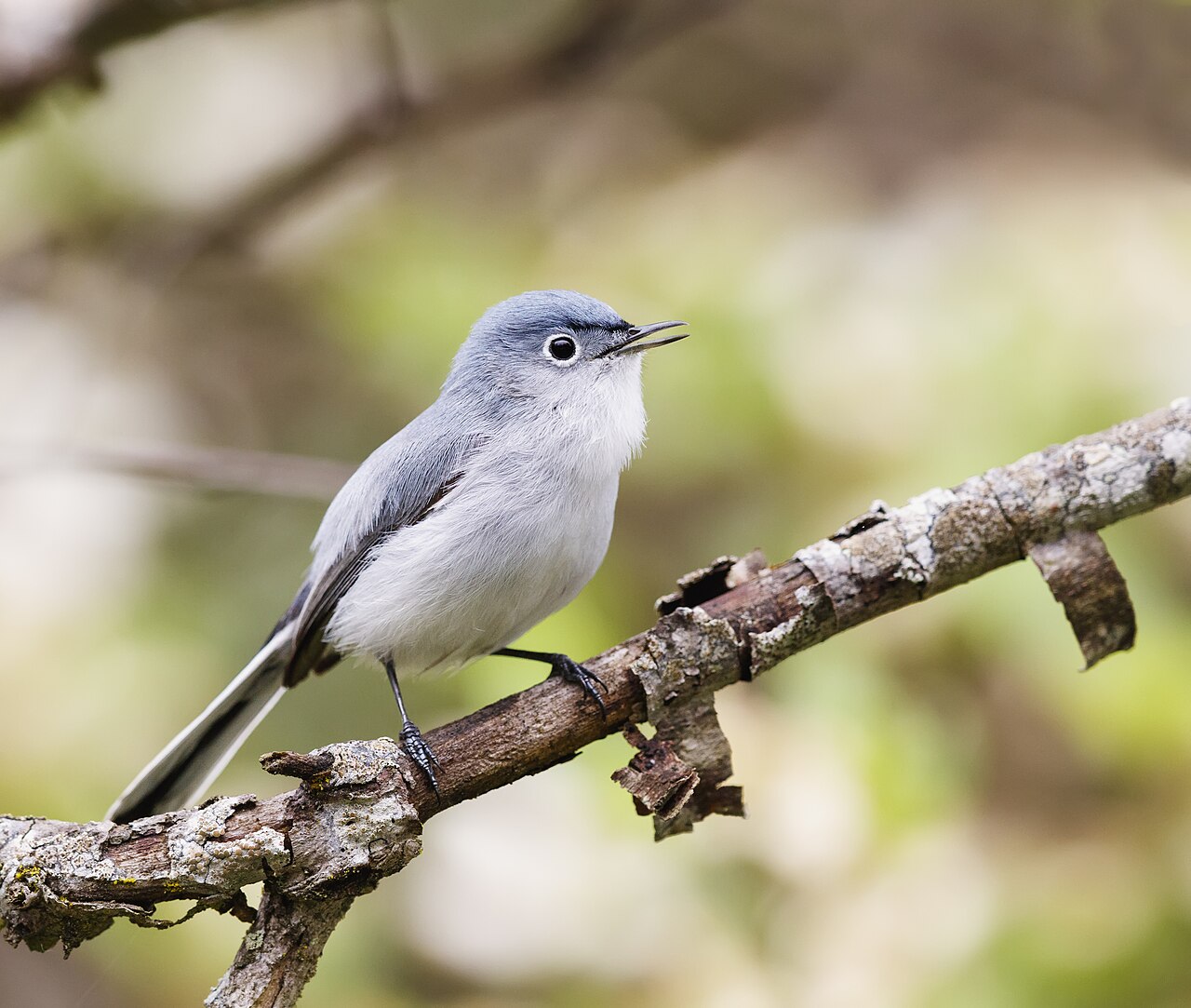
Ten to eleven centimetres and five to nine grams: smaller than almost anything else in the same tree. Blue-grey above, white below, with a closed white eyering in an otherwise unmarked face. The tail is long and black with white outer feathers, so that from below it looks white with a dark central stripe. In spring the male carries a narrow black band running from the base of the bill over the eye — the only difference between the sexes, and gone from him too in autumn. Female and winter male are greyer, with some brown on the back; juveniles are greenish grey, and the fine bill is black with a pale base.
Confusion species
Black-tailed Gnatcatcher (Polioptila melanura) of the southwest has an undertail that is almost entirely black with only white feather tips, calls a scraping chee-chee-chee, and in summer the male wears a full black cap. P. californica of the coast of southern California is darker still beneath the tail and mews like a kitten. Ruby-crowned Kinglet is as small but olive-green, with two white wingbars and a short tail, and hovers at the tips of branches. Bushtit also has a long tail, but without white and in brown-grey plumage, and it travels in flocks.
Habitat
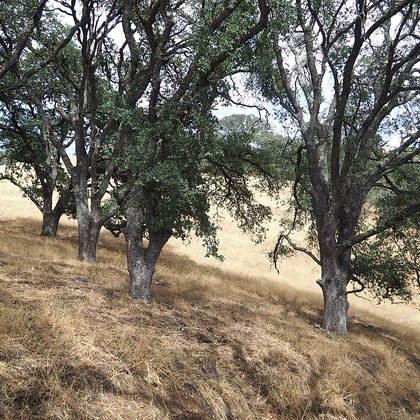
In the east open deciduous woodland and its edges, oak and hickory ridges, hedgerows and old willows along rivers; in the west live-oak woodland, pinyon (a low-growing pine of the dry south-western foothills)-juniper, chaparral slopes and mesquite (a thorny pod-bearing shrub of the Southwest that forms dense thickets) along desert washes. It works the outer canopy and needs tall shrubs or trees, but not closed forest: what matters is open branchwork with leaves on it. In winter it also enters thorn scrub, mangrove edges and gardens. It does not use bare farmland or dense conifer forest.
Where the bird is most often found, arranged by the USNVC — the vegetation classification of the United States and Canada — and CMECS for sea and coast.




Range and movements
Breeds from southern Ontario and New England west to the Great Plains, and in the west from Oregon and Wyoming south through the Great Basin and California deep into Mexico. The northern half of that range empties in autumn: it winters in the southern United States, throughout Mexico, in Belize, Guatemala, Honduras and El Salvador, and on Cuba, the Bahamas, the Turks and Caicos Islands and the Cayman Islands. The northern limit moved sharply during the twentieth century: only after about 1950 did it breed in Michigan, New England and southern Ontario. In the west it is expanding still.
- Resident
- Breeding (summer)
- Winter
- Passage
- dark = core range, pale = thinly spread
Where and when to look
Follow the call. In April walk slowly through an oak wood just coming into leaf and listen for that thin nasal note above you; because the bird never sits still for a moment, it usually shows itself within a minute. The nest is a small cup covered in lichen, set in the middle of a horizontal branch, looking like a knot until the bird settles on it.
Conservation
Not threatened (LC), with an estimated breeding population of a hundred and sixty million and a slight increase since 1966, especially in the west. The heaviest burden is the Brown-headed Cowbird, which lays its eggs in the nest: a gnatcatcher is too small to work such an egg out again and raises the young cowbird. Its answer is a new nest, often built from the dismantled material of the old one.
Scientific name
Polioptila caerulea | (Linnaeus, 1766)
Linnaeus described the species in 1766 as Motacilla caerulea, among the wagtails; because it was later placed in another genus, author and year stand in parentheses. The genus Polioptila was introduced by Sclater in 1855, from Greek polios, 'grey', and ptilon, 'feather'. caerulea is Latin for 'blue', after the upperparts of the male in spring. The type locality is given as Pennsylvania, later read as Philadelphia.