All species › Passerines › Shrike-babblers, Erpornis and vireos › Blue-headed Vireo
Blue-headed Vireo | Vireo solitarius
Brilvireo | Vireo solitario
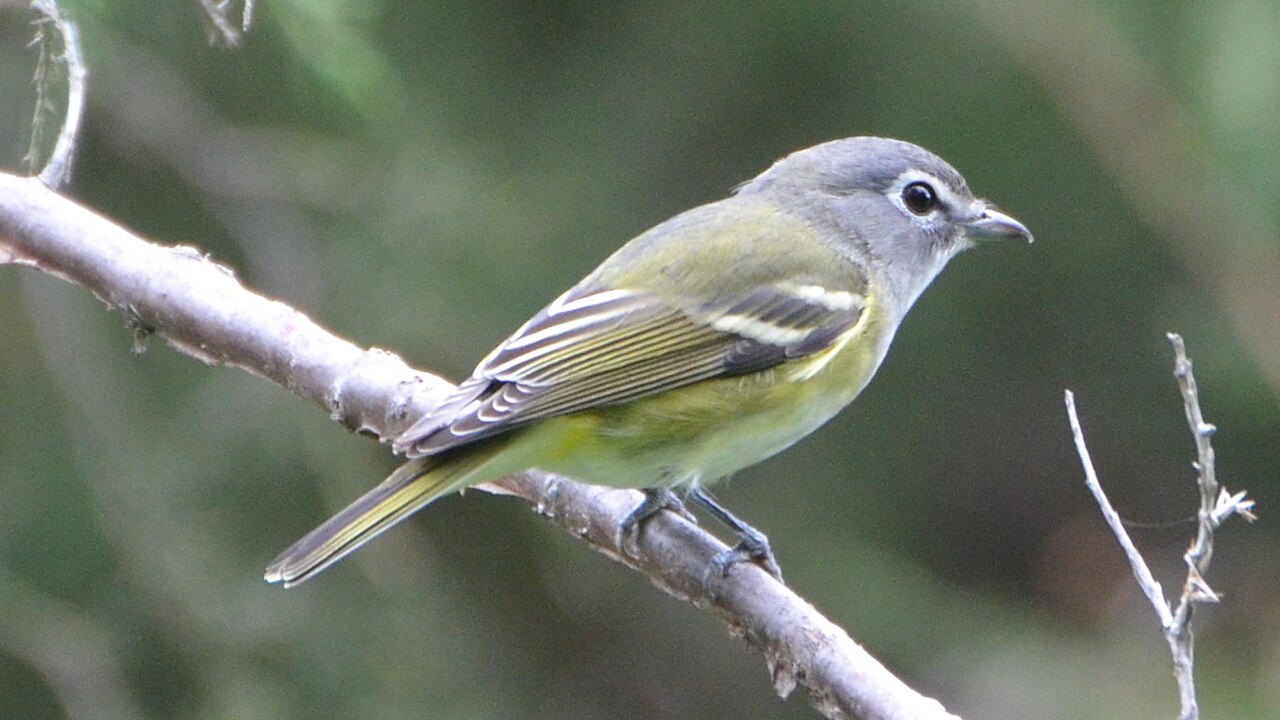
The Blue-headed Vireo is the eastern member of the three species treated until 1997 as a single Solitary Vireo. It is known by its blue-grey head with broad white spectacles and its sharply demarcated white throat. It breeds in cool conifer and mixed forest of Canada and the Appalachians, and in the east it is the first vireo back in spring and the last to leave in autumn.
Voice
The song is a series of short, clear whistled phrases of two to four syllables, each separated by about a second of silence, and the series continues for hours. Phrases alternate between a high and a low ending, so the pattern comes across as question and answer. The pace is slower than Red-eyed Vireo's and the tone is clearer, less burry than Yellow-throated Vireo's. The species also gives a fast scolding rattle, the sound most often heard from migrants and birds outside the breeding season, and on territory a range of short calls, shrieks, trills and a nasal nyaa. Males snap the bill in disputes.
Recording: Jim Berry — CC BY-NC-SA 4.0 · Harmony (near Niobe), Chautauqua County, New York, United States · xeno-canto
Identification
A heavy vireo with a thick bill and blue-grey legs. The head is blue-grey, with broad white spectacles encircling the eye and continuing onto the lores. Throat and breast are clean white and cut sharply against the grey head and grey cheek. The mantle is olive-green, the flanks washed yellow-green, the belly white. Two yellowish to white bars cross the dark wing, and the secondaries have broad pale edges. The sexes are alike, with little difference in colour. It forages slowly, working the inner parts of branches rather than the outer twigs, taking caterpillars, beetles, bugs and spiders.
Confusion species
Cassin's Vireo and Plumbeous Vireo are the immediate relatives, all three split from what was once one species. Blue-headed shows the strongest contrast between a blue-grey head and a clean white throat, the greenest mantle and the yellowest flanks. Cassin's has a duller grey-green head that contrasts far less with the throat, and less sharply defined spectacles. Plumbeous is almost entirely grey, without olive on the mantle and with at most a trace of yellow on the flanks, and is larger and longer-tailed. Range helps: Blue-headed is the only one of the three in the east. Yellow-throated Vireo has a yellow throat and breast and yellow spectacles.
Habitat
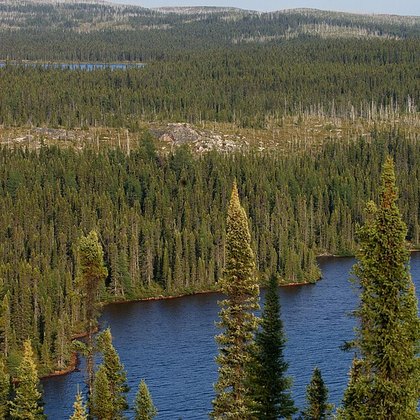
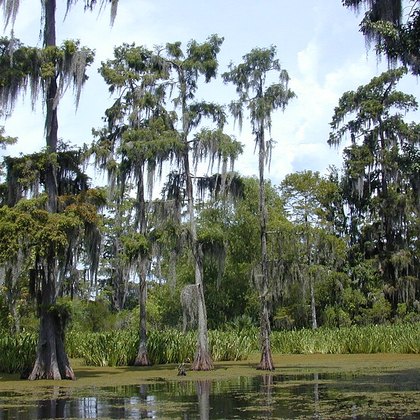
Cool mixed and coniferous forest of spruce, hemlock, fir and pine, with an understorey of alder, willow, poplar, birch or maple. In the Appalachians it also breeds in deciduous forest of beech, oak and maple. It requires a closed canopy and a developed shrub layer. In winter it uses mixed pine-hardwood forest, coastal swamp forest and thickets; in Mexico and Central America also montane forest and semi-open woodland.
Where the bird is most often found, arranged by the USNVC — the vegetation classification of the United States and Canada — and CMECS for sea and coast.




Range and movements
Breeds across the Canadian boreal zone from northeastern British Columbia and Alberta east to Newfoundland, and in the United States from Minnesota and the Great Lakes to New England, with a southern arm down the Appalachians to northern Georgia. In Virginia, the Carolinas and Georgia it breeds in the mountains and winters on the coastal plain, so it is present there all year. The winter range further covers the southeastern United States west to eastern Texas, eastern and southern Mexico, Belize, Guatemala, Honduras, El Salvador, Nicaragua, Cuba and the Bahamas. Through the Midwest and the central states it occurs only on passage.
- Resident
- Breeding (summer)
- Winter
- Passage
- dark = core range, pale = thinly spread
Where and when to look
In the east it is back by mid-April, weeks ahead of most warblers, and still present in October and November — which makes it the most likely vireo in those two windows. Watch the sharp border between the grey cheek and the white throat; that border is much vaguer in Cassin's and Plumbeous Vireo.
Conservation
Partners in Flight puts the breeding population at about 13 million birds; numbers have roughly doubled since 1970 and the species is not on the watch list. The increase goes with woodland regrowth in the northeast after earlier cutting. The species remains tied to forest with a closed canopy, so large-scale cutting in the breeding range depresses numbers locally.
Scientific name
Vireo solitarius | (Wilson, 1810)
Alexander Wilson described the species in 1810 as Muscicapa solitaria, from a bird taken in Bartram's woods near Philadelphia; because it was later placed in the genus Vireo, author and year stand in parentheses. The species name solitarius is Latin for 'solitary, living alone'. Until 1997 Vireo solitarius was treated as one species with the present Cassin's and Plumbeous Vireos; molecular work led to a split into three, with the original name staying with the eastern bird. The genus Vireo was introduced in 1808 by Vieillot, from Latin vireo, the name of a green bird.