All species › Passerines › Shrike-babblers, Erpornis and vireos › Yellow-throated Vireo
Yellow-throated Vireo | Vireo flavifrons
Geelborstvireo | Vireo gorjiamarillo
The Yellow-throated Vireo is the only vireo in North America with a bright yellow throat and breast against a white belly. The yellow spectacles around the dark eye and the two white wingbars make it recognisable in eastern deciduous woodland. It is a summer visitor, wintering in Central America, northern South America and the Antilles.

Voice
The song consists of short two- and three-syllable phrases, each with a burry, hoarse quality, separated by a second or more of silence; the pattern is repeated at the same pace for hours. A common phrase sounds like three-eight, alternately rising and falling. Red-eyed Vireo delivers a comparable series but with clear, unburry phrases and at a faster pace. The male sings from the canopy, including on migration, and sings less once paired. Both sexes give a harsh scolding chatter when disturbed, longer and louder as the threat comes closer.
Recording: Scott Gravette — CC BY-NC-SA 4.0 · Lawrence County, Alabama, United States · xeno-canto
Identification
A heavy vireo with a thick blue-grey bill and blue-grey legs. Head, throat and breast are bright yellow, the belly and undertail white; the border between yellow and white cuts sharply across the breast. Yellow spectacles surround the dark eye and reach onto the lores. The mantle is olive-green, the rump and lower back grey, giving a two-toned upperside. Two broad white bars cross the dark wing. The sexes are alike. It forages slowly and methodically in the middle and upper levels of the wood, hopping along bare branches and pausing motionless as it goes.
Confusion species
Pine Warbler also shows yellow on the breast, but duller, less sharply bordered and extending onto the flanks; its bill is thin and pointed rather than thick and blue-grey, its tail carries white spots and its wingbars are narrower. It is also largely confined to pine woods. Blue-headed Vireo has a white throat and a blue-grey head with white spectacles, with yellow only on the flanks. White-eyed Vireo also has yellow spectacles, but a white throat, yellow only on the flanks and, in adults, a white iris. Yellow-throated Warbler has a thin bill, a black-and-white face pattern and a yellow throat without a yellow breast.
Habitat
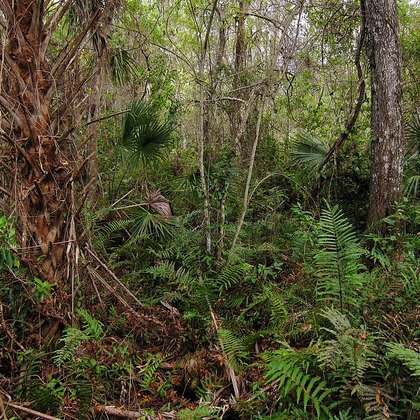
Open deciduous and mixed woodland, favouring edges, gaps and tall mature trees along water and roads. Breeding requires a continuous woodland block of roughly a hundred hectares or more; small fragments are avoided. In winter it uses forest, semi-open woodland, tropical forest and shade-coffee plantations up to about 1800 metres.
Where the bird is most often found, arranged by the USNVC — the vegetation classification of the United States and Canada — and CMECS for sea and coast.




Range and movements
Breeds in the eastern United States, from eastern Texas, Oklahoma, Kansas and Nebraska east to the Atlantic coast, and north to southern Ontario, southern Quebec and Maine. It breeds in northern Florida, while small numbers winter in the far south of that state. The winter range lies in southern Mexico, mainly on the Gulf slope and the Yucatán Peninsula, in Belize, Guatemala, Honduras, El Salvador and Nicaragua, further south to Colombia and Venezuela, and on Cuba, Jamaica, Hispaniola and the Bahamas. Spring migration largely crosses the Gulf of Mexico.
- Resident
- Breeding (summer)
- Winter
- Passage
- dark = core range, pale = thinly spread
Where and when to look
Look for it in April and May in mature deciduous woodland along a river or a woodland edge, and go by ear: burry two- or three-syllable phrases with a second's pause, slower than Red-eyed Vireo. It sits high, so watch for the sharp border between yellow breast and white belly as it shows against the sky.
Conservation
Partners in Flight puts the breeding population at about 4.4 million birds and the species is not on the watch list. The Breeding Bird Survey shows an increase of about 62 per cent between 1970 and 2014. In the early twentieth century it disappeared from urban areas in the northeast, possibly through spraying of elms against insects; numbers recovered as woodland returned. The main constraint remains forest fragmentation, since it needs large continuous tracts.
Scientific name
Vireo flavifrons | Vieillot, 1808
Louis Pierre Vieillot described the species in 1808 as Vireo flavifrons; since it has never changed genus, author and year stand without parentheses. The type locality is given as the United States, in practice the eastern part. The species name comes from Latin flavus 'yellow' and frons 'forehead'. The genus Vireo was introduced by Vieillot in the same year, from Latin vireo, the name of a green bird, related to virere 'to be green'.