All species › Passerines › Shrike-babblers, Erpornis and vireos › Hutton's Vireo
Hutton's Vireo | Vireo huttoni
Huttons vireo | Vireo de Hutton
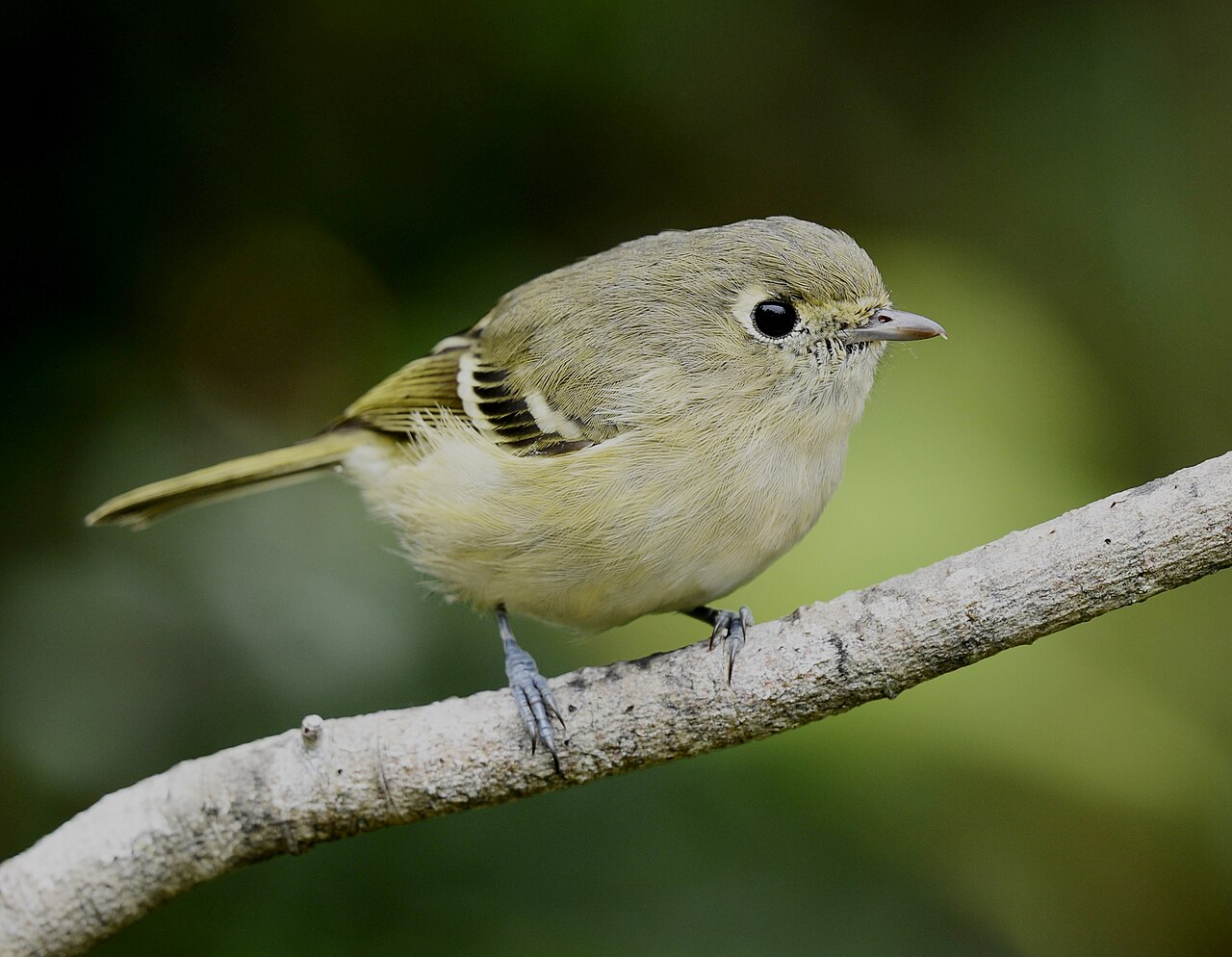
Hutton's Vireo is the smallest vireo of North America and the only one that stays in the same woodland all year. It is olive-green, has two pale wingbars and a broken white eye-ring, and lives in evergreen oak and conifer forest from British Columbia to Guatemala. Its size and wing-flicking make it a frequent source of confusion with Ruby-crowned Kinglet.
Voice
The song is a short phrase repeated without a break: a rising zu-wee or a descending zo-zoo, about once a second, and a bird may keep this up for ten minutes or more without stopping. There is little variation within one session, but the phrase differs sharply between individuals and between populations. Unlike most vireos it sings all year and at any hour of the day, usually from a half-hidden perch in the canopy. Calls are a nasal chu and a flat chit, often run into a rattling series when the bird is agitated.
Recording: Greg Irving — CC BY-NC-SA 4.0 · Dungeness Recreation Area, Clallam County, Washington, United States · xeno-canto
Identification
Small and compact, with olive-green crown and back, dingy to yellowish-white underparts washed olive, and yellow edges to the flight and tail feathers. The eye-ring is broad and white but broken above the eye, so no complete spectacle is formed; the lores are pale. Two dingy to yellowish wingbars cross the wing. The bill is short but thick and slightly hooked at the tip, the legs blue-grey, the iris dark brown. Coastal birds are greener and yellower, interior birds greyer. The sexes are alike. It forages slowly and methodically along branches, regularly hanging upside down, and flicks its wings as it goes.
Confusion species
Ruby-crowned Kinglet is the main confusion species and matches it closely in colour, size and wing-flicking. Three features separate them. First the wing pattern: the kinglet has a black bar immediately below the white wingbar, on the bases of the secondaries, and in Hutton's Vireo that black bar is entirely absent. Second the bill: thick, greyish and hooked at the tip in the vireo, thin, black and pointed in the kinglet. Third the face: the kinglet has a narrow, complete white eye-ring and the male shows a red crown patch when excited; Hutton's Vireo has a broad eye-ring broken above, no black bar through or behind the eye, and never red on the crown. The legs also help: the kinglet has yellow toes against a dark leg. Cassin's Vireo has a complete white spectacle, a greyer head contrasting with a white throat, and is larger.
Habitat
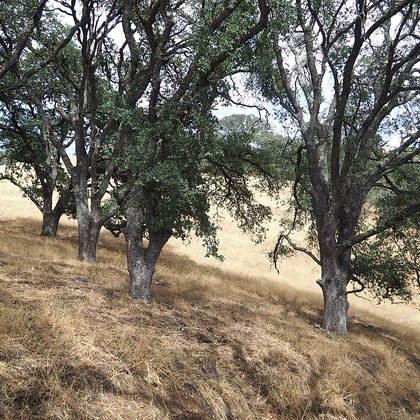
Evergreen woodland: live oak, coastal conifer forest with spruce and hemlock, and in the southwest pine-oak and pine-oak-juniper woodland. It needs a closed canopy and occurs mainly in tracts larger than about twenty hectares. On the coast it ranges from sea level to about 1800 metres, in Mexico and Guatemala between 1200 and 3500 metres. Oak woodland edges, oak-lined canyons and old gardens with tall oaks are also occupied.
Where the bird is most often found, arranged by the USNVC — the vegetation classification of the United States and Canada — and CMECS for sea and coast.




Range and movements
Resident throughout the range, with no migration. The range runs from southwestern British Columbia and Vancouver Island along the coast of Washington, Oregon and California, and through the mountains of southeastern Arizona, southwestern New Mexico and West Texas to the Mexican highlands and southwestern Guatemala. In Texas it breeds in the Davis Mountains, the Chisos, the Guadalupe Mountains and, since the 1990s, on the Edwards Plateau, an expansion on the situation Oberholser described in 1974. In Mexico it is spread over the Sierra Madre Occidental, the Sierra Madre Oriental and the Trans-Mexican Volcanic Belt.
- Resident
- Breeding (summer)
- Winter
- Passage
- dark = core range, pale = thinly spread
Where and when to look
Find it by ear: a short phrase repeated at the same rhythm for minutes on end gives it away faster than the view does, and it sings in December and January too. Once you have it in view, look at the wing first — a black bar below the white wingbar means kinglet, not vireo.
Conservation
The species is listed as Least Concern (LC). Partners in Flight puts the world population at about 2.7 million birds and the species is not on the watch list. The Breeding Bird Survey shows an increase of about 1.3 per cent per year between 1966 and 2015. The pressures are selective logging, which removes the closed canopy, and sudden oak death, a pathogen killing live oaks along the Californian coast.
Scientific name
Vireo huttoni | Cassin, 1851
John Cassin described the species in 1851 as Vireo huttoni; since it has never changed genus, author and year stand without parentheses. The specimen described came from Monterey, California. The species name honours William Rich Hutton, a surveyor and draughtsman in California, who collected the bird. The genus Vireo was introduced in 1808 by Vieillot, from Latin vireo, the name of a green bird, related to virere 'to be green'.