All species › Passerines › Crows, jays and magpies › Blue Jay
Blue Jay | Cyanocitta cristata
Blauwe gaai | Arrendajo azul
The Blue Jay is the loud, brilliant blue crow relative of eastern North America, with a pointed crest and a piercing call that puts an entire woodland on alert. It is one of the few songbirds to lay in its own winter stores: a single bird can bury thousands of acorns in a single autumn, scattered across a wide area, and so unintentionally helps reforest open ground.

Voice
Its best-known sound is a loud, screaming jay-jay-jay, often the first alarm a woodland gives when a hawk or owl is nearby. It also has a varied repertoire, including a soft, bubbling murmur near the nest and an imitation of a Red-shouldered Hawk's call accurate enough to scare other birds away from a feeder. Its true song is quiet and unobtrusive and is rarely heard beyond the immediate vicinity of the nest.
Recording: Ray Cooke — CC BY-NC 4.0 · St. Patrick Road, PF179119, St. Patrick Road, Prince Edward Island, Canada · xeno-canto
Identification
A medium-sized crow relative in brilliant blue and white, with a pointed crest, a black necklace, and black-and-white barred wings and tail with a broad white terminal band. The breast and belly are off-white to pale grey, and the black necklace continues up into the nape, so the head appears almost outlined when seen from the side. Males and females look alike; juveniles have a shorter tail and slightly duller colours but are otherwise nearly identical to the adult. In flight it shows broad, rounded wings and an undulating, somewhat unhurried flight style, clearly different from the straight flight of smaller songbirds.
Confusion species
Confusion within its range is almost impossible, since no other eastern songbird shares the same combination of brilliant blue, crest and black necklace. In the western Rocky Mountains, where its range occasionally brushes against that of Steller's Jay, that species' entirely black head with no white markings sets it apart from Blue Jay at once. The much smaller Florida Scrub-Jay of the southeast lacks a crest altogether and has a vaguer, greyer head.
Habitat
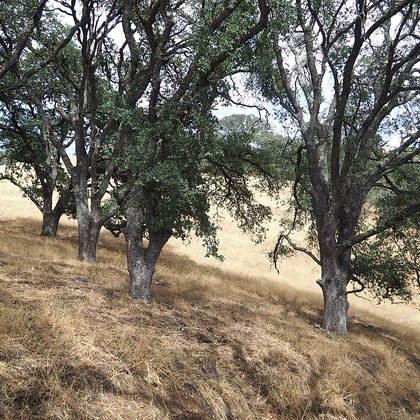
Deciduous and mixed woodland, forest edges, and above all oak woods with a rich supply of acorns, but just as often gardens, parks and leafy suburbs. It avoids dense, entirely closed conifer forest without hardwoods and completely open, treeless ground. Feeders stocked with peanuts and sunflower seed attract it easily, and in winter it is often one of the first birds to arrive at one.
Where the bird is most often found, arranged by the USNVC — the vegetation classification of the United States and Canada — and CMECS for sea and coast.




Range and movements
Distributed across eastern and central North America, from the southern Canadian prairie provinces to the Gulf Coast of Texas and Florida, and west to roughly the Rocky Mountains. Across most of its range it is resident, but part of the northern population migrates south in varying numbers each autumn — some years thousands of birds pass along the Great Lakes, other years almost none. The western edge of its range has slowly shifted over recent decades as tree planting has spread into formerly open prairie.
- Resident
- Winter
- Passage
- dark = core range, pale = thinly spread
Where and when to look
Follow a group of agitated, screaming jays: they are usually the first to react to a hawk or owl and often reveal a hidden Sharp-shinned Hawk or Eastern Screech-Owl that would otherwise go unnoticed. In autumn, an oak woodland around sunrise is the best place to watch them busily gathering and burying acorns, cheeks stuffed almost to the point of looking deformed.
Conservation
Numerous and widespread, with a population considered stable, though a gradual, not yet fully explained decline has been measured over recent decades. It clearly benefits from gardens and feeders, but is sometimes viewed with suspicion as a nest predator of other songbirds — a reputation that research has softened, since eggs and nestlings make up only a small part of its diet.
Scientific name
Cyanocitta cristata | (Linnaeus, 1758)
Linnaeus described the species in 1758 as Corvus cristatus, among the crows; because it was later placed in its own genus, author and year stand in parentheses. Cyanocitta is Greek for 'blue jay', from kyanos ('blue') and kitta ('jay'); cristata is Latin for 'crested'. The type locality lies in southeastern South Carolina.