All species › Passerines › Crows, jays and magpies › Steller's Jay
Steller's Jay | Cyanocitta stelleri
Stellers gaai | Chara de Steller
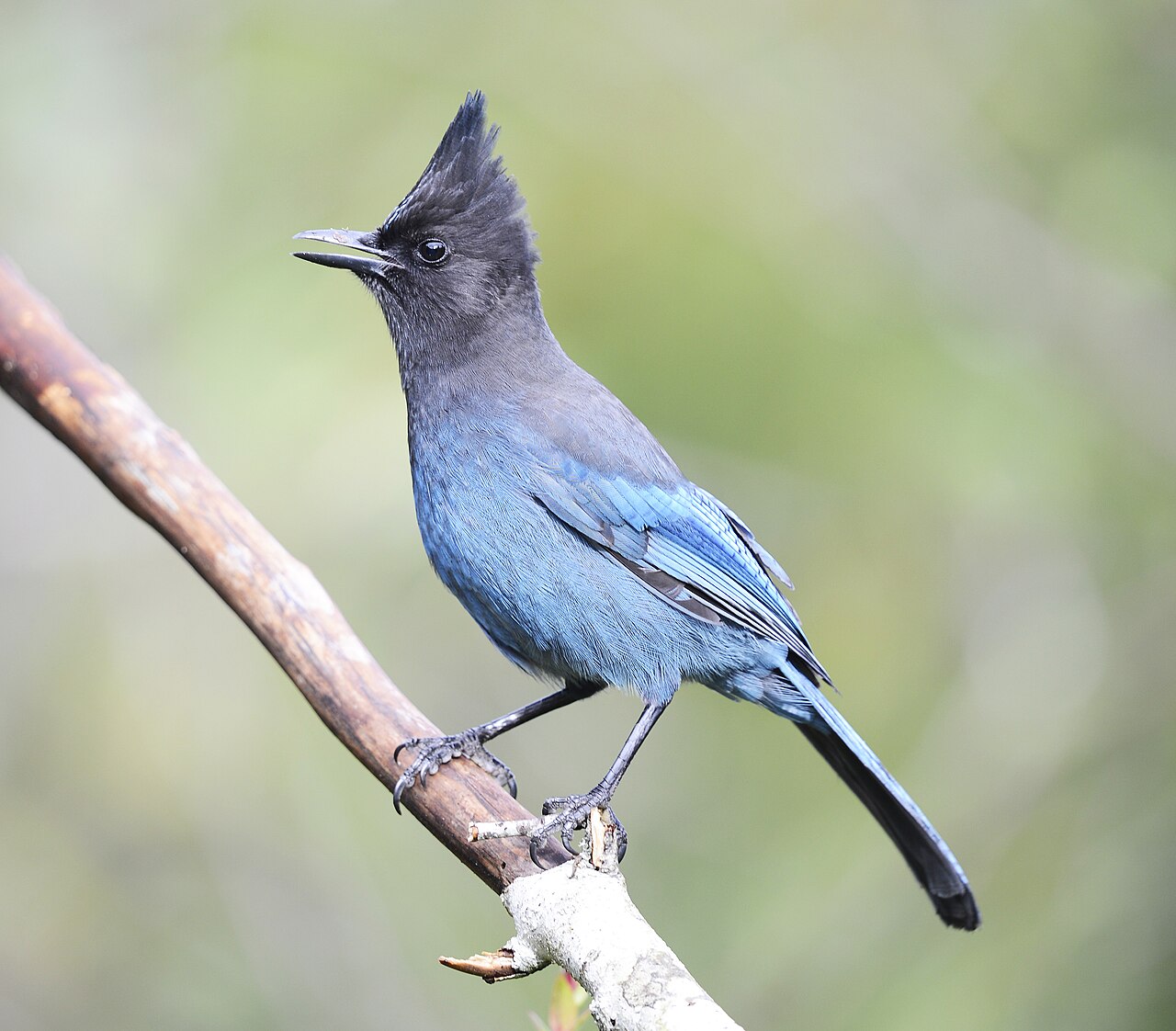
Steller's Jay is the only crested jay west of the Rocky Mountains. It is dark in front and blue behind, and across western North America it fills the place the Blue Jay holds in the east. The range runs from southern Alaska to northern Nicaragua, everywhere in coniferous and pine-oak forest.
Voice
The commonest sound is a harsh, rattling shack-shek-shek-shek, often from the top of a conifer. Alongside it come a squeaky skreeka-skreeka reminiscent of an old pump handle, a soft whistled hoodle hoodle, and a nasal wah in alarm. Females give a rattle, males a gleep gleep. The species imitates the calls of raptors, among them Red-tailed Hawk, Red-shouldered Hawk and Osprey; when a goshawk is heard but not seen, the birds take longer to resume feeding than the other way round. At the nest they are silent.
Recording: Jonathon Jongsma — CC BY-SA 3.0 · McClellan Ranch Preserve, Santa Clara, California, United States · xeno-canto
Identification
A large jay of 30 to 34 centimetres and 100 to 140 grams, with a long, raisable crest. Head, crest, breast and upper mantle are blackish brown to dark blue; shoulders, lower breast, wings and tail are blue, with fine dark barring on the flight and tail feathers. The bill is more slender and the legs longer than in Blue Jay. Plumage varies strongly by region: inland birds along the Continental Divide have clear white marks above and below the eye, birds in the middle of the range have pale blue ones, and Pacific coast birds have small marks or none. Thirteen subspecies are recognised.
Confusion species
Blue Jay is the only other crested jay; it has a blue rather than a black head, a black necklace, white patches in wing and tail, and white underparts. Where the ranges meet in the Rocky Mountain foothills the two hybridise, which accounts for part of the variation. Woodhouse's Scrub-Jay and California Scrub-Jay lack a crest, are paler below and sit in lower, more open scrub. Pinyon Jay has no crest, is an even blue-grey and moves in large flocks.
Habitat
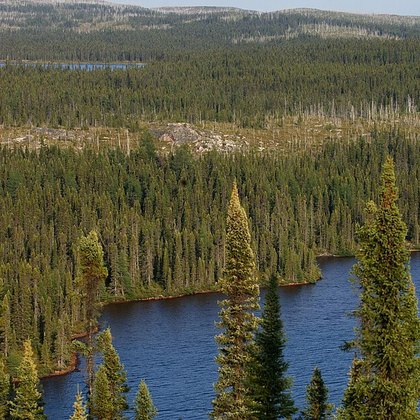
Coniferous and pine-oak forest, from sea level in the northwest up to near treeline in the mountains; in Mexico and Central America in the highlands. Density is lower in the central Rocky Mountains and in the scrub and desert of the Great Basin. It is common in built-up areas, at campgrounds and in orchards and gardens with forest nearby, and comes to feeders, preferring sunflower seed, cracked corn and whole raw peanuts, and suet in winter.
Where the bird is most often found, arranged by the USNVC — the vegetation classification of the United States and Canada — and CMECS for sea and coast.




Range and movements
Resident from southern Alaska and coastal British Columbia south through the western United States to west Texas, and on through the Sierra Madre Occidental, the Sierra Madre Oriental and the Mexican volcanic belt to the mountains of Guatemala, El Salvador, Honduras and northern Nicaragua. In the north the range is expanding: from southeast Alaska across the Coast Mountains into southern Yukon. There is no true migration; mountain birds drop to lower elevations in winter, and wanderers occasionally reach the prairie states.
- Resident
- Breeding (summer)
- Winter
- Passage
- dark = core range, pale = thinly spread
Where and when to look
Look for it at a campground or picnic area in conifer forest: the birds come to scraps and will then allow an approach to within a few metres. If you hear a Red-tailed Hawk inside dense conifer forest with no open sky above, check the treetops first — it is often the jay. For subspecies marks a look at the forehead is enough: white streaks point to inland birds, a plain blackish-brown head to coastal ones.
Conservation
The species is assessed as of least concern and is common throughout its range. It benefits from human presence around campgrounds and houses, which has local consequences for other birds: at a few sites on the Pacific coast it has been recorded taking Marbled Murrelet nests, and raised numbers around recreation areas are linked to that predation. Beyond this no large-scale threats are known.
Scientific name
Cyanocitta stelleri | (Gmelin, 1788)
Gmelin described the species in 1788 as Corvus stelleri, from Latham's 1781 account of a specimen from Nootka Sound on Vancouver Island collected on James Cook's third voyage; because the species was later moved, author and year stand in parentheses. The genus Cyanocitta was introduced in 1845 by Hugh Strickland, from Greek kyanos 'dark blue' and kitta 'jay'. The species name honours Georg Wilhelm Steller, the German naturalist who was the first European to record the bird, in 1741. The species is the provincial bird of British Columbia.