All species › Passerines › Crows, jays and magpies › Pinyon Jay
Pinyon Jay | Gymnorhinus cyanocephalus
Pinyongaai | Chara piñonera
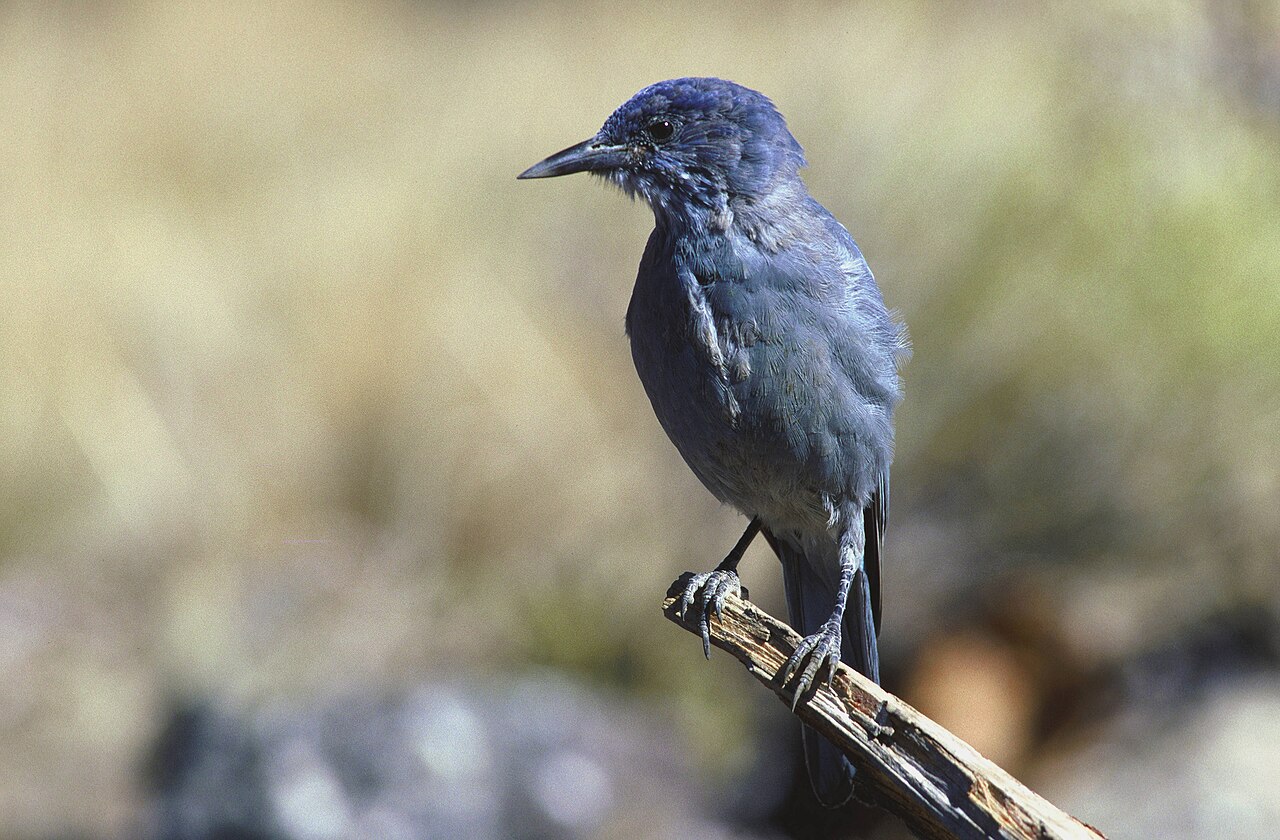
The Pinyon Jay is a crestless, blue-grey jay of the pinyon-juniper woodland of the American West. It lives in flocks of tens to hundreds of birds and depends largely on the seeds of the pinyon pine, which it buries by the thousand each autumn. The population has been falling steeply for decades.
Voice
A flock is audible almost continuously. The contact call is a crow-like, nasal caw or kwee-eh with a marked rising end, usually in series of two or three and given by several birds at once. Alongside it come a rolling laugh, a high kree-kree and soft gurgling notes within the flock. An approaching group is often heard several minutes before it is seen.
No freely licensed recording has been found for this species yet; what to listen for is described below.
Identification
About 26 to 29 centimetres long, with a wingspan around 46 centimetres and a weight of 90 to 120 grams. The plumage is an even blue-grey, with a deeper blue head and a dingy white throat patch with fine pale streaking. There is no crest. The bill is long, straight and dagger-like, without the nasal bristles other corvids carry at the base of the bill, and the tail is short. The outline therefore suggests a small crow rather than a jay. Flight is direct and strong, with quick wingbeats, and usually in close formation.
Confusion species
Woodhouse's Scrub-Jay and California Scrub-Jay overlap in range and colour, but have a longer tail, a shorter bill, a clear white supercilium pattern and a white breast band; they also move alone or in pairs rather than in large flocks. Mexican Jay is greyer below, also longer-tailed, and sits further south in pine-oak woodland. Clark's Nutcracker shares the build and the seed-caching habit but is pale grey with black-and-white wings and tail; the similarity in proportions is convergence. Mountain Bluebird is far smaller, brighter blue, and hunts from a perch.
Habitat
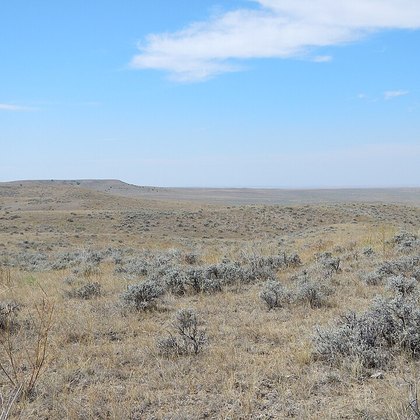
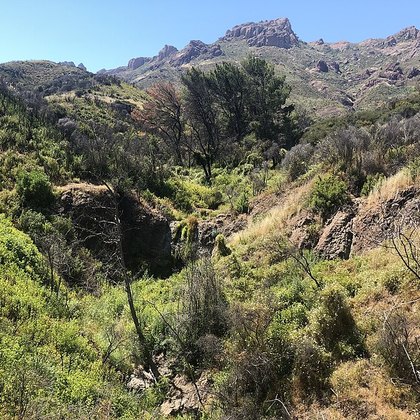
Pinyon-juniper woodland roughly between 1200 and 2400 metres is the core; beyond it, ponderosa pine forest at lower elevations, sagebrush, scrub oak and chaparral. The pinyon pine supplies the food, the juniper often the nest site, and the open ground beneath them the cache sites. Flocks also come into villages and to feeders along the edge of the woodland. A single bird may cache more than twenty thousand seeds in one season, one to seven per hole, preferably on the sunny side where snow melts first; from November to February up to ninety per cent of the diet comes from those stores. Trials show that the birds relocate a cache of their own after a week, and also remember where flock-mates have hidden something.
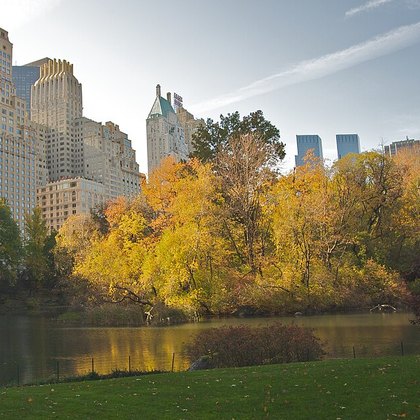
Where the bird is most often found, arranged by the USNVC — the vegetation classification of the United States and Canada — and CMECS for sea and coast.


Range and movements
Resident from central Oregon and the Great Basin east to western South Dakota and south to northern Baja California, Arizona, central New Mexico and western Oklahoma; west Texas and Montana are included. There is no true migration, but in years of poor seed crops flocks wander far outside the range, reaching Washington, California, Iowa and Saskatchewan. Within the range flocks move tens of kilometres between woodlands that are bearing and those that are not.
- Resident
- Breeding (summer)
- Winter
- Passage
- dark = core range, pale = thinly spread
Where and when to look
In autumn, drive slowly through pinyon-juniper woodland with the windows down and listen; the flock gives itself away with the nasal caw long before it is visible. If you see one, wait: dozens will follow. For the outline, watch the short tail and the long straight bill — at distance and against the light these are the most reliable marks.
Conservation
The IUCN lists the species as Vulnerable. Breeding Bird Survey counts show a decline on the order of eighty per cent since 1970, some three to four per cent a year. The extent of pinyon-juniper woodland has not shrunk to the same degree over that period, which indicates that simple loss of area is not the whole explanation; drought and heat that interrupt pinyon seed production, large-scale die-off of pinyon pines, mechanical removal of juniper for livestock range, and the opening up of woodland for oil and gas development are all cited. Defenders of Wildlife petitioned in 2022 for listing under the Endangered Species Act; the federal agency found the petition warranted further review, but no decision has yet been made.
Scientific name
Gymnorhinus cyanocephalus | Wied-Neuwied, 1841
Maximilian zu Wied-Neuwied described the species in 1841 from a specimen taken on the Marias River in Montana. The genus Gymnorhinus comes from Greek gymnos 'naked' and rhis, rhinos 'nose': unlike other corvids, the nostrils are not covered by bristle feathers. The species name cyanocephalus is Greek for 'blue-headed'. The species is the only one in its genus and has no recognised subspecies. Older English names are blue crow and Maximilian's jay; Pinyon Jay is the name settled on by the international committee.