All species › Waders, gulls and terns › Skimmers, noddies, terns and gulls › Bonaparte's Gull
Bonaparte's Gull | Chroicocephalus philadelphia
Kleine kokmeeuw | Gaviota de Bonaparte
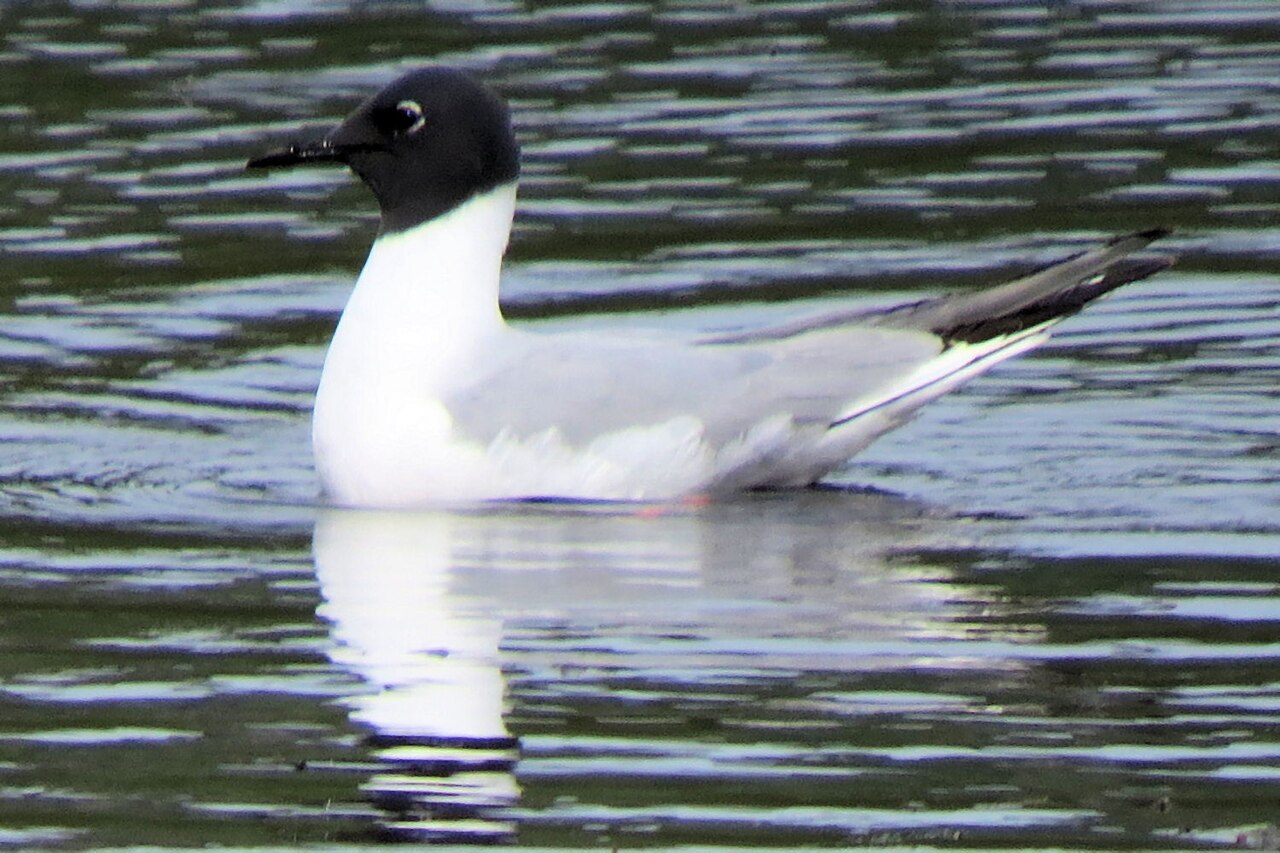
Bonaparte's Gull is a slight, tern-like gull with a black hood, a thin black bill and a long white wedge in the wingtip that flashes with every beat. It is the only gull in the world that regularly nests in trees: high in a spruce at the edge of a bog pool in northern Canada and Alaska. Outside the breeding season it turns up all along the coasts and on the Great Lakes, in tight, fast-moving flocks.
Voice
The call is nasal and raspy, a short cherr or drawn-out cheeer, with little of a gull about it and much of a tern. A feeding flock over a tide rip keeps up a soft, continuous grating chatter that reaches you before the birds do. At the nest it is noisy and aggressive, and a group driving off a crow or a jaeger makes a high rattling din. In winter it is at its quietest, and it is the flight rather than the voice that draws the eye.
Recording: Stanislas Wroza — CC BY-NC-SA 4.0 · La Haute-Côte-Nord Regional County Municipality (near Les Escoumins), Côte-Nord, Quebec, Canada · xeno-canto
Identification
A small gull with a fine, thin, wholly black bill, a pale grey mantle and a light, buoyant flight that suggests a tern. In breeding plumage it wears a slate to black hood with narrow white eyelids, and the legs are orange-red. The best mark is in the wing: a long white wedge runs along the whole outer edge of the upperwing, with a narrow black trailing border at the tip, and the underwing is clean white and translucent against the light. In winter plumage the head is white with a single round dark ear spot, and the legs are flesh-coloured. First-year birds carry a dark M across the upperwings, a black tail band and the same ear spot, but already show the white wedge.
Confusion species
Black-headed Gull (Chroicocephalus ridibundus) is the most similar, and in winter along the northeast coast the two often stand in the same flock: it is larger and heavier, with a red or dark red rather than black bill, a chocolate-brown rather than black hood, and — decisively — a dark grey rather than white underside to the primaries. Little Gull (Hydrocoloeus minutus) is smaller still, has rounded wings without a white wedge, and in adults a sooty black underwing. Laughing Gull (Leucophaeus atricilla) and Franklin's Gull (Leucophaeus pipixcan) have a dark grey mantle, a heavier bill and no white wedge in the wing. Whenever in doubt, look first at the underside of the wingtip: on Bonaparte's Gull it is clean white.
Compare gulls: legs, head, bill and wing tip side by side
Habitat
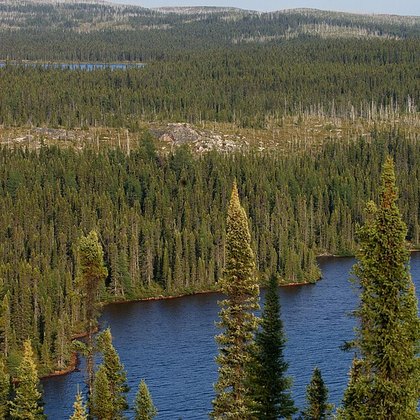
It breeds in the boreal forest, in the seam between bog and conifer wood: small lakes, fens and slow streams ringed with black spruce, tamarack and jack pine (a small pine of poor sandy soils in the eastern boreal zone), where it builds a nest of twigs and lichen three to twelve metres up in a tree, usually within a few tens of metres of water. There it eats mainly insects, plucked from the air like a swallow or picked off the water surface. Outside the breeding season it is a bird of estuaries, bays, harbours, tide rips, outfalls, reservoirs and the Great Lakes, wherever current brings small fish and shrimp to the surface. It ignores the rubbish dumps and ploughed fields where the big gulls gather.
Where the bird is most often found, arranged by the USNVC — the vegetation classification of the United States and Canada — and CMECS for sea and coast.




Range and movements
It breeds in a broad band through the boreal forest, from southwestern Alaska and Yukon across interior Canada to eastern Quebec, scattered and nowhere in dense colonies. In winter it is on both coasts: on the Pacific side from British Columbia south to western Mexico, on the Atlantic side from New England to Florida, along the Gulf Coast to Texas, inland in the southeast and out to the Bahamas and Cuba. Migration passes in numbers over the interior and the Great Lakes, with large concentrations on the Niagara River in November and December, where tens of thousands can gather at once. As a breeder of country that is hard to reach it has never been counted well; what figures there are point to a stable or increasing population.
- Resident
- Breeding (summer)
- Winter
- Passage
- dark = core range, pale = thinly spread
Where and when to look
Go to the Niagara River in November, or to a tide rip at a harbour mouth, and look not for a single bird but at the behaviour of the flock: Bonaparte's Gulls fly low into the wind, dipping to take prey, then drift back downwind and start again, like a conveyor belt. In spring, at high tide with an easterly wind, they stand together along the shore and it pays to go through every flock: among the hundreds there is sometimes a rare Black-headed Gull.
Conservation
The species is listed as Least Concern (LC); the world population is put at some two hundred and sixty thousand birds and has probably increased over the past century; it scores low on the North American watch lists. Its breeding range lies largely beyond farming and settlement, which protects it but also makes it hard to monitor. The known risks are heavy metals and other poisons that build up in the water, and shifts in the food supply at sea and in the lakes as the climate changes.
Scientific name
Chroicocephalus philadelphia | (Ord, 1815)
George Ord described the species in 1815 as Sterna philadelphia — he took it for a tern, which says something about how tern-like it looks; because it now stands among the gulls, author and year are in parentheses. The genus Chroicocephalus was introduced by Eyton in 1836 and is Greek, from chroa for colour and kephale for head, after the coloured hood that most species in the genus wear in summer. philadelphia simply means of Philadelphia: the described specimen came from near that city. The English name honours Charles Lucien Bonaparte, Napoleon's nephew, who spent several years in the United States in the 1820s working on the naming of birds.