All species › Tubenoses › Petrels, shearwaters and diving petrels › Bonin Petrel
Bonin Petrel | Pterodroma hypoleuca
Boninstormvogel | Petrel de las Bonin
Bonin Petrel is one of the few petrels in the genus Pterodroma that actually breeds within the guide area: in the northwestern Hawaiian Islands it digs its burrow by the thousand, so that some islands become, after dark, a solid carpet of calling birds. By day, at sea, none of that commotion shows: then it is a quiet, grey-and-white tubenose seen alone, far from any land.
Voice
At the burrow a series of nocturnal sounds carries: a growling, low-pitched churr with which a bird greets its mate or defends its burrow, a raucous kukuer and a high, rapid tititi. During courtship pairs chase each other calling above the colony in pitch darkness, since the species almost never visits land in daylight. On the open sea, far from the breeding islands, Bonin Petrel is silent.
Recording: Percy Ulsamer — CC BY-NC-SA 4.0 · Volunteer House, Sand Island, Midway Atoll, United States · xeno-canto
Identification
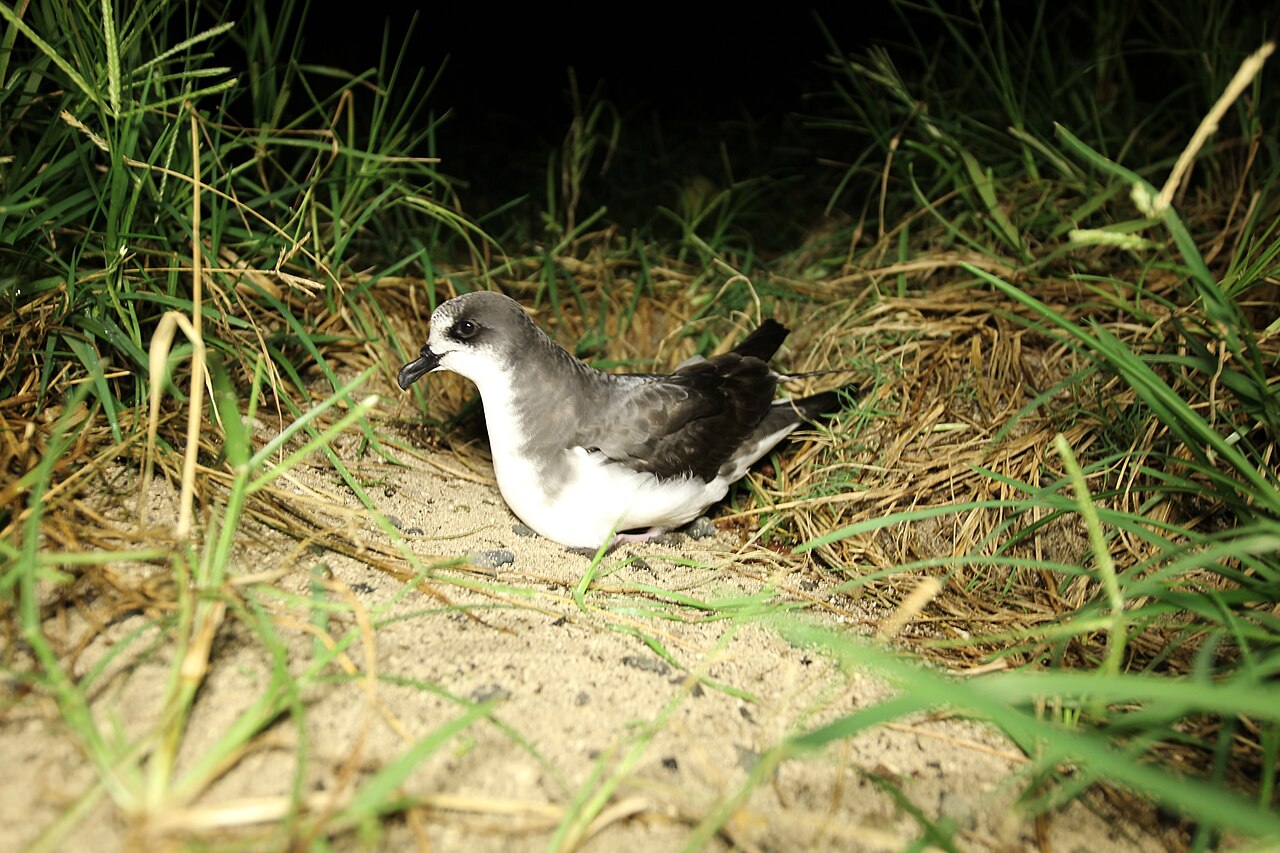
Above, Bonin Petrel is pale grey, with a dark 'M' pattern crossing the wings and rump — a pattern that recurs in many petrels of this genus. The head is white with a sharply defined black cap and facial markings, and a dark half-band crosses the breast like a partial collar. The underwing is white with a dark trailing edge and a dark patch at the wing bend, the tail is grey, and the legs are pink with dark patches. Male, female and juvenile look alike. In flight it alternates quick wingbeats with long glides, banking high above the waves in its typical fashion.
Confusion species
Black-winged Petrel (Pterodroma nigripennis), of similar size and likewise commonly seen around Hawaii, has a vague grey cap rather than a sharply black one, lacks the dark breast band, and has black rather than pink legs. Tristram's Storm-Petrel, which breeds on the same islands, is much smaller and entirely dark, without any white. Bulwer's Petrel is also mostly dark, with a long, pointed tail that Bonin Petrel entirely lacks. At a distance the combination of the white head with black cap and the clear 'M' pattern on the back is the most reliable feature.
Habitat
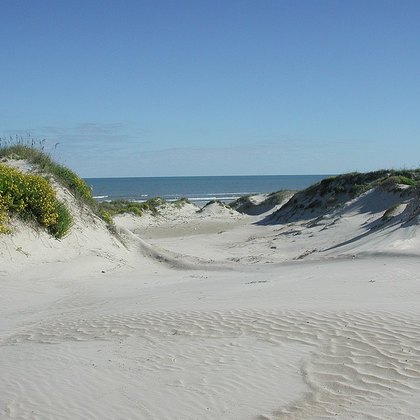
For breeding, Bonin Petrel seeks low, grass-covered or bare sandy flats and coral rubble on remote islands, where it digs a tunnel sometimes more than a metre long. At sea it is a bird of open, subtropical to tropical water far from shore, where it takes squid and small fish from the surface at night. It avoids inhabited islands and the mainland almost entirely; even within the Hawaiian archipelago it breeds almost exclusively on the uninhabited islands of the northwest.
Where the bird is most often found, arranged by the USNVC — the vegetation classification of the United States and Canada — and CMECS for sea and coast.

Range and movements
Bonin Petrel breeds in the northwestern Hawaiian Islands — from French Frigate Shoals to Kure Atoll, with the largest colonies on Lisianski and Laysan — and also on the Volcano and Bonin Islands south of Japan, from which the Dutch name (and the English one) is taken. After breeding, the birds head north in July and August to waters off Honshu and Sanriku in Japan, returning to the colonies in September. On the main Hawaiian Islands the species bred before the arrival of the Polynesians, but hunting and introduced predators wiped it out there; only the uninhabited islands of the northwest still hold breeding colonies.
- Breeding (summer)
Where and when to look
Within this area Bonin Petrel is practically never seen from the mainland; the one practical chance is a visit to Midway Atoll, one of the few northwestern Hawaiian islands occasionally open to visitors, where the birds emerge from the ground after sunset and fill the air with their calls. By day there is little to see on the island itself, since the birds then sit deep in their burrows.
Conservation
With between 270,000 and 395,000 breeding pairs, Bonin Petrel is not considered threatened, but numbers on individual islands have taken heavy blows: on Midway Atoll the colony collapsed under introduced rats from an estimated 250,000 to only 5,000 pairs before the rats were eradicated there and recovery began. Introduced rabbits elsewhere ate away the vegetation that protects the burrows from erosion, and artificial light from buildings and antenna masts disorients flying birds at night, causing them to collide with obstacles.
Scientific name
Pterodroma hypoleuca | (Salvin, 1888)
British ornithologist Osbert Salvin described the species in 1888 as Oestrelata hypoleuca; because it has since been placed in another genus, author and year stand in parentheses. The genus Pterodroma was introduced in 1856 by Bonaparte, from the Greek for 'wing' and 'runner', after the fast, banking flight of this group. hypoleuca is Greek for 'white below', referring to its white underparts. The type locality Salvin gave, the 'Krusenstern Islands', does not exist: the collector used that name instead of the actual location, one of the islands in the western Hawaiian chain.