All species › Passerines › New World sparrows › Botteri's Sparrow
Botteri's Sparrow | Peucaea botterii
Botteri's gors | Chingolo de Botteri
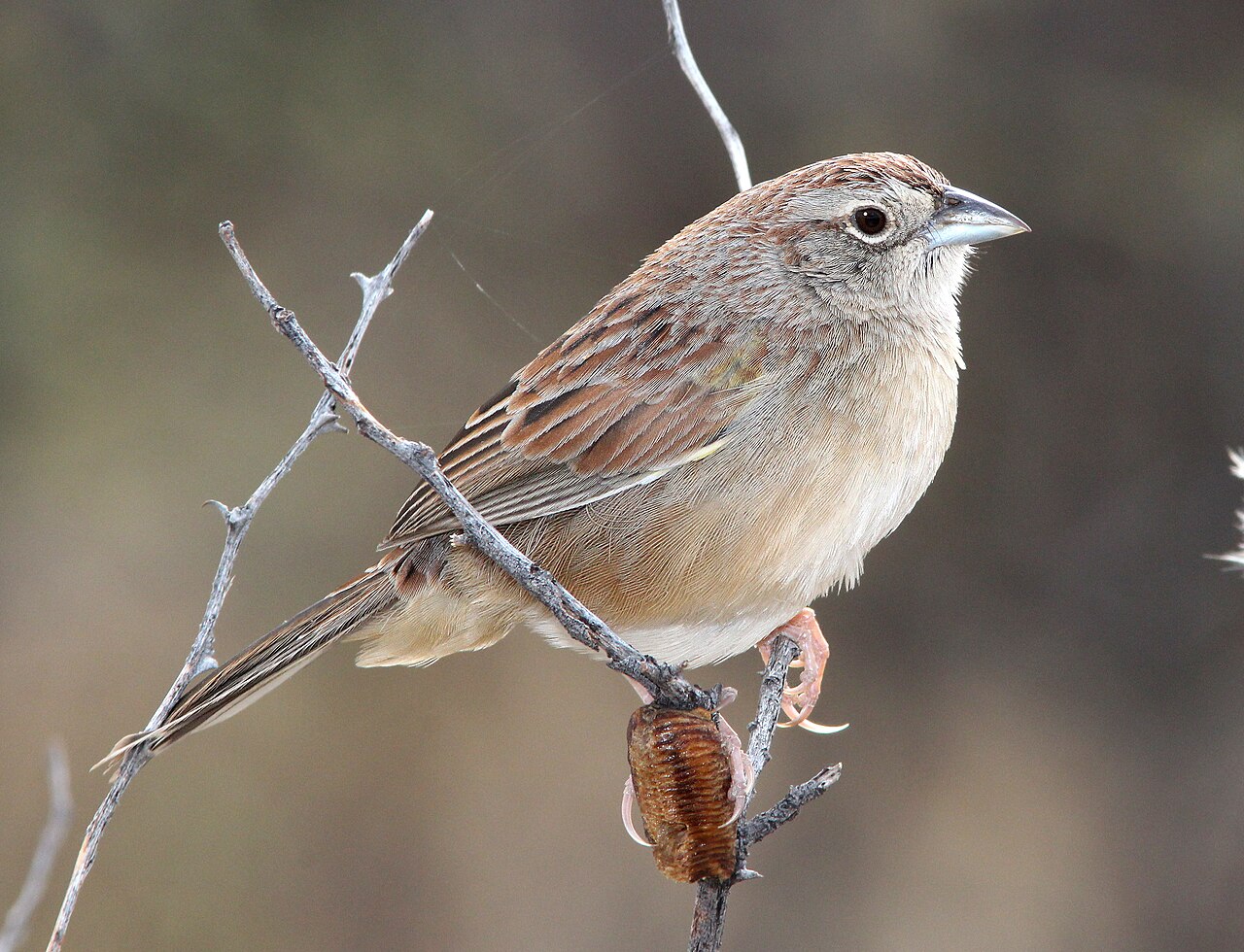
Botteri's Sparrow is a large, plain brown grassland sparrow with a heavy bill and a long, rounded tail. In the United States it breeds in two separate areas: the desert grasslands of southeastern Arizona and the coastal prairie of south Texas. It almost always gives itself away by song first.
Voice
The song is a bouncing series: a few separate chip notes that follow ever faster and run out into a dry trill, like a small ball bouncing to a halt on a stone floor. That acceleration is the most reliable mark of the species. Only the male sings, usually from a shrub or a yucca, sometimes in a short flight, but without the high song flight of Cassin's Sparrow. Calls are a short tsip, often doubled, and a chattering chr-r-r.
Recording: Manuel Grosselet — CC BY-NC-SA 4.0 · Santa María del Tule, Santa María del Tule, Oaxaca, Mexico · xeno-canto
Identification
Grey-brown to russet above with fine black streaks, plain cream to dingy white below, without breast streaking and without a central breast spot. The head is flat, the bill large and grey-blue with a darker upper mandible; a thin brown line runs behind the eye and the supercilium is pale and inconspicuous. The tail is long, rounded and plain brown, with faint bars on the central feathers. Male and female are alike.
Confusion species
Cassin's Sparrow is the direct confusion species and often nests in the same field. Cassin's has pale grey to whitish tips to the outer tail feathers, fine streaking on the flanks, and dark arrowhead marks on the back feathers; Botteri's has a plain brown tail without pale tips and unstreaked flanks. The difference in song is greater than the difference in plumage: Cassin's sings a sustained high trill with two lower closing notes from a song flight, Botteri's the bouncing acceleration from a shrub. Bachman's Sparrow, which approaches it in Texas, is redder on crown and back and has a grey face with a rufous eyeline.
Habitat
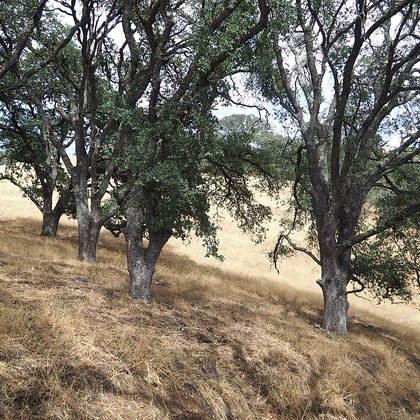
Tall, dense bunchgrass with scattered shrubs: in Arizona the sacaton flats and desert grasslands up to about 1500 metres, in Texas the coastal prairie with cordgrass and scattered mesquite (a thorny pod-bearing shrub of the Southwest that forms dense thickets). Grazing that keeps the grass short makes a site unsuitable. Further south it also uses oak savanna, and in the southern part of the range open lowland pine savanna.
Where the bird is most often found, arranged by the USNVC — the vegetation classification of the United States and Canada — and CMECS for sea and coast.




Range and movements
The main range lies in Mexico, from Sonora and the central highlands to the Gulf slope and Yucatán, and on into Belize, Guatemala, Honduras and Nicaragua, where it is resident. Birds of southeastern Arizona, southwestern New Mexico and northern Mexico are migratory: they arrive in May, breed with the monsoon and leave in September and October. In south Texas the species is present from spring to late summer on the coastal prairie of Kenedy and Kleberg counties and nearby.
- Resident
- Breeding (summer)
- Winter
- Passage
- dark = core range, pale = thinly spread
Where and when to look
Go early in the morning in July or August to a sacaton flat in the San Rafael Valley or the Sonoita grasslands and listen for the bouncing acceleration. Outside the singing season it is rarely seen: it runs off over the ground rather than flushing, and seldom stays in view.
Conservation
Partners in Flight puts the world population at about 170,000 breeding birds, some 30,000 of them in the United States; its Continental Concern Score is 13 out of 20. In Arizona numbers appear stable in recent decades, after earlier loss of grassland to grazing and shrub encroachment. In Texas numbers have fallen historically along with the coastal prairie itself, part of which survives in reserves. The IUCN regards the world population as stable.
Scientific name
Peucaea botterii | (Sclater, 1858)
Philip Lutley Sclater described the species in 1858 as Zonotrichia botterii; because it was later moved to Peucaea, author and year stand in parentheses. The genus name Peucaea is from Greek peukē 'pine'. The species name honours Matteo Botteri (1808–1877), a Dalmatian-born naturalist who settled at Orizaba, Veracruz, and collected the type specimen there. The Dutch, English and Spanish names all refer to him.