All species › Passerines › New World sparrows › Rufous-winged Sparrow
Rufous-winged Sparrow | Peucaea carpalis
Roestvleugelgors | Chingolo alirrufo
The Rufous-winged Sparrow is a grey-brown ground sparrow of the Sonoran Desert that in the United States occurs almost only in southern Arizona, around Tucson and along the border valleys. It stays in the same scrub all year and breeds only once the summer monsoon has fallen.
Voice
Only the male sings, and unlike most sparrows he does so in every month of the year. The song opens with two or three separate clear notes and runs into a dry, rapid trill: chip chip cheee-r-r-r. The call is a thin tseet or a shorter pip, and pairs keep contact with a soft tslip. After the first heavy monsoon storm singing increases sharply; that is the signal that the breeding season has begun.
Recording: Pat Goltz — CC BY-NC-SA 4.0 · Proctor Road, Madera Canyon, Arizona, United States · xeno-canto
Identification
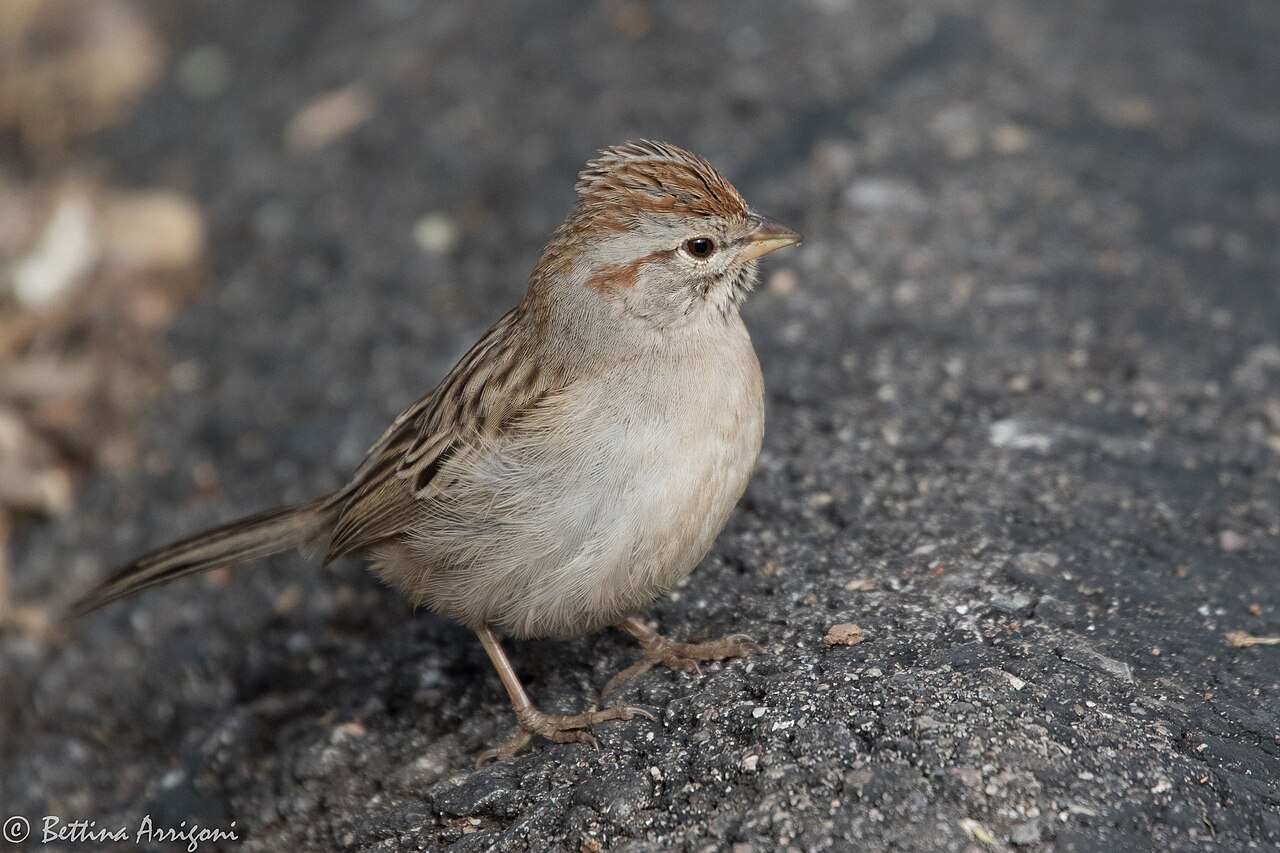
A slim, long-tailed sparrow with a pale pinkish to horn-coloured bill and a grey face. The crown is rufous with a thin grey central line, and a rufous stripe runs back from the eye. The underparts are plain greyish white, without streaking. Two features place it: a cinnamon-rufous patch at the bend of the wing, and a dark malar stripe running down each side of the throat — two stripes, not one. Male and female look alike; young birds have a streaked breast.
Confusion species
The grey face and rufous crown invite confusion with Rufous-crowned Sparrow, which has a single dark malar stripe instead of two, a deeper grey face, no rufous shoulder patch, and sits on rocky slopes rather than in mesquite scrub. Chipping Sparrow in breeding plumage has a black eyeline, a white supercilium and no rufous at the bend of the wing. Botteri's Sparrow is larger, browner and streaked above, without a rufous crown or shoulder patch.
Habitat
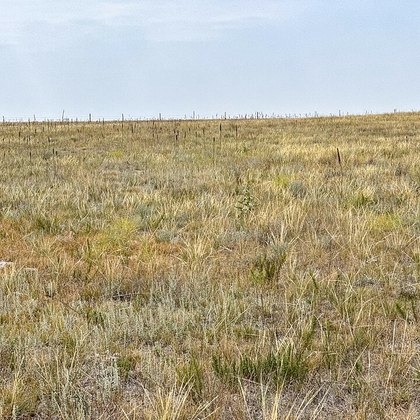
Desert scrub with mesquite (a thorny leguminous shrub of the Southwest that forms dense thickets), acacia, thorn shrubs and cholla, always over a layer of bunchgrass — grassland without shrubs, or scrub without grass, it does not use. It also occurs along dry watercourses, beside irrigation canals and in washes with fairly tall shrubs. In Mexico it occupies comparable thornscrub as far as the coastal belt of Sinaloa.
Where the bird is most often found, arranged by the USNVC — the vegetation classification of the United States and Canada — and CMECS for sea and coast.



Range and movements
The range is small and continuous: from the Santa Cruz and San Pedro valleys near Tucson south through Sonora to Sinaloa. In Arizona it is local and not numerous; the edge of the range lies roughly at Phoenix. There is no migration — birds remain year-round in the same scrub, and numbers fluctuate with rainfall. In the 1880s and 1890s it disappeared from the country around Tucson after heavy overgrazing and drought, and was not recorded there regularly again until after 1930.
- Resident
- Winter
- Passage
- dark = core range, pale = thinly spread
Where and when to look
Look for it in July or August, shortly after the first monsoon storms: the male then sings from the top of a mesquite and carries a long way. Outside that period he stays low in the scrub. With any grey-faced sparrow in southern Arizona, check the throat first: two dark malar stripes point to this species, one to Rufous-crowned Sparrow.
Conservation
The species is listed as Least Concern (LC); the world population is estimated at about 200,000 mature birds and the trend is downward. The species depends on the combination of thornscrub and native bunchgrass, and that combination is being lost to urban growth around Tucson, to grazing, and to the spread of introduced buffelgrass, which fuels fires that mesquite and cholla do not survive. The United States range is small enough for a regional decline to show up in the national surveys.
Scientific name
Peucaea carpalis | Coues, 1873
Elliott Coues described the species in 1873 from a specimen taken at Tucson, Arizona, and placed it directly in Peucaea; author and year therefore stand without parentheses. The genus name Peucaea goes back to Greek peukē 'pine', referring to the pine woodland in which the first species of the genus, Bachman's Sparrow, was found. The species name carpalis is from Latin carpus 'wrist' and refers to the rufous feathers at the bend of the wing — the same feature that gives the English name.