All species › Passerines › Finches, euphonias and allies › Brambling
Brambling | Fringilla montifringilla
Keep | Pinzón real
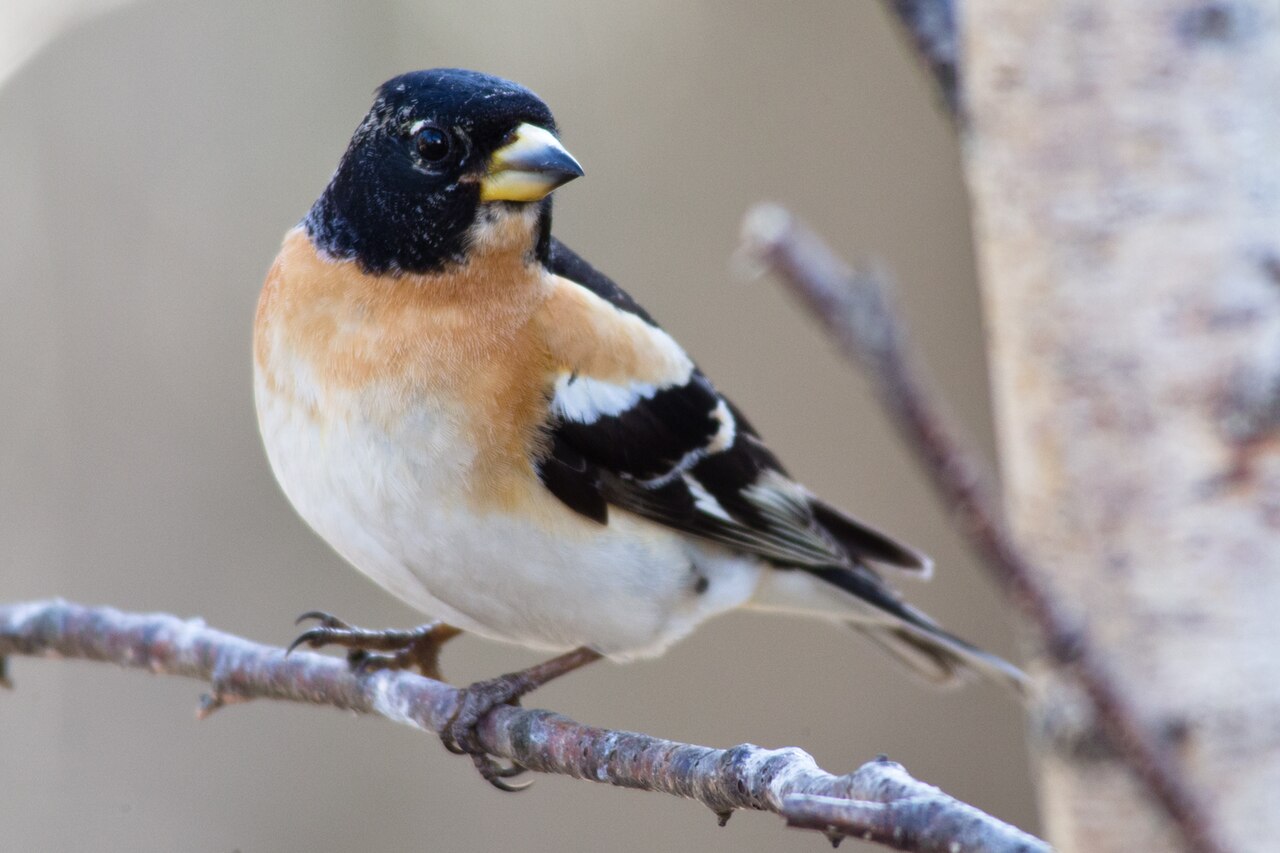
The Brambling is a Eurasian finch with a white rump and orange shoulders that appears annually in small numbers on the Aleutians and the Bering Sea islands. It is the finch of northern birch and conifer forest; away from Alaska it turns up scattered across the continent, usually at a winter feeder.
Voice
The flight call is a nasal, hard chek or kwek, often given by a whole flock at once as it flushes. The song is a drawn-out, hoarse zhreee, a single note held for several seconds and recalling the sound of a Greenfinch; it is delivered from a high branch in the breeding wood and repeated at long intervals. Winter flocks keep up a soft continuous chatter while feeding under beeches and birches.
Recording: Toy Janssen — CC BY-NC-SA 4.0 · Telpost Vogelwacht Uden (near Schaijk), Landerd, Noord-Brabant, Netherlands · xeno-canto
Identification
In breeding plumage the male has a black head and mantle, an orange-buff breast and shoulders and a white belly with black spots along the flanks. Outside the breeding season head and mantle are brown with black scaling, the black emerging only in spring as the feather fringes wear away. In every plumage and at every age the sharply defined white rump stands out as the bird flies off, and the tail is short and forked. The female is duller, with a greyer head and two dark stripes over the side of the crown.
Confusion species
Common Chaffinch, its closest relative, has a green rump instead of white, a pinkish-brown rather than orange breast and white shoulder bars. A winter-plumaged Snow Bunting shows far more white in the wing and no orange. North American observers most often take a Brambling for a Summer Tanager or an American Goldfinch at a feeder; the combination of orange breast, orange shoulder panel, black flank spots and white rump rules all of those out.
Habitat
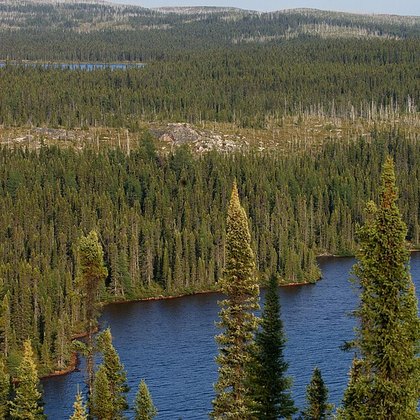
Breeds in open conifer and birch woodland of the taiga and in scrub at the treeline. Outside the breeding season it depends on seed-rich deciduous woodland — beech above all — and on stubble, field edges and gardens with feeding stations. In Alaska birds are seen on bare island slopes and in village gardens, where cover and seed are scarce and a flock may stay at one spot for days.
Where the bird is most often found, arranged by the USNVC — the vegetation classification of the United States and Canada — and CMECS for sea and coast.




Range and movements
The breeding range spans northern Eurasia from Scandinavia to Kamchatka, with wintering in southern Europe, North Africa and southern and eastern Asia. Across the Bering Sea it reaches western Alaska annually in small numbers: the western Aleutians, St. Lawrence Island, the Pribilofs and the coast near Nome, chiefly in May and again in September and October. Some of those birds carry on: there are scattered winter records from British Columbia, the northern United States and southern Canada, usually single birds at a feeder.
Where and when to look
On the Aleutians late May offers the best chance, when persistent westerly winds bring migrants off the Asian coast. Elsewhere on the continent it is almost always one bird among House Sparrows or goldfinches at a feeder: scan winter flocks for a bird with an orange breast, and check the white rump as it flushes.
Conservation
The world population is put at 100 to 200 million birds and the species is listed as Least Concern (LC), though the trend is downward. Numbers swing strongly from year to year with the beech mast crop in the winter quarters, so that roosts of millions of birds form in some winters and not in others. No management applies to its North American occurrence; these are stray birds at the edge of a large Eurasian range.
Scientific name
Fringilla montifringilla | Linnaeus, 1758
Linnaeus described the species in 1758 as Fringilla montifringilla, and because it still stands in that genus author and year carry no parentheses. Fringilla is the Latin word for a finch; the species name adds mons 'mountain', so 'mountain finch'. The Dutch name keep and the English brambling are old vernacular names of uncertain origin of uncertain origin and has nothing to do with brambles. The type material came from Sweden.