All species › Passerines › New World blackbirds, troupials and allies › Brown-headed Cowbird
Brown-headed Cowbird | Molothrus ater
Bruinkopkoevogel | Tordo cabeza café
The Brown-headed Cowbird builds no nest and incubates no eggs: the female lays them in another songbird's nest and leaves the work to the owner. More than two hundred host species have been recorded, and a single female may lay several dozen eggs in one summer. It is the brood parasite spread over most of North America, and in this guide it keeps turning up in the text about some other bird.
Voice
The male's song is a short, bubbling introduction followed by two thin, high whistles, glug-glug-glee, delivered with the wings drooped and the body bowed deeply forward. He also has a series of sharp whistles, tsee-chee-chee, given from a wire or in flight. The female answers with a dry rattle, chrr, often just before she visits a nest. The highest notes of the song lie so high that not everyone still hears them; what is left then is the bubbling at the start.
Recording: Stanislas Wroza — CC BY-NC-SA 4.0 · Lotbinière (near Notre-Dame-du-Sacré-Coeur-d'Issoudun), Chaudière-Appalaches, Québec, Canada · xeno-canto
Identification
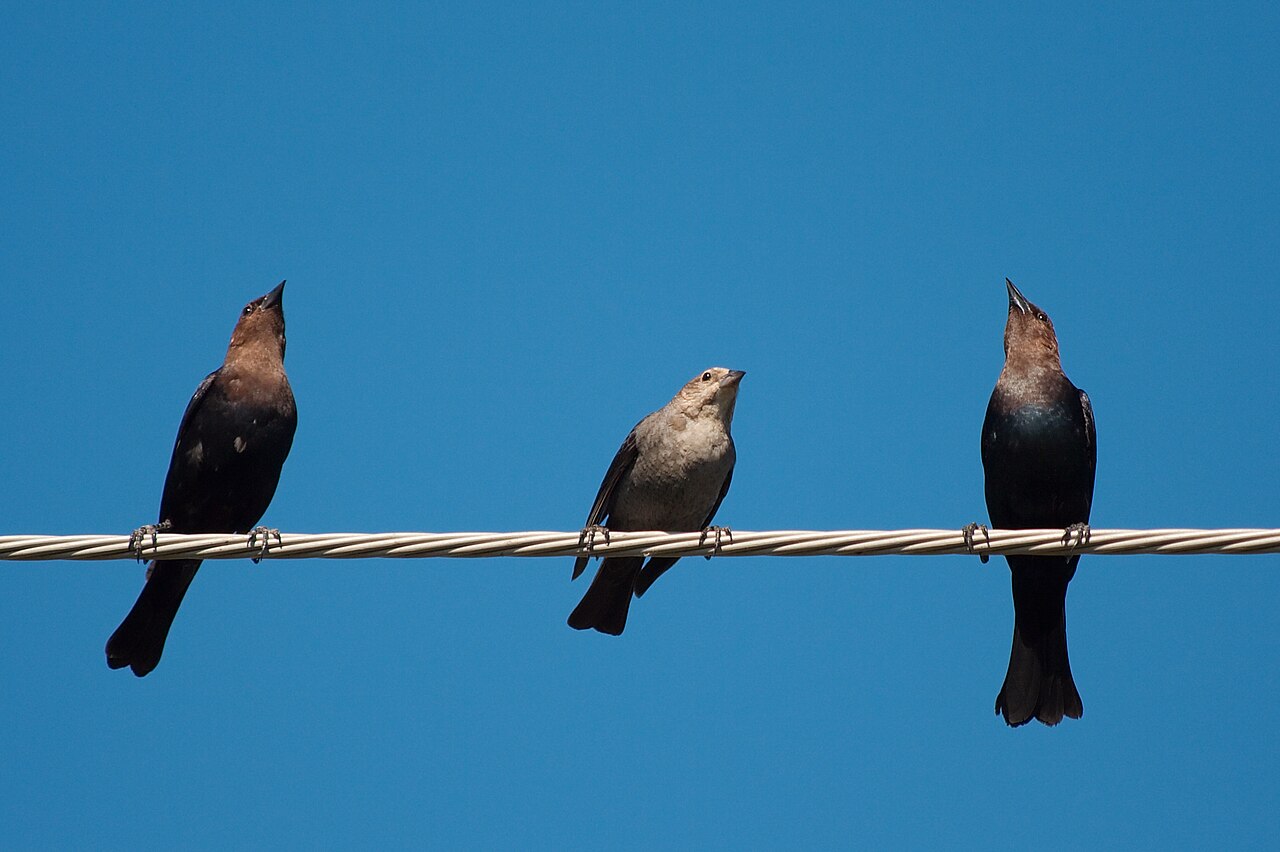
The male is glossy black with a dull brown head and neck, and in side light that head looks as though it came off another bird. The female is plain grey-brown, a little paler on the throat, with faint streaking below and a dark eye with no markings around it. Both have a short, thick conical bill, a rather heavy head and a short tail; on the ground they walk with the tail held slightly up. Young birds are grey-brown with pale feather edges on the back, which makes the upperparts look scaled, and with coarse streaks on breast and belly. Such a youngster is often fed by a foster parent half its size, and that sight names the species faster than any plumage mark.
Confusion species
European Starling is as dark but has a long, pointed bill, an even shorter tail and triangular wings, and outside the breeding season it is closely spotted with white. Red-winged Blackbird is longer-tailed and sharper-billed, and the male carries red shoulders. The female cowbird is most often taken for a sparrow; then the short, deep conical bill, the plain grey-brown face without markings and the faint streaking decide. In the southwest Bronzed Cowbird (Molothrus aeneus) joins in: it is larger, has a red eye, and the displaying male puffs out a ruff on the neck.
Habitat
Half-open country with short vegetation and a woodland edge or hedgerow nearby: pasture with stock, mown fields, farmyards, verges, lawns and feeding stations. It feeds walking on the ground, often among grazing animals that stir up insects, and uses the woodland edge to find nests. It avoids unbroken forest, but enters it along every road, clearing and field margin; a wood cut into pieces consists for this bird almost entirely of edge. Outside the breeding season it roosts in large mixed flocks in reeds and dense scrub.
Where the bird is most often found, arranged by the USNVC — the vegetation classification of the United States and Canada — and CMECS for sea and coast.





Range and movements
Breeds from southern Canada to central Mexico. Before 1800 it was mainly a bird of the shortgrass prairie, moving with the bison herds; the opening up of the eastern forest carried it to the Atlantic coast during the nineteenth century, and in the west stock farming did the same. Northern birds move in autumn to the southern United States and Mexico, where they join the resident birds; in the south it is present all year. Since about 1970 numbers have been falling again over most of the range.
- Resident
- Breeding (summer)
- Winter
- Passage
- dark = core range, pale = thinly spread
Where and when to look
In May or June stand at a woodland edge along a pasture and watch for a bird that sits low and still in a bush and barely moves: that is nearly always a female keeping an eye on a nest. Early morning gives the best chance; later in the day the females are feeding out in the open. In July and August the reverse can be observed: look for a small songbird feeding a youngster larger than itself.
Conservation
Not threatened (LC); the breeding population is put at well over a hundred million birds. The North American Breeding Bird Survey nonetheless shows a steady decline since 1966, of the same order as in other birds of farmland. Attention goes mainly to what it does to others: where a scarce host accepts the egg the burden can grow too heavy, and for Kirtland's Warbler the trapping of cowbirds was part of the rescue of the species.
Scientific name
Molothrus ater | (Boddaert, 1783)
Boddaert described the species in 1783 as Oriolus ater, among the orioles of the Old World; because it was later placed in another genus, author and year stand in parentheses. The genus Molothrus was introduced by Swainson in 1832, who gave no explanation for it; two readings have been carried along since, Greek molobros, 'greedy beggar', and a compound of molos, 'struggle', with throsko, 'to sire'. ater is Latin for matt black, as against niger for glossy black. The first specimen described came from Carolina, printed in the type locality record as 'Carohna'.