All species › Gamebirds › New World quail › California Quail
California Quail | Callipepla californica
Californische kuifkwartel | Colín de California
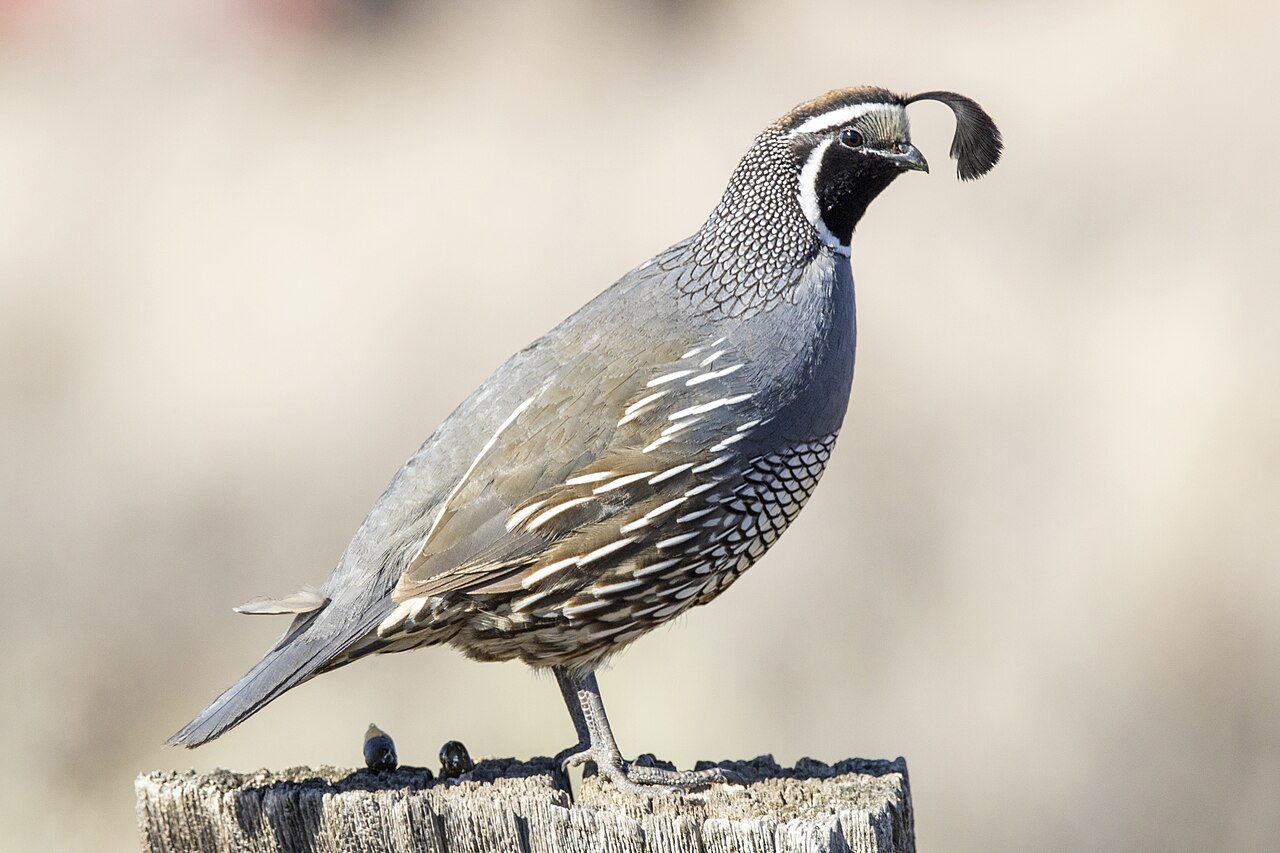
The California Quail is California's state bird and one of the most familiar birds of the West Coast: a compact, greyish-brown quail with a forward-curving, comma-shaped black plume and a finely scaled belly pattern reminiscent of chain mail. Large, bustling coveys scuttle through chaparral, oak woodland and suburban gardens, and the species has proved so successful that it has been deliberately introduced elsewhere in the world — from British Columbia to New Zealand and Chile.
Voice
The male gives a loud, rhythmic chi-CA-go, stressed on the second, highest syllable, which serves as an assembly call to bring the covey together and is distinctive among American quail. Contact between covey members is kept up with soft, short pip notes as they forage together over the ground. At danger a harsh, rising alarm call follows, at which the whole covey either runs off together or, if truly necessary, flushes. In the early morning, given from a low shrub or fence, the chi-CA-go is often the first sound that gives away a suburban neighbourhood with quail.
Recording: Jonathon Jongsma — CC BY-SA 3.0 · Fremont Older Open Space Preserve, Santa Clara, California, United States · xeno-canto
Identification
The male has a bluish-grey breast, an olive-brown back, a black face edged white along the forehead and throat, and a belly densely scaled in brown and black, like chain mail. The forward-curving black plume is made of several fused feathers and is noticeably longer than in the female. The female is more evenly greyish-brown, almost lacking the black-and-white facial pattern, with a fainter, less contrasting scaled belly. Juveniles resemble the female, with a still shorter plume. In flight the species shows short, rounded wings and a short tail, and coveys rarely fly far: usually just a short hop to the nearest cover.
Confusion species
Confusion with Gambel's Quail is greatest where their ranges meet in southeastern California and northern Baja California. The male California Quail has a densely scaled, olive-brown belly without a clear patch, against the plain creamy belly with one large black patch of Gambel's Quail, and its flanks are more reddish-brown and coarser marked rather than clean chestnut with white streaks. The female is harder to separate, but shows a more clearly scaled belly and less red on the flanks than the female Gambel's Quail. From Mountain Quail, whose range also touches it in northern California, California Quail is told at once by the curved rather than straight plume and its considerably smaller size.
Habitat
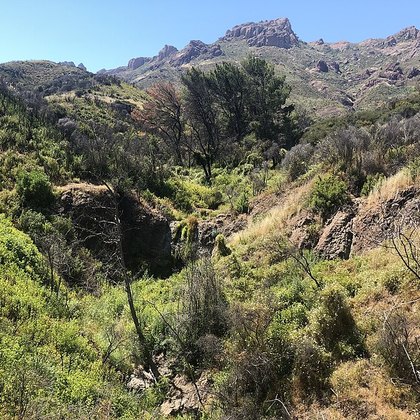
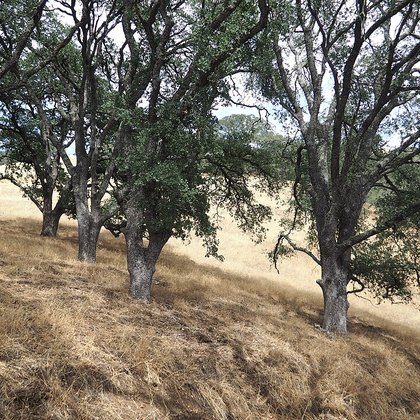
It occupies chaparral, coastal scrub, the edge of oak woodland and riparian vegetation, and is one of the few quail that adapts effortlessly to suburbs: parks, hedgerows and gardens planted with dense shrubs are used as readily as natural scrub. It seeks the transition between dense cover to hide in and more open ground to forage on, making it more an edge species than one of closed habitat. It avoids dense, tall forest without understory and bare, waterless desert terrain. Nearby water is needed, but less strictly than for Gambel's Quail: dew and succulent food suffice in the cooler parts of its range.
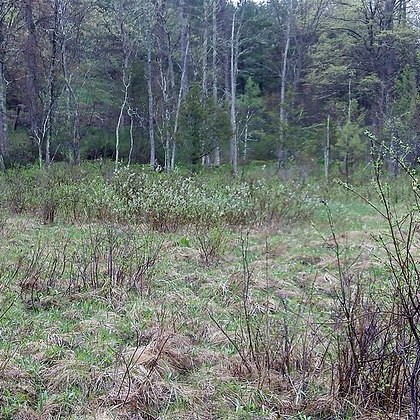
Where the bird is most often found, arranged by the USNVC — the vegetation classification of the United States and Canada — and CMECS for sea and coast.


Range and movements
California Quail is native to nearly all of California outside the highest mountains and driest deserts, western Oregon, and a small part of Baja California and Nevada. It has been successfully introduced to Washington state and British Columbia, and further afield to places such as Hawaii, New Zealand, Chile and Argentina, establishing easily wherever it was released. It is entirely resident, with no migration at all. The total population has increased slightly since the mid-twentieth century, but in heavily urbanized parts of Southern California it is declining locally as continuous scrub is increasingly fragmented by development.
- Resident
- Breeding (summer)
- Winter
- Passage
- dark = core range, pale = thinly spread
Where and when to look
Look for it at dawn along a trail through chaparral, a park with dense shrubs, or even an ordinary suburban garden: the rhythmic chi-CA-go from a fence post or low branch gives the covey away before you see it. Then wait at an open gap between two patches of shrub — quail cross such gaps in quick single file, briefly showing the whole covey within a few seconds.
Conservation
The global population is estimated at 5.8 million birds and increased by roughly 0.8 percent per year between 1966 and 2019 — a slight but steady growth. The species is rated of low conservation concern and is heavily hunted: in California alone, between eight hundred thousand and 1.2 million birds are shot annually, without any apparent dent in the population. Locally, especially in the most densely populated parts of Southern California, it is declining as continuous scrub is lost to development.
Scientific name
Callipepla californica | (Shaw, 1798)
Shaw described the species in 1798 as Tetrao californicus, among the grouse; since placed in Callipepla — a genus introduced in 1832 by Wagler, from the Greek kalli-, 'well-formed', and peplos, 'robe' — author and year stand in parentheses. californica means 'of California'. Shaw worked up the description at the British Museum, from a specimen the Vancouver Expedition had collected along the California coast in the 1790s. The type locality is Monterey, California.