All species › Gamebirds › New World quail › Gambel's Quail
Gambel's Quail | Callipepla gambelii
Gambels Kuifkwartel | Colín de Gambel
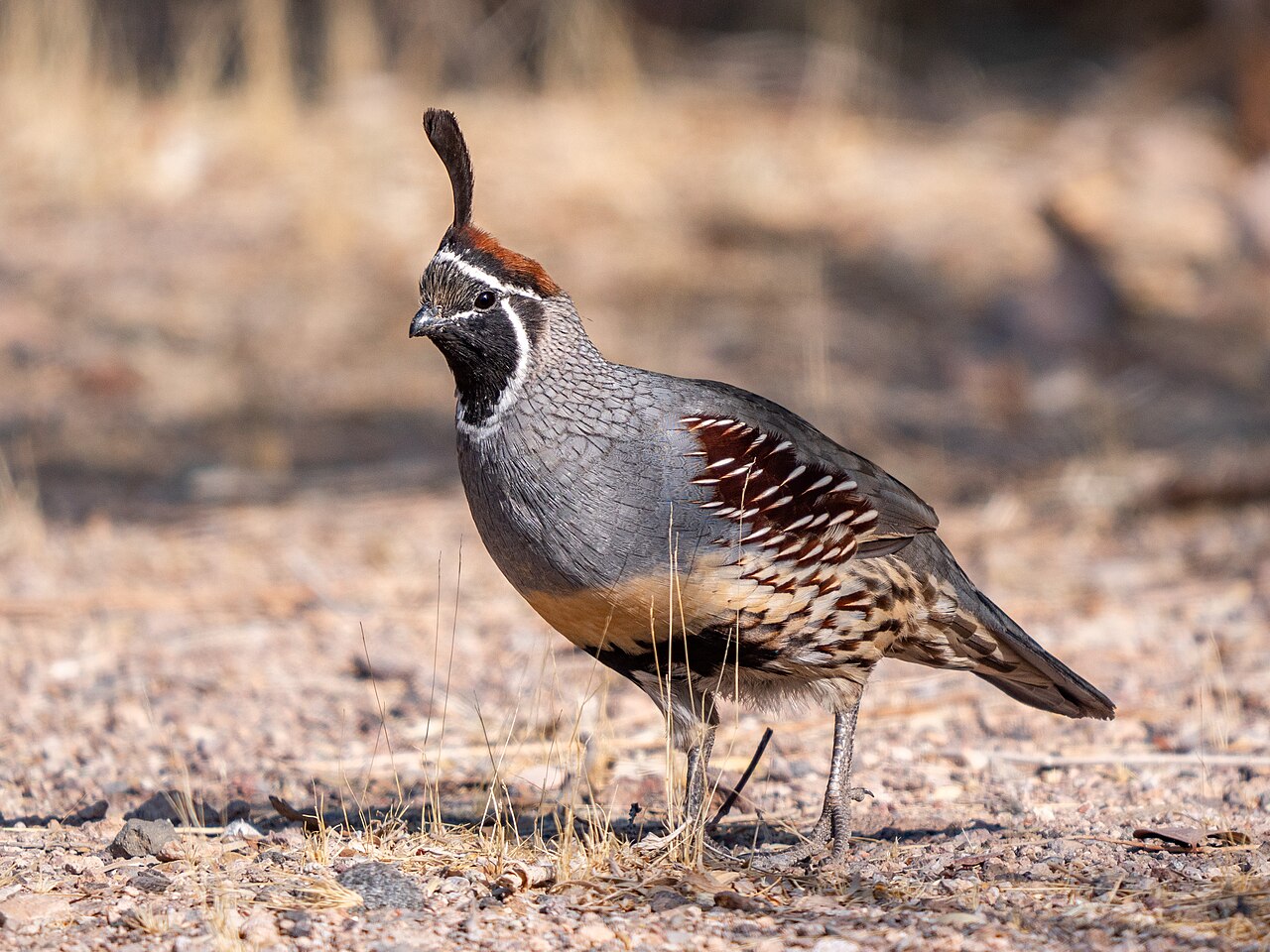
Gambel's Quail is the quail of the American desert: a bird of bare, mesquite-lined washes, moving in large, bustling coveys that dash between the shrubs. The male carries a forward-curving black plume above a chestnut crown and shows a bold black patch in the middle of an otherwise creamy belly — a pattern no other North American quail shares. In the suburbs of Phoenix and Tucson it is one of the most familiar garden birds.
Voice
The male gives a ringing puk-kwaw-cah, stressing the middle, highest-pitched syllable, repeated from a lookout above the brush to mark a territory. When calling the covey together a lower, cackling chica-go-go follows, and at alarm a series of short, excited clicks. Chicks and young keep up a constant soft peeping contact with the adults as the covey forages through dense cover. Outside the breeding season a large covey is best located by the steady soft clucking that rises as the birds spread out to feed.
No freely licensed recording has been found for this species yet; what to listen for is described below.
Identification
The male has a grey body, a chestnut crown beneath the black, forward-curving plume, a black face and throat sharply outlined in white, and chestnut flanks streaked with white. On the belly sits a large, solid black patch on an otherwise creamy ground — the clearest mark of the male. The female is evenly greyish-brown, with a much shorter, thinner plume, lacking both the black facial pattern and the black belly patch. Juveniles resemble the female but are duller still and more finely marked. Both sexes show short, rounded wings and a compact, short-tailed silhouette in flight, typical of desert quail that would rather run than fly.
Confusion species
The main source of confusion is California Quail, whose range meets Gambel's in southeastern California and northern Baja California. The male Gambel's Quail has a plain creamy belly with one large black patch, against the finely scaled, olive-brown belly pattern of California Quail, which lacks any such patch; the flanks are also cleaner chestnut with white streaks, rather than reddish-brown with a coarser scaled pattern. The female is harder to separate, but shows redder-toned flanks and a less clearly scaled belly than the female California Quail. The two species can occasionally hybridize, and such birds show a mix of features matching neither cleanly.
Habitat
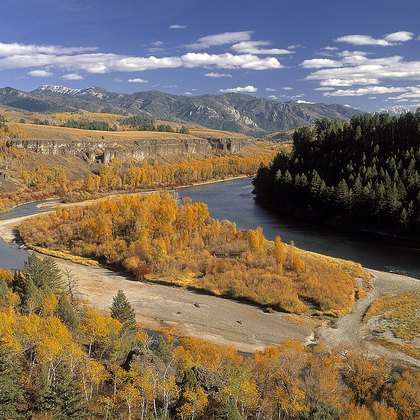
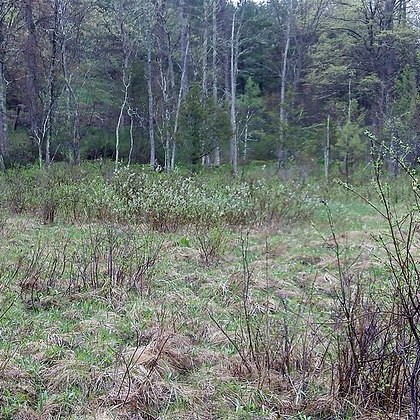
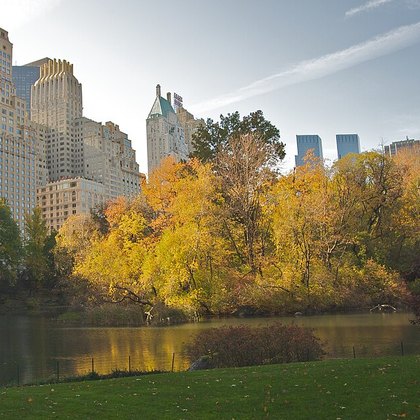
It lives in dry desert scrub with mesquite, palo verde and cactus, and is most often found in and around the vegetated washes that briefly carry water after rain — where food and cover lie closest together. It rarely strays far from open water; in the driest parts of its range, distance to a spring, stock tank or irrigated yard determines where it does and does not occur. It entirely avoids bare sand flats without scrub and higher-elevation conifer forest. In the suburbs of desert cities such as Phoenix and Tucson, planted gardens with a water source provide a perfectly usable substitute for natural desert scrub.
Where the bird is most often found, arranged by the USNVC — the vegetation classification of the United States and Canada — and CMECS for sea and coast.

Range and movements
Gambel's Quail occupies the Sonoran and Mojave deserts: the core range lies in Arizona, extending across southern Nevada, southeastern California, southern Utah, southwestern New Mexico and western Texas, and south through northwestern Mexico into Sonora and Baja California. A small introduced population lives in Hawaii. It is entirely resident: a covey rarely moves more than a couple of kilometres from its home territory all year round. Numbers fluctuate strongly from year to year with rainfall — after a dry year the species breeds poorly and the population drops, only to recover quickly after a wet winter brings abundant food.
- Resident
- Winter
- dark = core range, pale = thinly spread
Where and when to look
Look for it at dawn or late afternoon near a mesquite-lined wash or a water source: coveys emerge from cover then to drink and forage, and the male's ringing puk-kwaw-cah gives the spot away from a distance. In the suburbs of Phoenix and Tucson, a yard planted with native desert vegetation and a low water dish is often enough to draw in an entire covey.
Conservation
The global population is estimated at 5.8 million birds and remained stable between 1966 and 2019, though annual numbers fluctuate strongly with rainfall. It is rated a species of low conservation concern and is one of the most prized game birds of the Southwest, hunted within quotas tied to the condition of the population. Artificial water sources built for desert wildlife management have, if anything, helped the species locally by increasing the supply of open water.
Scientific name
Callipepla gambelii | (Gambel, 1843)
Gambel described the species in 1843 as Lophortyx Gambelii, in a different quail genus; since placed in Callipepla — a genus already introduced by Wagler in 1832 — author and year stand in parentheses. Callipepla comes from the Greek kalli-, 'well-formed', and peplos, 'robe'. The species name honours Gambel himself: the American naturalist William Gambel, the first botanist to reach California overland, who died at twenty-six in 1849 of typhoid during an epidemic among miners on the Yuba River. The type locality was fixed only in 1910 by the American ornithologists' committee, as southern Nevada.