All species › Gamebirds › New World quail › Northern Bobwhite
Northern Bobwhite | Colinus virginianus
Virginiaanse boomkwartel | Colín de Virginia
The Northern Bobwhite is the round little quail that calls its own name, and for generations it belonged to every American field edge. In fifty years it has vanished from large parts of that country: numbers fell by roughly eighty-five per cent, and the species now stands as Near Threatened on the Red List.
Voice
The best-known sound is a clear two- or three-syllable bob-WHITE, the last note shooting upwards, which on a still May morning carries a kilometre. Birds of one covey keep contact with a soft, low tu-loo, barely audible at ten metres. Scattered birds call one another back together with a rising, three-part koi-lee, usually at dusk. In danger there is a quick tuk-tuk-tuk, and after that nothing.
Recording: Valerie Heemstra — CC BY-NC-SA 4.0 · Pine Flatwoods Trail, Merritt Island NWR, Brevard County, Florida, United States · xeno-canto
Identification
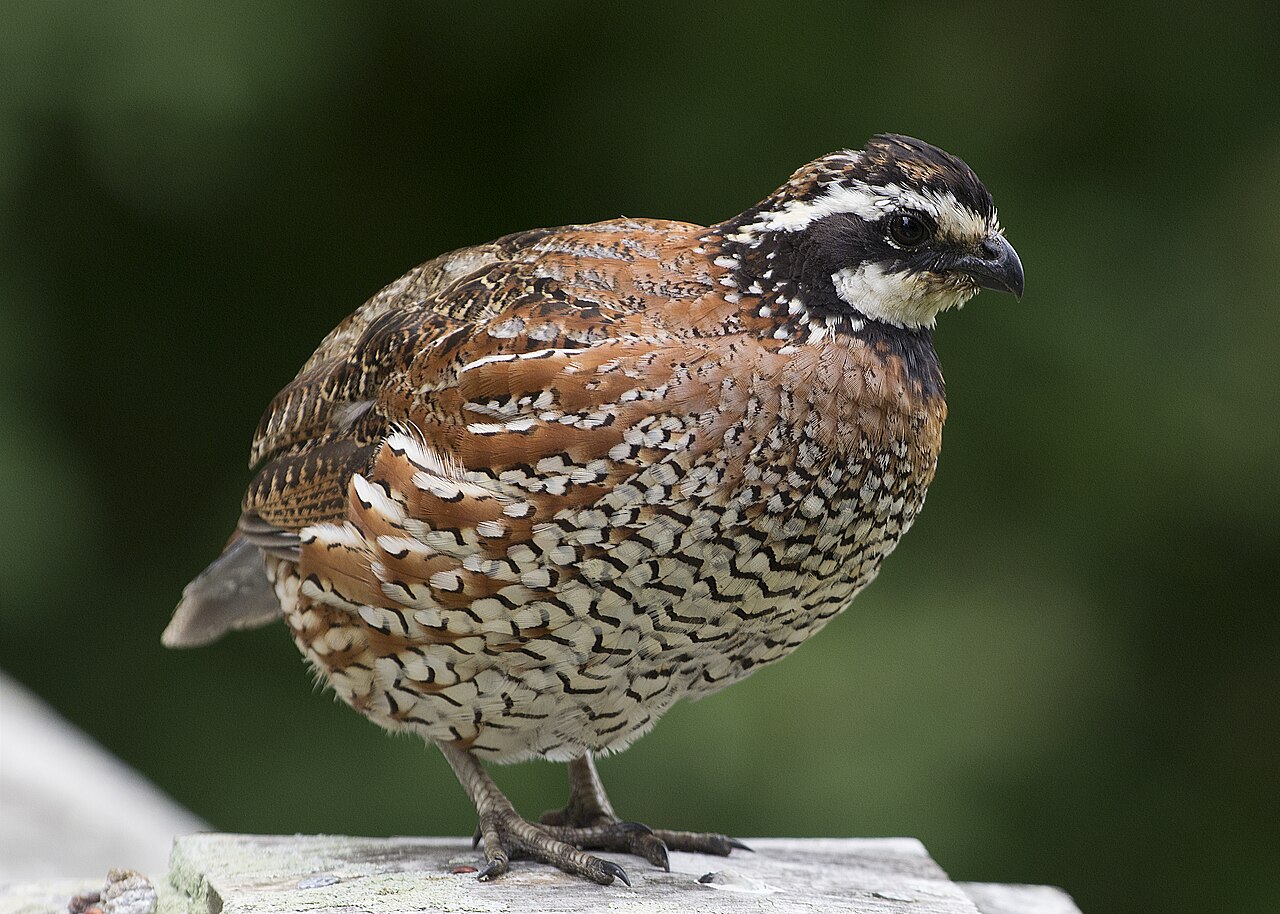
A small, round gamebird the size of a small dove, with a short grey tail, mottled red-brown upperparts and finely black-and-white scaled underparts. The male has a white throat and a white eyebrow, both sharply outlined in black; on the female those same areas are warm buff and the black outline is missing. It carries no forward-curving plume — at most it raises the crown feathers into a small crest when excited. When it flushes, the short grey tail and the broad, rounded wing stand out.
Confusion species
Yucatan Bobwhite (Colinus nigrogularis) of the Yucatán peninsula and Belize has, in the male, a black throat scaled with white instead of a white one; the females are barely separable. In southern Mexico some forms of this species itself have an entirely black head, which at first glance looks like another bird. In the west of its range it meets Scaled Quail (Callipepla squamata), which is grey, larger, and carries a small white tip to the crest. Released farm-reared birds are often paler and far tamer than wild ones, and sometimes walk away only at the last moment.
Habitat
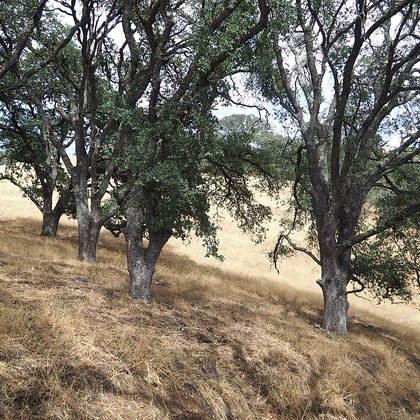
Half-open country with a low, dense herb layer and bare ground between: fallow fields, rough field margins, hedgerows, and above all the open pine savanna of the southeast that burns regularly. It needs both cover and open ground within a few tens of metres; a closely mown pasture with a dense sward is as useless as closed forest. Where fire and grazing fall away, suitable ground grows over within a few years. In Mexico it goes into dry scrub and into grassland high in the mountains.
Where the bird is most often found, arranged by the USNVC — the vegetation classification of the United States and Canada — and CMECS for sea and coast.




Range and movements
Resident in the eastern and central United States, from Massachusetts — where it is now virtually gone — to Texas and Florida, and south through Mexico to Chiapas and western Guatemala. Cuba has a native form of its own. In the northeast and the Midwest it has disappeared from whole states, and in Canada only a small area in the extreme south of Ontario is left. It has been released on Hawaii, where it survives on several islands; the form of the Sonoran desert has gone from the wild in Arizona and is being released there again.
- Resident
- Breeding (summer)
- Passage
- dark = core range, pale = thinly spread
Where and when to look
Drive or walk sandy roads with rough verges in May and June and listen; the calling male often sits on a post or a fence and, if you stand still, will let itself be watched for minutes. Outside the breeding season you see it almost only by accident: walk an edge between rough ground and arable land and be ready for the sudden roar of a covey bursting apart. The best areas now are the pine-savanna reserves of Georgia, Florida and the Carolinas, which are managed with fire.
Conservation
The Red List places it as Near Threatened (NT), the category below threatened. Between 1966 and 2014 numbers in North America fell by roughly eighty-five per cent, and the decline continues. The cause is the loss of untidy edges: fields ploughed clean to the ditch, dense pasture grasses, less fire in the pine woods and fallow land growing over. Farm-reared birds are released for shooting on a large scale, but they do not establish themselves and do not keep the wild population up.
Scientific name
Colinus virginianus | (Linnaeus, 1758)
Linnaeus described the species in 1758 as Tetrao virginianus, among the grouse; because it was later moved to another genus, author and year stand in parentheses. The genus Colinus was introduced by Goldfuss in 1820 and goes back, by way of Spanish colin, to the Nahuatl word zolin, 'quail'. virginianus means 'of Virginia'. Linnaeus gave only 'America' as the origin; that was later restricted to Virginia.