All species › Gamebirds › New World quail › Mountain Quail
Mountain Quail | Oreortyx pictus
Bergkuifkwartel | Colín Serrano
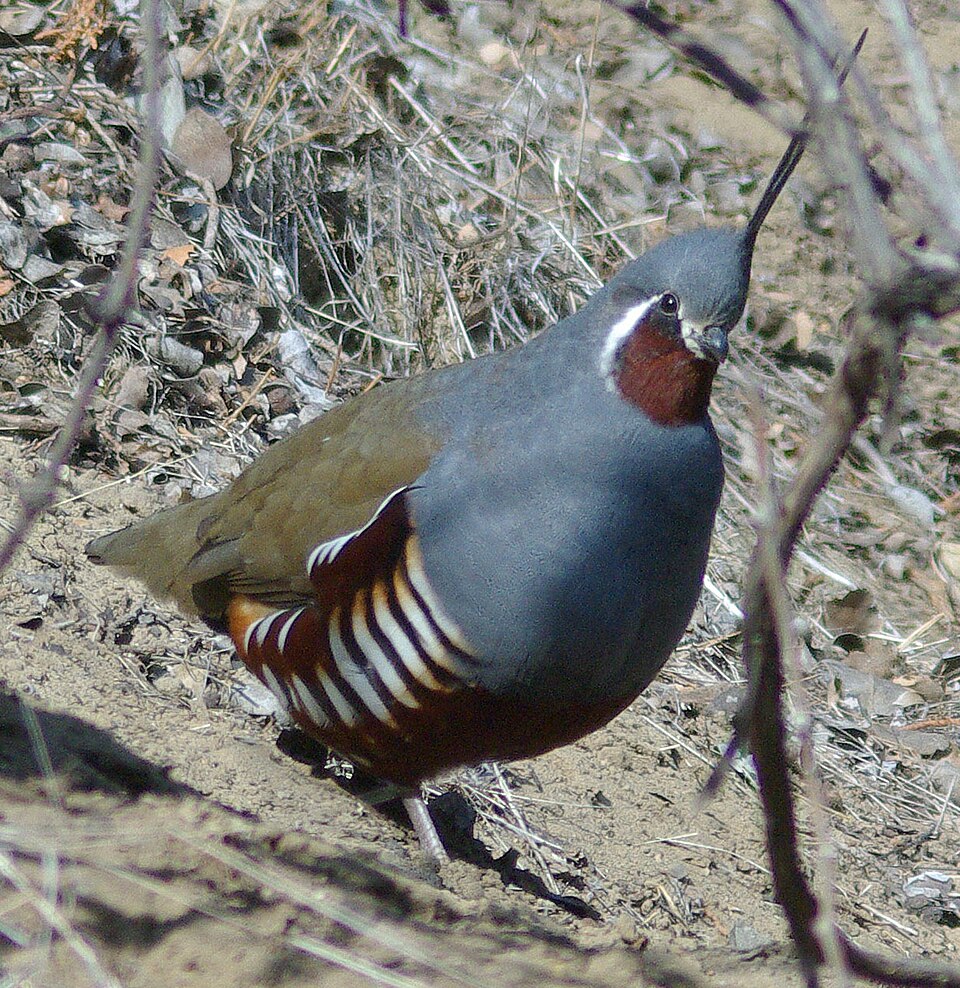
The Mountain Quail is the largest quail in North America and wears the most striking headgear of the three: two long, perfectly straight black plumes projecting forward over the bill. Yet it is also the shyest: whoever hears it calling from a steep, brush-covered mountainside rarely sees it — the bird prefers to freeze motionless in cover and run rather than fly.
Voice
In spring the male gives a loud, echoing kyork or woook, repeated for minutes on end from an open spot on a slope and carrying across entire canyons — often the only sign that a Mountain Quail is somewhere in the brush. Outside the display season birds keep in contact with soft, short whistles while cover keeps them out of sight. When disturbed a harsh, cackling alarm call follows, and a flushing bird gives a short, explosive whirr of wings. Unlike many other American quail, the female does not join the calling; the echoing kyork is the male's alone.
Recording: Diana Doyle — CC BY-SA 4.0 · Ashland, Jackson County, Oregon, United States · xeno-canto
Identification
Male and female look strikingly alike — unusual for an American quail — with a blue-grey head, breast and back, a chestnut throat bordered white, and flanks marked with bold, sharply defined white bars on chestnut. The two straight plumes are slightly shorter and less rigid in the female than in the male, which is otherwise only marginally brighter. Juveniles are duller and more vaguely marked, with a still-short, soft plume that reaches full length only after the first moult. The silhouette is heavy and rounded for a quail, with a relatively long tail, and the bird prefers to move low through dense cover rather than show itself. In flight — rarely sustained for long — it shows short, rounded wings and a heavy, low-slung body.
Confusion species
Where its range touches that of California Quail, in northern California, the Mountain Quail is told apart by the plume alone: straight and thin in the Mountain Quail, against the forward-curving, comma-shaped plume of both California and Gambel's Quail. Its notably larger size, plain blue-grey head lacking black-and-white facial markings, and the absence of any real difference between the sexes are further marks usable at range. A flushing bird in dense forest is sometimes mistaken for a small grouse, but grouse entirely lack the straight plume and are considerably bulkier. Given its shyness and preference for dense cover, it is heard far more often than seen, and confusion arises less with other quail than with correctly recognizing the call itself.
Habitat
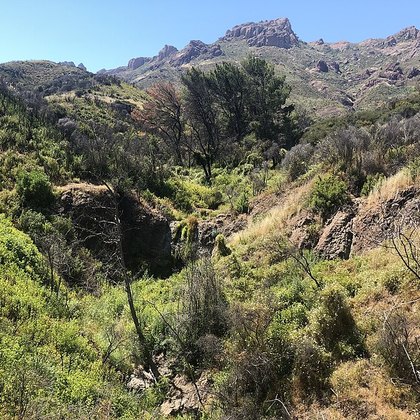
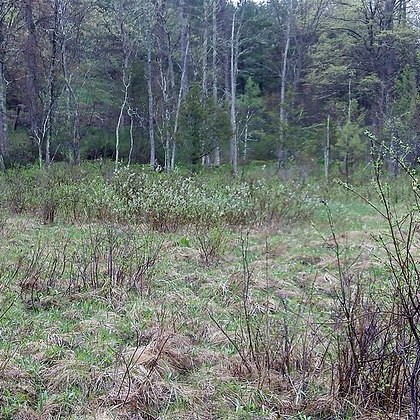
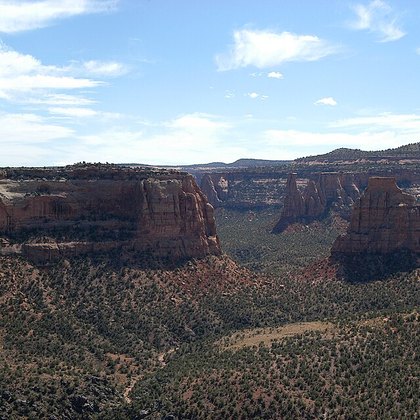
It seeks dense, shrubby cover on steep mountain slopes: manzanita and ceanothus chaparral, the edge of pine-oak woodland, and, in the north of its range, weathered lava fields with brush. Cover reaching almost to the ground is essential — the bird would rather walk through a tunnel of shrubs than cross open ground — and in hot weather it rarely strays more than a couple of kilometres from open water. It avoids open grassland, bare desert floor, and closed high forest without understory. When heavy snow falls, birds move on foot in groups to lower, snow-free slopes — the only North American quail to make a genuine altitudinal migration this way, though the distance covered is usually limited to a few kilometres.
Where the bird is most often found, arranged by the USNVC — the vegetation classification of the United States and Canada — and CMECS for sea and coast.


Range and movements
The Mountain Quail occupies the mountain ranges of the Pacific coast, from southern Washington through Oregon and nearly all of California — the Coast Ranges, the Sierra Nevada, and the southern mountain chains — to northern Baja California. An isolated population lives far to the east, in western Idaho and adjoining Oregon and Nevada, separated from the main range by hundreds of kilometres of unsuitable lowland. It is resident in the strict sense — there is no migration to another region — but does move seasonally in elevation, as described under habitat. At the edges of its range, in Washington and eastern Oregon, it has declined sharply in numbers and distribution over recent decades, while the core population in California has remained more stable.
- Resident
- Breeding (summer)
- dark = core range, pale = thinly spread
Where and when to look
In late spring, go at dawn to a fire road or trail through dense chaparral and listen for the echoing kyork — the call carries so far that it is far easier to find than the bird itself. Then wait quietly beside an open patch at the edge of the brush: Mountain Quail sometimes venture out briefly to forage before retreating into cover again. Searching in the early morning gives the best chance, before the heat of the day drives them deeper into shade.
Conservation
The global population is estimated at around 260,000 birds, considerably fewer than either of the other two crested quail, and the species scores markedly higher on the scale of conservation concern for North American birds than its lowland relatives. The decline is sharpest at the edges of its range, especially in Washington and eastern Oregon, possibly through fire suppression altering chaparral structure and through habitat loss to development. It is hunted in parts of its range, but in far smaller numbers than the other two crested quail, owing to its low densities and the difficult terrain it occupies.
Scientific name
Oreortyx pictus | Douglas, 1829
Douglas described the species in 1829 as Ortyx picta, in a different quail genus; since placed in Oreortyx, author and year stand in parentheses. That genus was introduced in 1858 by Baird, from the Greek oros, 'mountain', and ortyx, 'quail'. pictus is Latin for 'painted, patterned', after the sharply marked head and flank pattern. The type locality lies in the 'interior of New California', later fixed as the headwaters of the Umpqua River near the Calapooia Mountains in Oregon — collected by Douglas himself, the Scottish plant hunter after whom the Douglas fir is named.