All species › Gamebirds › New World quail › Scaled Quail
Scaled Quail | Callipepla squamata
Geschubde kwartel | Colín Escamado
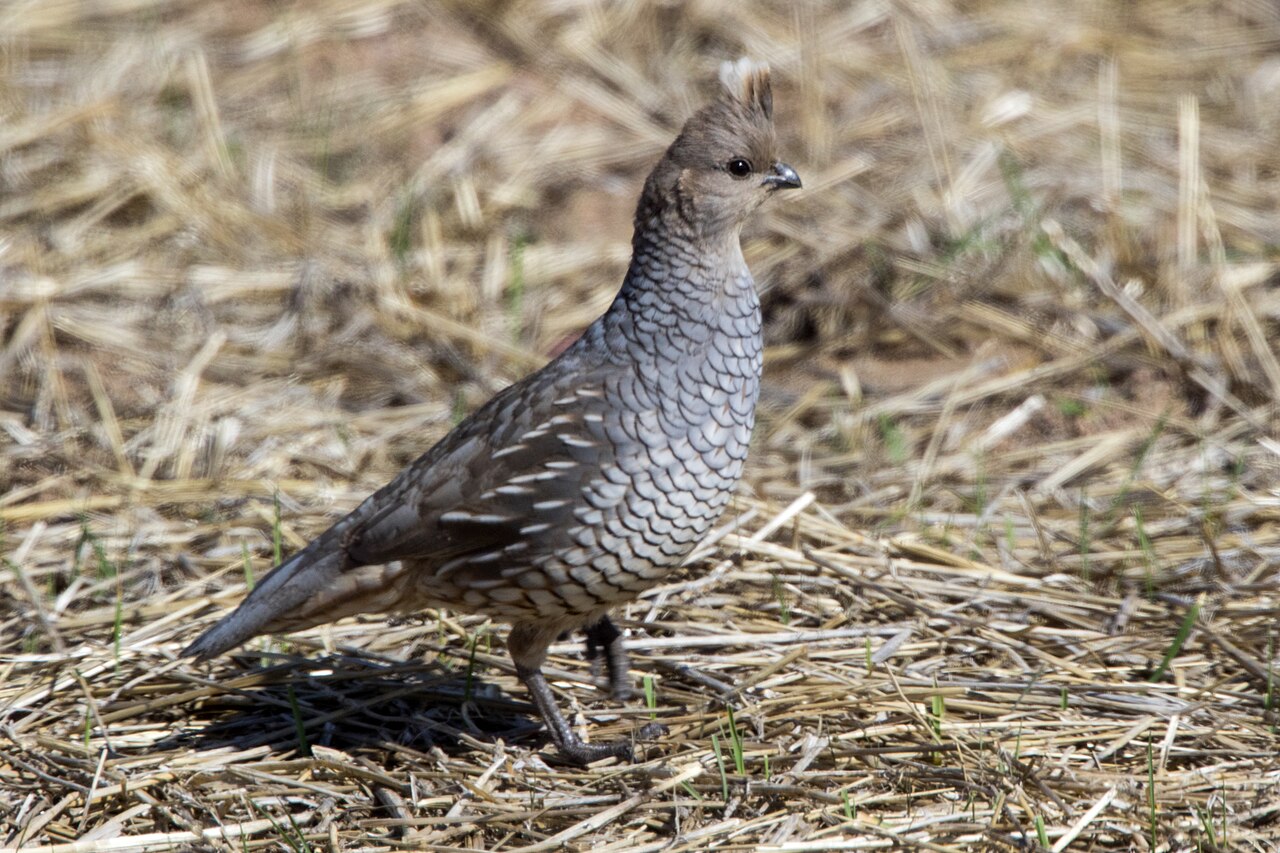
The Scaled Quail is the quail of dry shortgrass prairie and mesquite flats: blue-gray above, with a scaled pattern across the entire underside where each feather carries a dark edge. Its ragged white crest tip earned it the Texas nickname 'cottontop'. It prefers to walk away rather than fly, and a whole covey can vanish silently between the yuccas.
Voice
The contact call between covey members is a low, harsh pe-cos or wok-ka, more a growl than a whistle, carrying best in the still hour before dawn. When alarmed the birds give a series of short, hoarse chuk notes to warn each other without flushing. Song in the usual sense is absent; the sound this species makes is functional rather than musical, and it is rarely produced far from cover.
Recording: Richard E. Webster — CC BY-NC-SA 4.0 · Bald Knob, Cochise County, Arizona, United States · xeno-canto
Identification
The male is plain blue-gray on the breast with the characteristic scaled pattern, a chestnut patch on the belly, and a short, round, white-tipped crest that curves forward. The female is duller and browner on crown and neck, with a less sharply defined scaled pattern on the throat. Juveniles are vaguely streaked and lack the clear white crest tip until nearly grown. In flight the bird looks short and round with quick, whirring wingbeats, but it rarely flies more than a few dozen metres.
Confusion species
Where their ranges overlap in Arizona and New Mexico, Gambel's Quail (Callipepla gambelii) is told apart by its longer, forward-curving crest plume and, in the male, the black belly patch and chestnut flanks — Scaled Quail lacks those bright colours and looks grayer overall. At the eastern edge of its range in Texas and Oklahoma it overlaps with Northern Bobwhite, which is more rufous-brown, shows a clear eye stripe, and gives a clear whistled call instead of this species' hoarse contact note. Both species can occur in the same valley, but Scaled Quail keeps to the more open, drier ground away from water, while Gambel's Quail stays closer to riverside growth and gardens.
Habitat
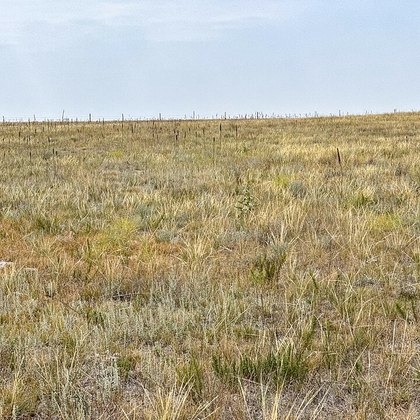
Dry short grassland and desert grassland with scattered mesquite (a thorny pod-bearing shrub of the Southwest that forms dense thickets), yucca and prickly pear, where the ground between the tussocks stays open enough to walk and dust-bathe on. It avoids both bare, plantless sand and dense scrub without open ground, and depends on stock tanks or natural pools for water in dry summers. On overgrazed rangeland where the grass cover disappears and only shrubs remain, the species gradually vanishes.
Where the bird is most often found, arranged by the USNVC — the vegetation classification of the United States and Canada — and CMECS for sea and coast.


Range and movements
Resident in the southwestern United States, from southern Arizona and New Mexico east across the extreme southeast of Colorado and southwestern Kansas to western Oklahoma and central and western Texas, and south through northern and central Mexico to Jalisco, Guanajuato and Hidalgo. It does not migrate and shifts at most locally between summer and winter range. Numbers at the edges of the range declined through the second half of the twentieth century as grassland was lost to cropland and through sustained overgrazing, while the core range in the Chihuahuan Desert has stayed more stable.
- Resident
- Breeding (summer)
- Passage
- dark = core range, pale = thinly spread
Where and when to look
At sunrise, drive or walk slowly along a dirt road through shortgrass prairie and listen for a covey's low contact call before you see anything. Flushed birds typically run off in single file before, if pressed, flying low and briefly; standing still and waiting often brings them back into view within a few minutes.
Conservation
The IUCN lists the species as Least Concern (LC), but breeding bird surveys in Texas, New Mexico and Oklahoma have shown a steady decline for decades, especially at the edges of the range. Loss of grassland to cropland, sustained overgrazing, and shrub encroachment at the expense of open grass cover are considered the main causes.
Scientific name
Callipepla squamata | (Vigors, 1830)
Vigors described the species in 1830 as Ortyx squamatus; it has since been placed in the genus Callipepla, hence the parentheses around author and year. Callipepla is built from Greek kallos ('beauty') and peplos ('robe'), after the colourful plumage of the crested quails; squamata is Latin for 'scaled', after the scale-like pattern across the underside. The type locality was given at the time only as 'Mexico', with no further detail.