All species › Gamebirds › New World quail › Montezuma Quail
Montezuma Quail | Cyrtonyx montezumae
Montezumakwartel | Colín de Moctezuma
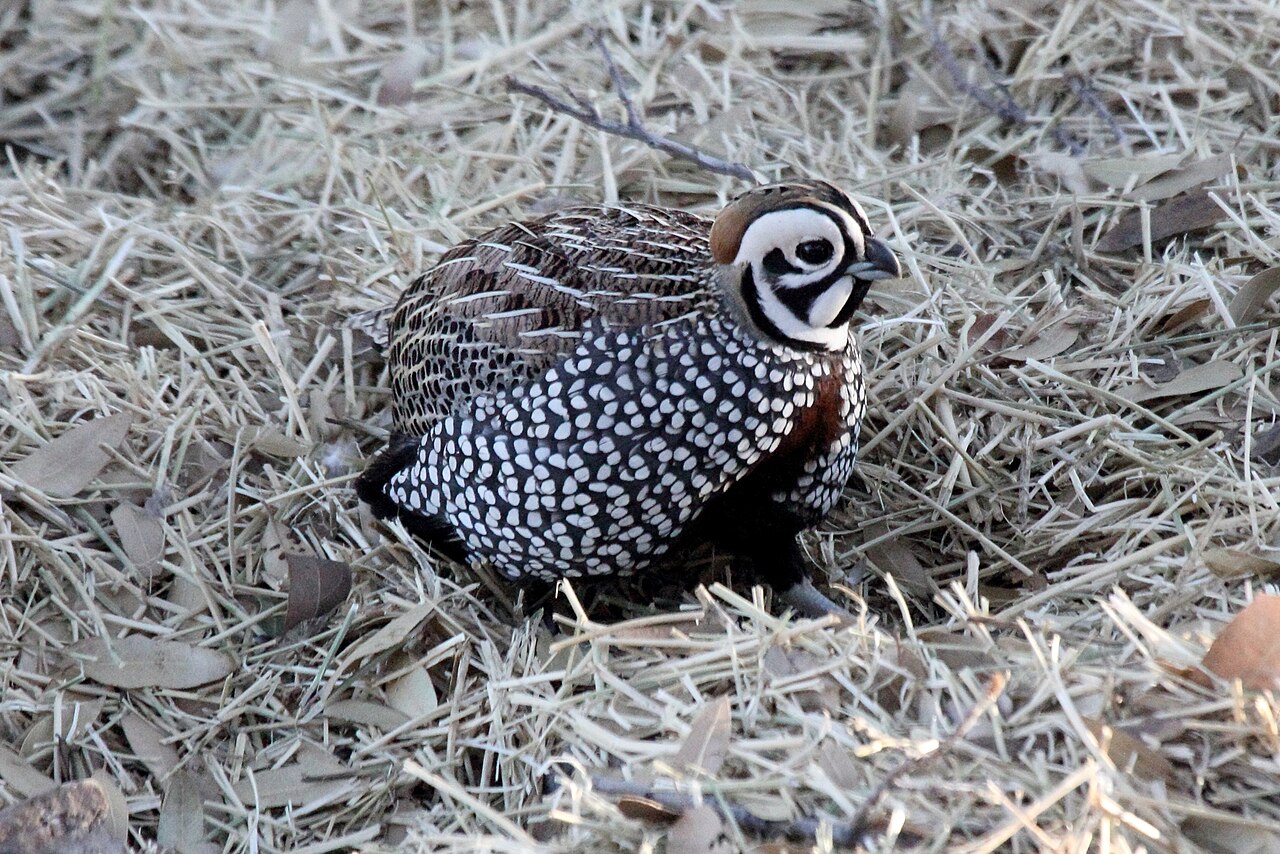
The Montezuma Quail is North America's least conspicuous quail until it reveals itself: the male carries a black-and-white blocked harlequin mask on an otherwise chestnut and blue-gray body covered in white spots. It lives hidden in tall grass beneath open oak woodland in the mountains of the southwest and rarely gives itself away by flying — only at close range, and then suddenly.
Voice
The call is a descending, quavering whistle that fades slowly, seeming to come from a different direction than the bird actually sits — a quality that makes it hard to pinpoint. Covey members keep contact with soft, short peeps while foraging through dense grass. When a covey scatters after being disturbed, a thinner, repeated whistle helps the birds call each other back together.
Recording: Diana Doyle — CC BY-SA 4.0 · Hereford, Cochise County, Arizona, United States · xeno-canto
Identification
The male has an unmistakable black-and-white striped face with a black throat, a chestnut breast covered in round white spots, and a blue-gray back with black streaks; the crest is bushy and fan-shaped rather than pointed. The female is plain sandy brown and mottled, without bright colours, and stands out mainly for its round, chunky shape and the lack of any obvious neck. Both sexes have a noticeably short tail and long, curved claws used to dig up bulbs and tubers. In flight the bird is short, round and fast, with an explosive launch from the ground.
Confusion species
The male's harlequin pattern makes it unmistakable among North American birds. The female can look at a distance like a female Scaled Quail or Northern Bobwhite, but is shorter-tailed, rounder-bodied, and far less inclined to flush: where those species run or burst upward, Montezuma Quail sits perfectly still and sometimes allows itself to be almost touched before finally exploding into flight. The habitat chosen also differs — dense, tall grass under oak woodland rather than open grassland or scrub.
Habitat
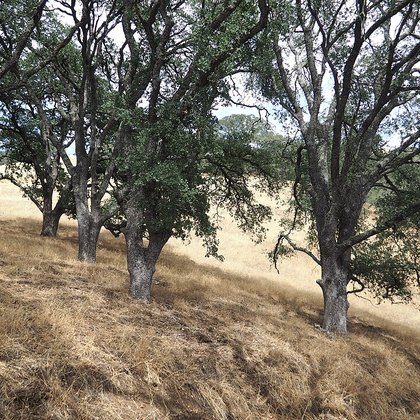
Open oak woodland and oak savanna with a dense, tall grass understory, on slopes between roughly 1,200 and 2,500 metres in the mountain ranges of the southwest. The bird depends heavily on that grass layer for both food and cover: without a dense stand of old growth grass to hide in and dig bulbs from, it disappears even where the oak woodland itself remains intact. It avoids both closely grazed grassland and closed forest lacking a grass understory.
Where the bird is most often found, arranged by the USNVC — the vegetation classification of the United States and Canada — and CMECS for sea and coast.

Range and movements
Resident in isolated mountain ranges of southeastern Arizona, southwestern New Mexico and the extreme west of Texas, with the bulk of the range centred on the Sierra Madre of Mexico, where it continues south into the central highlands. It does not migrate, although birds at the northern edge of the range sometimes drop to slightly lower slopes in severe winters. Overgrazing that strips away the grass understory beneath oak woodland has made the species scarcer in parts of its US range than it was a century ago.
- Resident
- Breeding (summer)
- Passage
- dark = core range, pale = thinly spread
Where and when to look
In early morning or late afternoon, walk slowly through grassy oak woodland and watch for small, fresh pits in the soil — the digging left by a foraging covey is often easier to find than the birds themselves. Stop the moment you suspect a covey is near: the birds sometimes give themselves away only when you are almost standing on top of them.
Conservation
The IUCN has not yet assessed the species separately. Locally it has declined through overgrazing and the loss of the grass understory beneath oak woodland, while in better-preserved mountain terrain it can still be common; reliable figures for the whole North American population are lacking.
Scientific name
Cyrtonyx montezumae | (Vigors, 1830)
Vigors described the species in 1830 as Ortyx Montezumae; it has since been placed in the genus Cyrtonyx, hence the parentheses around author and year. Cyrtonyx is Greek for 'curved claw', after the noticeably long, hooked nails the bird uses to dig; montezumae honours Moctezuma II, the last Aztec emperor, after the species' Mexican core range. The type locality was given at the time only as Mexico.