All species › Gamebirds › Partridges, pheasants, grouse and allies › Wild Turkey
Wild Turkey | Meleagris gallopavo
Wilde kalkoen | Guajolote norteño
The Wild Turkey is the heaviest gamebird on the continent and one of the great successes of American conservation: a few tens of thousands survived in the 1930s, and millions walk the woods today. It is also the ancestor of every bird on the Thanksgiving table.
Voice
The male's gobble carries more than a kilometre in spring: a rolling, gurgling burst of a second or two, often triggered by any loud noise — a car door, an owl, distant thunder. Hens give a series of nasal yelp notes and a soft clucking contact call; in alarm comes a sharp, hard putt, after which the whole group freezes. From the roost trees at first light comes a soft tree-yelping and clucking, just before the birds sail down.
Recording: Stanislas Wroza — CC BY-NC-SA 4.0 · La Haute-Côte-Nord (near Rivière-Sainte-Marguerite), Côte-Nord, Québec, Canada · xeno-canto
Identification
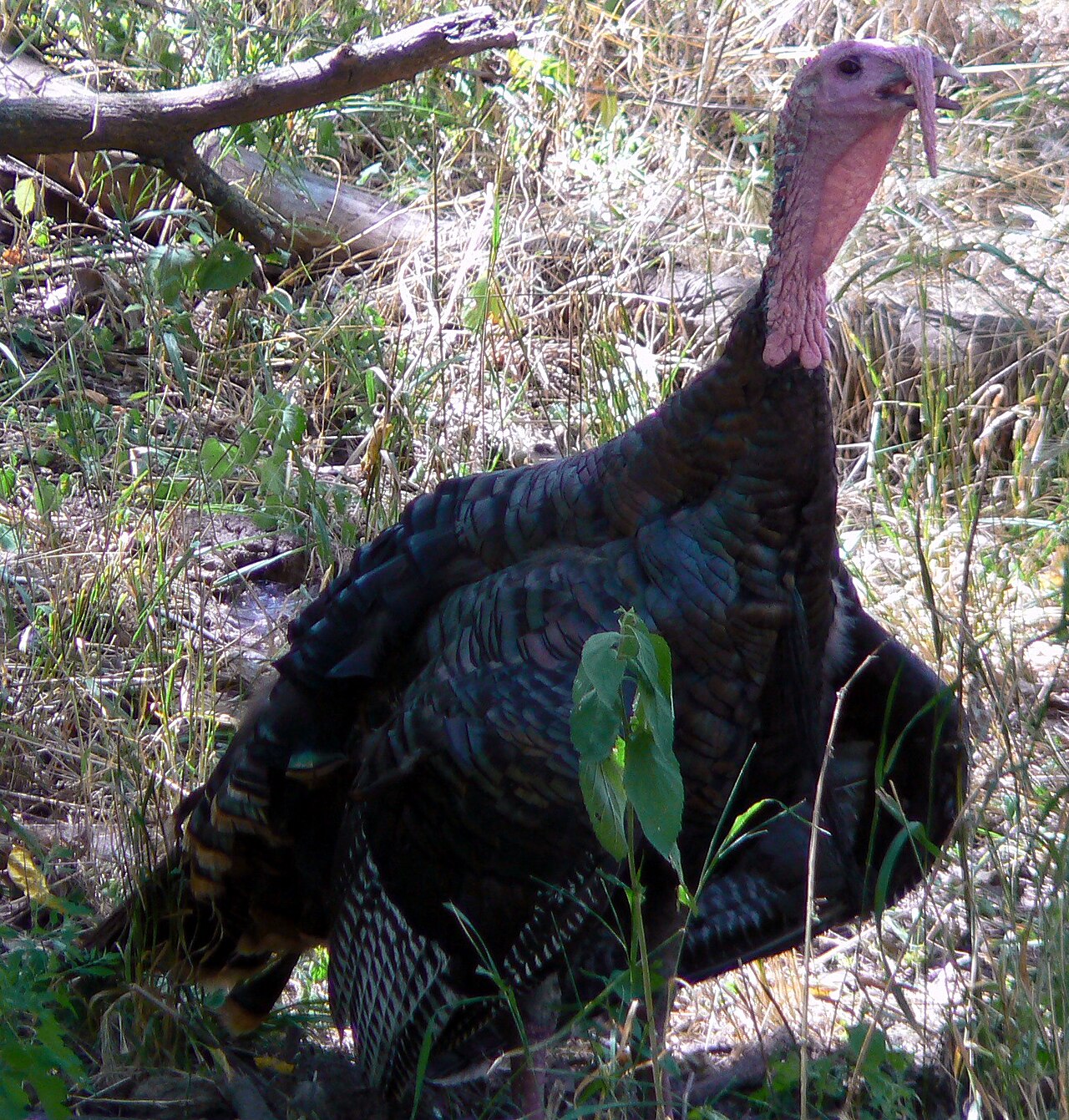
A large, long-legged gamebird with a small bare head shading from blue to red, a dark body flashing bronze, green and copper in sunlight, and a long, broadly barred tail. The male has red wattles, a snood hanging over the bill, spurs on the legs and a bristly 'beard' of modified breast feathers; displaying, he spreads the tail into a full fan and drags his wingtips along the ground. The hen is a third smaller and far duller, with a greyish, partly feathered head; about one hen in ten also carries a beard. The tail tips give away the subspecies: chestnut-brown in eastern birds, dirty white in merriami of the west.
Confusion species
Within the guide area confusion is barely possible, except on the Yucatán, where Ocellated Turkey (Meleagris ocellata) occurs: smaller, beardless, with a blue head studded with orange nodules and eye-shaped bronze-and-blue spots in the tail band. Feral and escaped domestic turkeys are often white-blotched or wholly white, heavier-bodied and shorter-legged, and scarcely bother to run. Broods in summer are taken at a distance for Ruffed Grouse or prairie-chickens, but are already longer-legged and longer-necked than any grouse.
Habitat
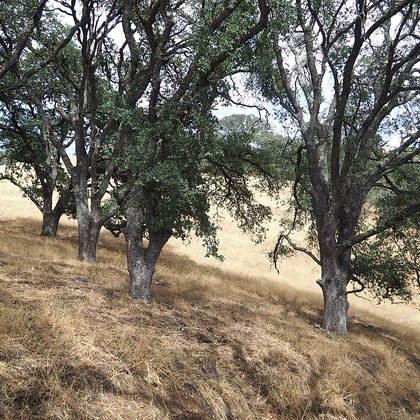
Mature deciduous woodland with clearings and a good acorn and nut crop, broken by fields, pasture and woodland edge; unbroken closed forest without open ground is as unsuitable as bare arable land. It forages on foot on the woodland floor but always roosts in trees, and that is the limiting requirement — where there are no heavy limbs, there are no turkeys. In the west it occupies ponderosa pine and oak woodland in the mountains, in Florida swamp forest with palmetto.
Where the bird is most often found, arranged by the USNVC — the vegetation classification of the United States and Canada — and CMECS for sea and coast.



Range and movements
Resident across the eastern and central United States, north into southern Ontario and Quebec and the Maritimes, and — through releases — now also in the Rocky Mountains, California and the Northwest, far outside its original range. Southward it reaches northern and central Mexico; the southern Mexican nominate form, from which the domestic turkey descends, has all but vanished in the wild. The entire Canadian range is the result of reintroduction.
- Resident
- Breeding (summer)
- Winter
- Passage
- dark = core range, pale = thinly spread
Where and when to look
In April find a woodland edge along a field before sunrise and sit still: the gobbling starts while the birds are still on the roost, and they walk out onto open grass afterwards. Outside spring the triangular scratch-patches in leaf litter and the big three-toed tracks in sand or mud are often the only evidence — a group of fifty hens and poults can move through dense woodland in complete silence.
Conservation
Deforestation and unregulated hunting cut the population to about thirty thousand birds by the 1930s. Trapping wild birds with cannon nets and moving them — not releasing farm-reared stock, which invariably failed — brought the species back to millions within a few decades, some six million today. Since the turn of the century numbers have fallen again across parts of the Southeast, probably through poorer poult survival under changing forest management; globally the species is listed as Least Concern (LC).
Scientific name
Meleagris gallopavo | Linnaeus, 1758
Linnaeus described the species in 1758 in the tenth edition of Systema Naturae as Meleagris Gallopavo, and in the same work introduced the genus Meleagris; because it has never since been moved out of it, author and year stand without parentheses. Meleagris is Greek for 'guineafowl', after the sisters of Meleager, turned into guineafowl in the myth. gallopavo is late Medieval Latin, a compound of gallus 'cock' and pavo 'peafowl', used in that form by Conrad Gessner in 1555. Linnaeus worked from the domestic bird; the type locality reads 'North America', meaning Mexico, where the turkey had been domesticated centuries earlier.